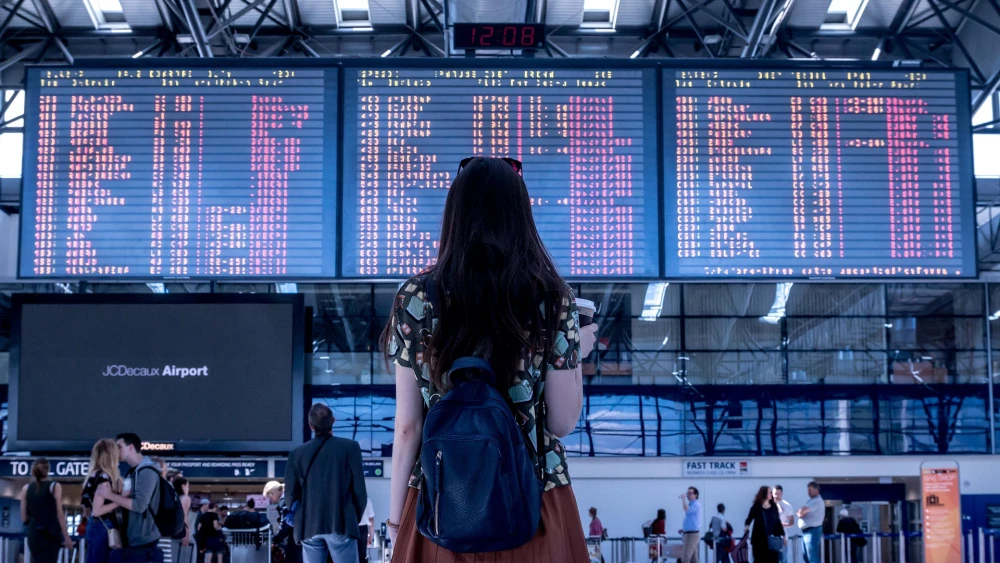

Let’s take a short break from the imbroglio over delivering paychecks to TSA agents and funding the DHS to recall why we need a Transportation Security Administration and a U.S. Department of Homeland Security in the first place.
Because if you’re, say, a 22-year-old graduating from college this spring, you don’t remember when there were no lines at airports, no requirement for IDs, no limits on liquids, no conveyer belts for your shoes, belt and coat, and no body scanners to determine whether that’s a gun in your pocket or you’re just glad to see the TSA agent. (Sorry, I can never pass up the chance to repurpose an old Mae West line.)
Will the college senior I’m imagining at least have studied what life was like back in the good old days? Too many, I fear, spent their schooldays listening to lectures on intersectionality and de‑naturalizing gender/sexuality.
So, a little modern history: The TSA was founded not long after Sept. 11, 2001, the worst terrorist attacks ever carried out on American soil. Those attacks were executed by Al-Qaeda, Arabic for “the base,” implying the launching point for global jihad.
According to the terrorist group’s ideology—or, more precisely, its theology—the United States is the paramount enemy of God. It is therefore the duty of Muslims to wage holy war on Americans and, sooner or later, defeat them.
The DHS, now a sprawling bureaucracy with tens of thousands of employees, likewise was conjured into existence after Al-Qaeda demonstrated that the American homeland was vulnerable to coordinated, mass-casualty terrorism.
Since then, we have come to take for granted not only that we must surrender our time and dignity at airports, but also that we must spend trillions of dollars on counterterrorism.
Islamist violence has warped global energy markets as well. The Persian Gulf, through which a significant share of the world’s oil and liquefied natural-gas transits, became a zone of danger and instability because the Islamic Republic of Iran made it so.
Energy prices now reflect not just supply and demand, but an insurance-risk premium built on the fact that Iran’s rulers have decided to make the world’s oil supply an arrow in their quiver.
Similarly, the Houthis of Yemen, terrorists funded and armed by Tehran, occasionally turn the Red Sea into a shooting gallery, forcing merchant ships to reroute around Africa, adding weeks and millions of dollars to voyages that were routine when freedom of navigation—a fundamental international law—was not being violated by fanatical rebels.
Yet when Americans complain about the price of gasoline, words such as “jihad” and “mullahs” rarely arise.
Iran’s rulers have long been recognized by U.S. administrations, Republican and Democratic alike, as the world’s leading sponsors of terrorism. They have pursued a nuclear-weapons capability for decades. They first took Americans hostage in 1979 and for more than 40 years have murdered Americans both directly and through proxies.
A little more modern history: Though the Islamic Republic is Shia and predominantly Persian, its founding galvanized Arab and Sunni followers of the Muslim Brotherhood, a movement that aims to re-establish an Islamic caliphate and global Islamic supremacy. From this seed, Al-Qaeda grew.
Iran’s rulers gave Al-Qaeda sanctuary after 9/11, and since at least 2023, Saif al-Adel, its current leader, has been living in Tehran under the protection of the regime’s Islamic Revolutionary Guard Corps. Is he still there, dead or alive? Perhaps the CIA and Mossad know.
Readers preparing to call me an “Islamophobe” should save their carbon-dioxide exhalations. There are multiple interpretations of Islam, and most of the faith’s roughly 2 billion adherents believe that they can be good-enough Muslims without lopping off the heads of infidels.
There are also serious Muslim thinkers—men and women of great courage—who argue that Islamism is a corruption of their faith, not its fulfillment.
Yousef Al Otaiba, the United Arab Emirates’ ambassador to the United States, wrote on March 25 in The Wall Street Journal: “The U.A.E. is a modern, progressive, prosperous Muslim society that delivers for its people. We empower women and welcome all faiths. The U.A.E. is the argument Iran can’t win, the idea it can’t accept.” He calls for a “conclusive outcome” to the conflict now being fought against Tehran.
Iran’s rulers, who in January slaughtered tens of thousands of anti-Islamist demonstrators within its borders, probably have more sympathizers on American college campuses than in the Middle East.
Yet many Western politicians, academics and journalists refuse even to name the enemy we are fighting, while pretending that energy security is one issue, airport security another, the war in Gaza a third, and the conflict with Tehran a fourth.
The good news is that America’s military is formidable, and Israel is a capable partner. The intelligence agencies of both countries are doing yeoman’s work. The Emiratis and the Saudis may soon contribute more directly to the collective security of the region.
That college senior I mentioned—the one who has never known an airport without body scanners—should have been taught about all this.
She should have learned that the Islamic Republic has been fighting a civilizational war since its founding in 1979. The alternative to confronting it now would be to wait until it’s stronger, likely in possession of nuclear weapons and many more missiles, including those that can deliver those nukes to American cities.
The theocrats’ claws and fangs are now being trimmed and maybe even removed. Sometime after that, the Iranian people may succeed in throwing off the clerical dictatorship.
If that happens sooner rather than later, perhaps it can be a teachable moment for next year’s graduates.
Originally published in “The Washington Times.”