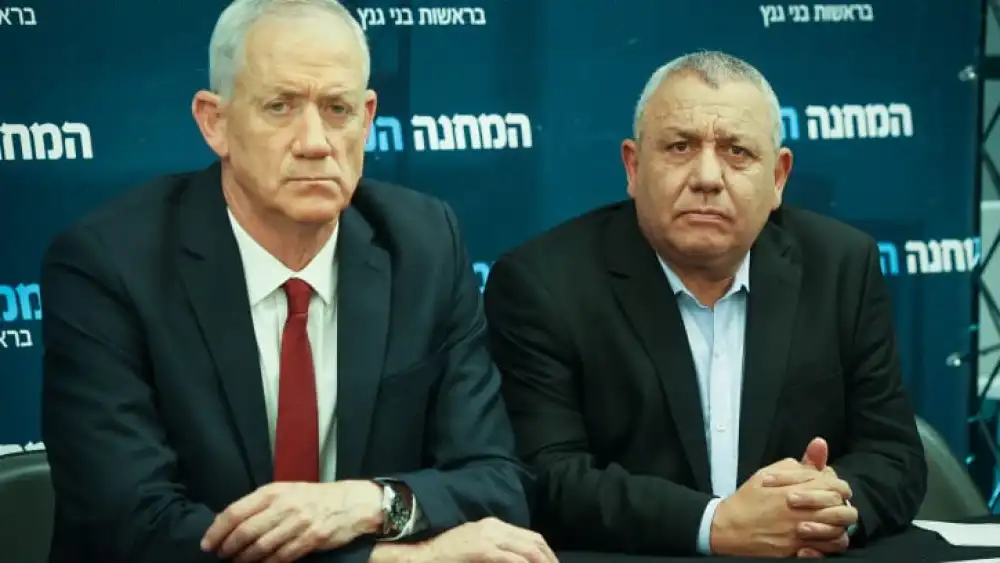
Ministers-without-Portfolio Benny Gantz and Gadi Eizenkot, who both serve in the War Cabinet, proposed that Israel limit the flow of humanitarian aid to the Gaza Strip.
They made the suggestion during closed-door meetings in recent days, Channel 12 reported on Wednesday.
“It is possible to examine reducing the supply as part of the pressure to build another mechanism [to distribute aid] in the Strip and also as part of the move to return the hostages,” they reportedly said.
According to Ronen Bar, head of the Israeli Security Agency, or Shin Bet, Hamas diverts at least 60% of the goods entering the Strip for its own purposes.
The Israeli army and security establishment are working on a plan to cut Hamas out of aid relief, with one possible replacement being IDF soldiers distributing the supplies in pre-defined humanitarian areas.
Gantz and Eizenkot, both members of the National Unity Party, argued that reducing aid could help undermine Hamas, which still remains the power Gazans look to for assistance. Constricting aid could also influence the situation on the “day after” Hamas.
Israel came under pressure at the start of the war from Western countries, in particular the U.S., to provide humanitarian aid to Gaza’s noncombatants. Israel agreed to allow food and water, but no fuel. Under further pressure, it allowed fuel supplies to enter the Strip as well.
However, anger is growing in Israel over the supply of aid given that 136 Israeli hostages are still held by Hamas in what released captives described as abysmal conditions.
On Thursday, Religious Zionism Party Knesset member Zvi Sukkot told Channel 14 from the Kerem Shalom border crossing to Gaza, “It’s unbelievable that we’re helping the enemy during a time of war. We’ll do everything we can to stop this disgrace.”
On Wednesday, several dozen Israelis protesting at the crossing were detained by law enforcement. Protesters complained that police used excessive force.
Despite the disturbances, 120 aid trucks entered southern Gaza via Kerem Shalom on Wednesday morning.
“There is no logic in bringing the trucks directly to the hands of Hamas terrorists,” said Tzav 9 (“Order 9"), the group behind the protests. “We are ready to be tested in real-time, together with thousands of supporters who demand that the supplies to Hamas be stopped. No aid should pass until the last of the hostages returns.”
Two other groups supportive of the effort to stop aid, Mothers of IDF Soldiers and the IDF Reservists movement, gathered outside the U.S. embassy in Jerusalem on Wednesday.
“We do not support sending humanitarian aid, otherwise known as Hamas aid, to Gaza,” Mirit Hoffman, English-language spokeswoman for Mothers of IDF Soldiers, told JNS.
“Since the Biden administration has been putting pressure on the Israeli government to do so, we are going to the source,” she said.