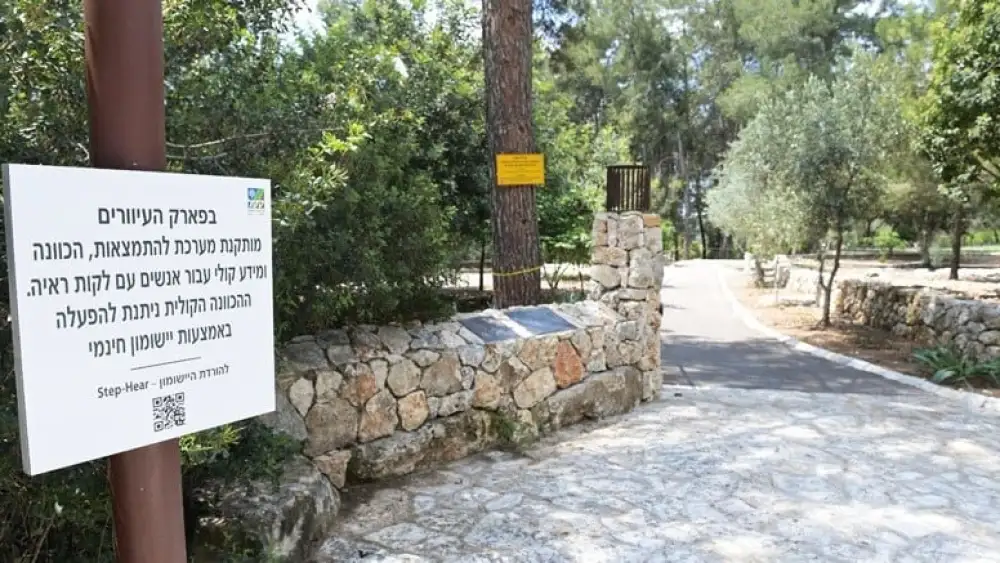
Israelis celebrated the reopening ceremony of the Blind People Park on April 14 after several years in which it suffered from poor maintenance.
The trail is part of the Ben Shemen Forest, which covers some 200,000 acres in the Gush Dan and is visited by thousands of travelers annually.
It was paved at the beginning of the current millennium by Keren Keyemeth LeIsrael. In 1998, Israel passed a law ensuring equal rights for people with disabilities that led to making recreation areas and forest public sites accessible. The idea of setting up a trail for visually impaired people came from the “Peula” (“Action”) organization. The upgrade of the Blind People’s Garden was done with a large accompanying KKL-JNF team that includes the planning division, the area management, the public coordinator, the operations division and the accessibility director.
Israel’s updated accessibility laws required the trail—stretching about 500 meters (a half-mile) and incorporating a water pit, wine press, old ruin and ancient orchard—to be adapted for people with disabilities.
The trail consists of three circular rings, providing the feel of a larger site for travelers. It has been paved with asphalt, and its incline has been adjusted according to accessibility standards. The diagonal curbstones were kept to assist blind people who might use a guide cane. They are painted in contrast to the color of the trail, helping the visually impaired and keeping people who use wheelchairs from falling outside the trail.

The old handhold was replaced with a new one; wooden benches were renovated; and a new space was created nearby to allow wheelchair users to sit beside them. A grapevine hut was built near the ruin, and the wooden lots were replaced with stones. The orchard has fig, almond, pomegranate, olive and carob trees. Also as part of the park’s upgrades, spice plants have been replanted in flowerbeds, allowing those challenged by sight to use their other senses.
To mark active areas, entrances to the trail were added with stone stripes built into the asphalt, used as guiding strips for people with lighter cases of visual impairment. A stone bridge at the entrance has also been renovated and now includes a wind bell.

As part of the renovation, audio elements along the trail offer a special application to tell the story of the site, and signs were added with explanations in Braille that include illustrations.
The spice garden was rebuilt and lowered to allow more convenient access. Trees, cyclamen and squills were planted in the orchard and along the trails. Near the park, two picnic recreation areas were set up. The park is situated on the main path of a cycling track where “tandem” groups of blind people also come cycling.
The park has been renovated with the support of Jewish National Fund (JNF) Germany, Switzerland, Italy and the United States.