
Once, the world seemed relatively straightforward. On one side stood the United States and the democratic world; on the other, the Soviet Union, China and their satellites, where democracy was never a governing principle.
Today, the picture is far more complicated.
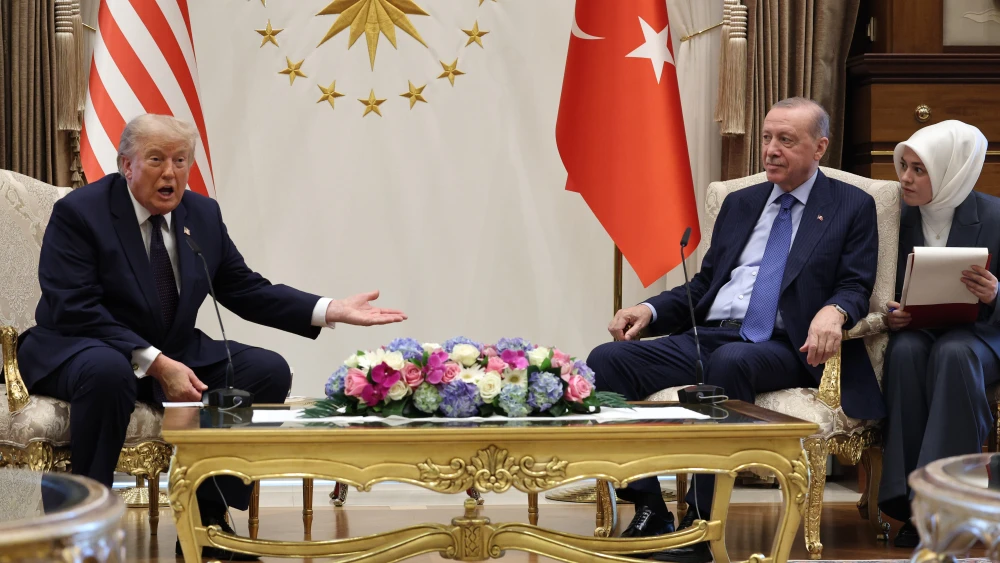
Even as tensions with the Shi’ite regime in Iran intensify once again, U.S. President Donald Trump has embraced an alliance with another problematic regional power: Turkey, an Islamist, authoritarian Sunni state whose trajectory the late historian Bernard Lewis once warned would ultimately resemble that of Iran.
Turkey was once a source of hope. As a member of NATO, it was widely seen as a bridge between the Islamic world and the West. That vision has long since collapsed. Under President Recep Tayyip Erdoğan, Turkey has become a vehicle for aggression and ideological hostility.
Trump has suggested he trusts Erdoğan because, although Turkey initially appeared ready to side with Iran during the recent conflict, it ultimately aligned itself with Washington. That confidence is reportedly reinforced by U.S. Ambassador to Turkey Tom Barrack, who strongly supports a strategic triangle of Turkey, Syria and Iraq as a cornerstone of American regional policy—a vision that leaves little room for Israel.
Yet Erdoğan, who openly presents himself as the leader of a revived Ottoman sphere of influence and as a champion of the Muslim Brotherhood, is a highly questionable recipient for one of America’s most advanced fighter aircraft.
Over the years, he has consistently worked against Egyptian President Abdel Fattah el-Sisi, seeking to fracture the moderate Sunni bloc aligned with the West. That bloc gave birth to the Eastern Mediterranean energy partnership linking Egypt, Israel, Greece and Cyprus—one of the region’s most innovative strategic initiatives.
Greece views Turkey as an increasingly aggressive neighbor. Cyprus remains divided, with Turkey continuing to occupy the northern half of the island. Erdoğan has only recently begun rebuilding fragile ties with Saudi Crown Prince Mohammed bin Salman.
Meanwhile, Ankara has openly hosted Hamas leaders, praised the Oct. 7 massacre, allowed flotillas to depart for Gaza from Turkish territory and made hostility toward Israel a centerpiece of its foreign policy. Erdoğan routinely compares Israeli Prime Minister Benjamin Netanyahu to Adolf Hitler and has spoken of Jerusalem as a future Turkish objective. Turkish Foreign Minister Hakan Fidan recently declared, “Israel is a burden humanity can no longer bear.”
There are practical reasons as well for caution.
Turkey’s 2019 purchase of the Russian S-400 missile defense system triggered U.S. congressional sanctions and led to its removal from the F-35 program because of concerns that sensitive technology could ultimately be exposed to Russia—or even China. Reversing that decision would take years even if Washington chose to do so.
The United States must also preserve Israel’s Qualitative Military Edge, a longstanding bipartisan commitment that remains central to American policy.
Israel also provides strategic advantages that few regional partners can match. Even today, U.S. military operations can be launched from Israeli territory, while many surrounding Arab states continue to deny such access.
Asked about selling F-35s to Turkey, Netanyahu recently said simply, “I wouldn’t do it.”
Given Erdoğan’s record, his ambitions and the uncertainty surrounding the Middle East’s future, that advice deserves careful consideration.
Indeed, if Trump has come to recognize how difficult it is to reach a durable agreement with the revolutionary Islamist regime in Tehran, he should also ask whether any long-term strategic understanding with an increasingly Islamist, authoritarian and messianic Turkey can truly be relied upon. That is a question Washington cannot afford to ignore.