The mastermind of a 1994 Panamanian airline bombing that killed 21 people is finally being brought to trial. Twelve members of Panama’s Jewish community died in the bombing, the target of the attack.
Ali Hage Zaki Jalil, of Lebanese descent, had been living on Venezuela’s Margarita Island, where he was seized by authorities last month. Panama is seeking his extradition.
Few are familiar with the bombing, which took place on July 19, 1994, just one day after the yet more horrific attack on the AMIA (Asociación Mutual Israelita Argentina) building in Buenos Aires, in which a suicide bomber drove a truck filled with explosives into the structure, killing 85 people and injuring hundreds.
U.S., Israeli and Panamanian intelligence long believed the bombings were connected, as they used the same methods and explosives.
Flight 901 of now-discontinued commuter airline Alas Chiricanas took off from the city of Colón to Panama City at 4:30 p.m. Central Daylight Time. The small twin-engine plane exploded shortly after takeoff.

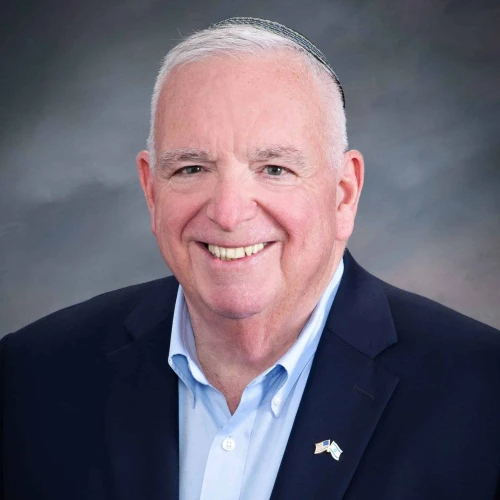
“It was a 15-minute flight. And, in fact, I took that same flight the day before,” Panama’s Ambassador to Israel Ezra Cohen told JNS.
Four Hezbollah operatives were believed to be involved. One, the suicide bomber, was identified in a 2020 FBI bulletin as Ali Hawa Jamal. He likely smuggled the explosives on board inside a portable radio, as he had a Motorola Radio P-500 with him during the flight, according to the Federal Bureau of Investigation.
At first, investigators weren’t sure if it was an accident or sabotage. They soon fixed on a bomb as the cause. They debated whether it was drug-related or politically motivated terror targeting Panama’s Jewish community.
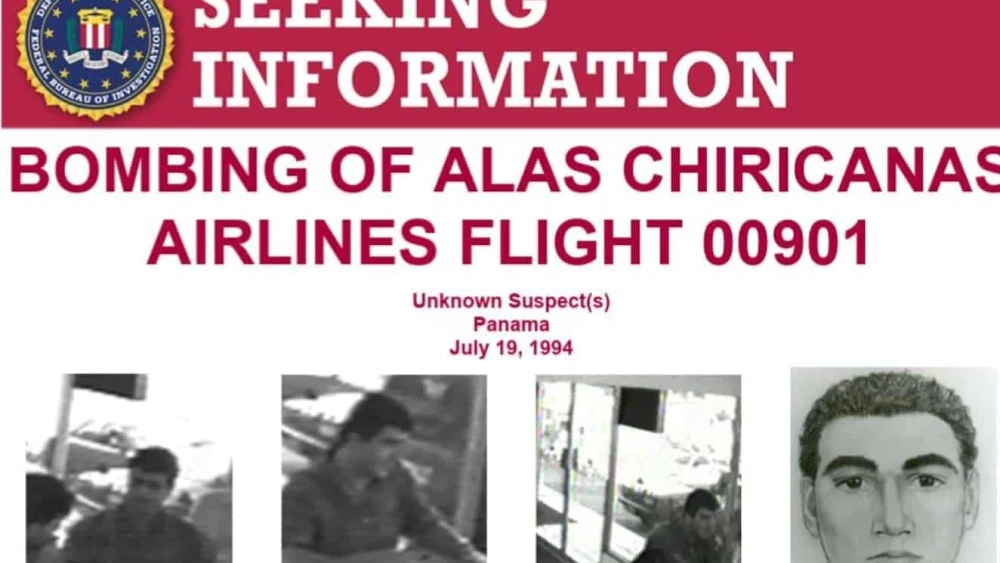
The second hypothesis soon became the likeliest scenario. In 1994, the FBI issued a bulletin seeking “unknown” males of “Middle Eastern descent” in connection with the attack.
Two terrorists were eventually captured, but Jalil remained at large.
The Panamanian authorities had him in their hands without realizing it. According to the FBI, Jalil was arrested five months after the attack for possessing 16 Mini Mac 9mm submachine guns, detonation caps and a military detonation cord similar to one used in the bombing.
Inexplicably, he was released.
From the 1990s through the 2010s, the case went cold. There were no breakthroughs and no one was held accountable. Jalil moved about freely. He owned several bars on Margarita Island and was an avid parachutist, competing in sport skydiving as late as 2018, according to the FBI.
Panama reopened the case in August 2019 after then-Panamanian President Juan Carlos Varela visited Israel in 2018. Israeli Prime Minister Benjamin Netanyahu told Varela that Israeli intelligence assessments pointed to Hezbollah as the group behind the bombing.
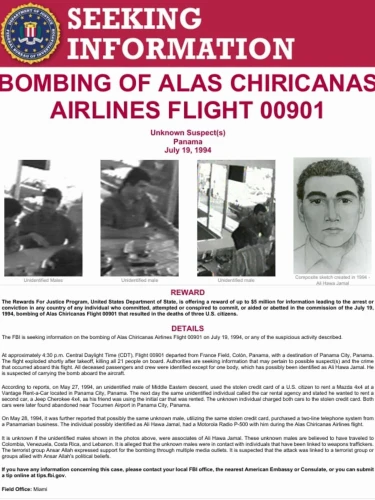
In Sept. 2020, the FBI put out a new “Seeking information” bulletin about Jalil, then 52. The State Department offered a reward of up to $5 million for information leading to the capture or conviction of individuals responsible for the bombing.
In late 2024, authorities located Jalil, who was living under assumed identities. On Nov. 8, Interpol Panama confirmed his arrest in a joint operation with the FBI and local authorities on Margarita Island.
With Jalil’s arrest and Panama’s push for extradition, Flight 901 may finally see its first full terrorism trial—offering the families of the victims a chance, however belated, to see someone held to account for one of Panama’s darkest days, said Cohen.
Cohen has been among those publicly emphasizing the importance of the case, both as a matter of justice and of historical memory. He notes that for many younger Panamanians, the attack is barely known today, despite its impact on the country’s Jewish community and its place in the broader pattern of anti-Jewish terror in the 1990s.
Efforts to memorialize the victims continue to grow. Inspired by the AMIA memorial in Buenos Aires, Cohen’s wife, Linda, founded the initiative Conciencia Viva to establish a permanent memorial site in Panama to honor those who perished on Flight 901. The chosen location and proposed design aim to create a space for reflection, education, and national remembrance.
“It’s important to keep the memory alive so that future generations understand the value of education in preventing terrorism,” Cohen said.
“Acts of violence and terrorism are entirely foreign to the Panamanian character and to the values of its people. Panama, historically, has been a common ground for Arabs, Jews, and people of all backgrounds to live together in harmony,” said Cohen. “We must maintain this situation of peace and unity. There is no place for violence or for the harboring of terrorist cells in Panama.”