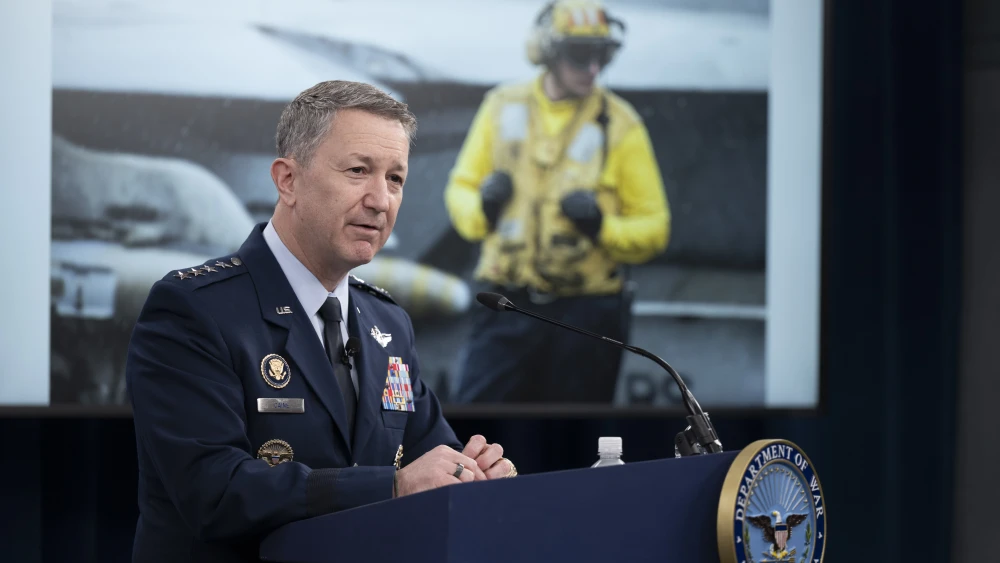
U.S. President Donald Trump and senior administration officials provided new details on Monday about the rescue of two F-15 crewmen from Iran.
Speaking to the press at the White House briefing room alongside U.S. Secretary of Defense Pete Hegseth, CIA director John Ratcliffe and U.S. Air Force Gen. Dan Caine, chairman of the Joint Chiefs of Staff, Trump said that the recovery of the F-15 weapons systems officer over the weekend involved more than 155 aircraft as “thousands” of Iranian forces were trying to capture the wounded colonel.
“The second rescue mission involved 155 aircraft, including four bombers, 64 fighters, 48 refueling tankers, 13 rescue aircraft and more,” Trump said. “A lot of it was subterfuge. We wanted to have them think he was in a different location because they had a vast military force out there.”
Trump and the officials did not say what caused the crash of the F-15 on Friday, though The Wall Street Journal and others have reported that it was shot down. It was the first time that Iran had shot down a manned U.S. aircraft and one of only a handful of times that an F-15 has ever been downed by enemy fire.
The pilot was recovered in a separate rescue operation the same day, but the weapons system officer remained in Iranian territory for about 48 hours.
Hegseth described the moment when the officer was first able to communicate using his emergency transponder.
“His first message was simple, and it was powerful. He sent a message, ‘God is good,’” Hegseth said.
Trump and the officials confirmed that two C-130 transport aircraft involved in the rescue operation on Saturday were deliberately destroyed by U.S. forces after they became trapped in sand and that some of the troops were injured after taking gunfire, but that no U.S. service members were killed during either rescue mission.
Ratcliffe said Iran was disappointed by its failure to capture the F-15 crew or to prevent their rescue deep inside its territory, despite a massive Iranian military presence.
“Our intelligence reflects that the Iranians were embarrassed and ultimately humiliated by the success of this audacious rescue mission,” Ratcliffe said.
While the president and his national security team provided new details about the operation, the officials made it clear that they were not willing to reveal the full extent of covert operations to recover the crew.
“How many men did you send altogether, approximately, to the operation?” Trump asked.
“I’d love to keep that a secret, Mr. President,” Caine replied, to laughter from the room.
‘This is a critical period’
In taking questions from the press, Trump also laid out more of the U.S. negotiating position with Iran and responded to criticism that the war lacks a strategic purpose.
“Somebody said, ‘Oh, he doesn’t have a plan,’” Trump stated. “I have the best plan of all, but I’m not going to tell you what my plan is.”
Trump declined to say if a ceasefire agreement with Iran would include Israel or be limited to the United States, and said that whether or not the war was “winding down” depends on how Iran responds to Tuesday’s deadline to reach a deal or risk increased U.S. strikes on a wider set of Iranian targets.
“This is a critical period,” he said. “I can tell you they’re negotiating, we think, in good faith. We’re going to find out.”
“We’re giving them till tomorrow, 8 o’clock, Eastern time, and after that, they’re going to have no bridges, they’re going to have no power plants,” Trump said.
He did not substantively respond to a question from The New York Times asking whether strikes on bridges and power plants might violate the Geneva Conventions’ ban on targeting civilian infrastructure.
The president said reopening the Strait of Hormuz to maritime traffic is a priority, though one made difficult when the mere threat of an Iranian attack on shipping has been enough to effectively close the critical energy corridor.
“They’re very good bulls**t artists,” Trump said of Tehran. “For 47 years, they’ve been bullsh**ting other presidents.”
Ahead of Tuesday’s negotiating deadline, Hegseth said that Monday would see “the largest volume of strikes since day one of this operation.”“Iran has a choice,” Hegseth said. “Choose wisely, because this president does not play around.”