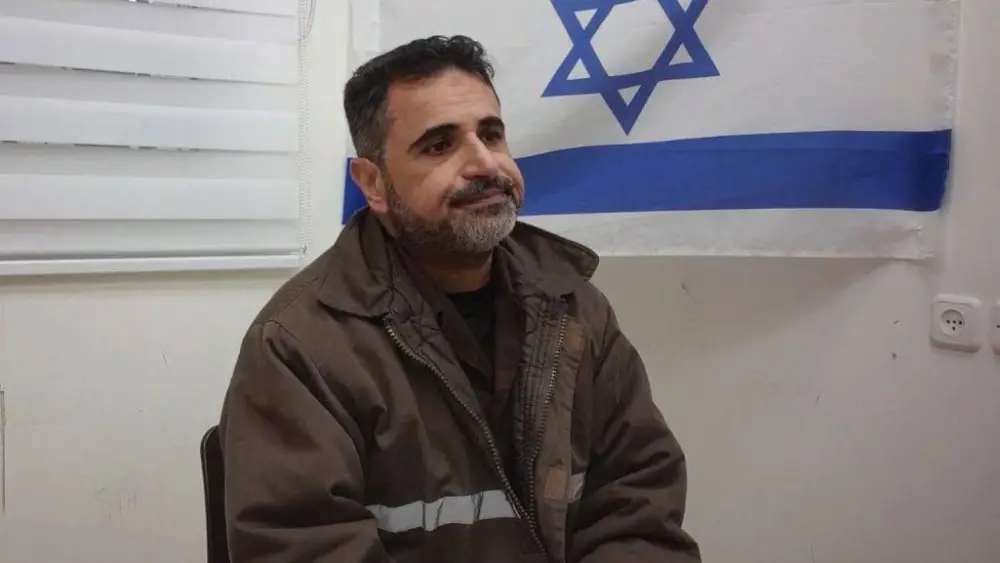
The director of a Gaza hospital admitted to Israeli interrogators that he had been recruited by Hamas to help turn the Strip’s medical centers into military facilities, the Israel Security Agency (Shin Bet) announced on Tuesday.
In a video released by the Shin Bet, Ahmed Kahlot, director of the Kamal Adwan Hospital in the northern Gaza Strip, said, “I was recruited to Hamas in 2010 at the rank of lieutenant colonel. There are employees in the hospital who are military operatives of Izz ad-Din al-Qassam [Hamas’s “military branch”]—doctors, brothers, paramedics, clerks, staff members.”
Hamas in their own words:
— Israel Defense Forces (@IDF) December 19, 2023
Ahmad Kahalot—Senior Hamas Member since 2010 and director of the Kamal Adwan Hospital in Jabalya in northern Gaza admits that Hamas has used hospitals as military facilities under their control.
Video credit: ISA Spokesperson pic.twitter.com/QGLclR94at
Kahlot added, “They hide in hospitals because they believe that a hospital is a safe place. They will not be harmed if they are inside a hospital.”
Israel security forces arrested Kahlot on Dec. 12.
During the interrogation, Kahlot describes how Hamas used hospitals and ambulances to hide operatives, launch military activity, transport members of terror squads and even deliver a kidnapped Israeli soldier.
“Hamas has offices inside the hospitals. There are places for senior officials, they also brought a kidnapped soldier there. There is a designated place for investigations, internal security and special security. They all have private phone lines inside the hospital,” he said.
Regarding the kidnapped soldier, Kahlot explained that “Hamas uses private ambulances. It has a different color, and no license plate. It was used to bring the kidnapped soldier and to transfer bodies. It comes and goes and does not take down the wounded.”
Kahlot told the interrogator: “Once I begged them to take a wounded man to the Indonesian hospital, for healing, for treatment. They refused. Their mission is more important.”
Hamas’s leaders, he continued, “are cowards. They left us in the field while they hide.... They destroyed us.”
On Nov. 23, Israeli security forces arrested Muhammad Abu Salmiya, director of the Shifa Hospital, Gaza’s largest medical facility.
As far back as 2009, the Shin Bet reported during the war of that year that Hamas operatives were hiding in the hospital, and that the basement had become its headquarters.
In addition to being used to hide Hamas leaders and hostages, the terror group is known to have launched rockets, tortured suspected collaborators and hoarded a half-million liters of fuel in the hospital compound.
Other Gazans interrogated by Israel have confirmed that Hamas and Palestinian Islamic Jihad have also embedded themselves in other hospitals and in the Strip’s Palestinian Red Crescent headquarters.
At least 1,200 people were killed in Hamas’s Oct. 7 assault on southern Israel. The number of men, women, children, soldiers and foreigners held captive in Gaza by Hamas is now believed to be 129. Other people remain unaccounted for as Israeli authorities continue to identify bodies and search for human remains.