


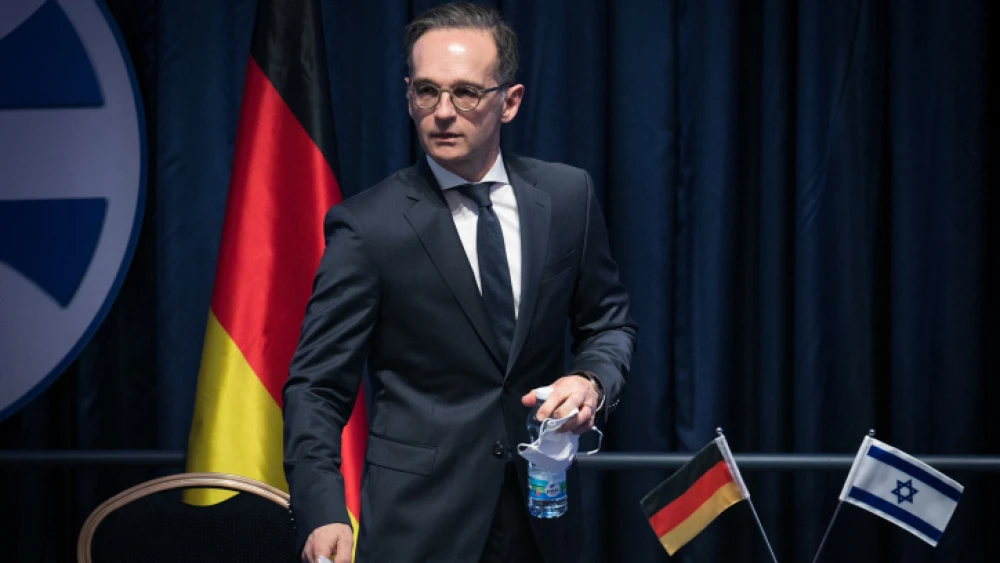
German Foreign Minister Heiko Maas said, “Tehran’s reckless behavior in the past weeks served as a reminder why we must stop the country from ever acquiring a nuclear weapon. The best tool for doing so remains the JCPOA [the Iran nuclear deal]. Although it may be far from perfect, it does give us more transparency than we ever had before.”
Maas made the remarks at the 14th annual conference of Tel Aviv University’s Institute for National Security Studies, which was held virtually this week due to the pandemic.
“I agree with you that this is not enough. We must also address Iran’s dangerous missile program and its aggressive regional behavior, but tackling them will be much easier if we first control the nuclear threat through this JCPOA.
In his recorded remarks, Maas also spoke about the Israeli-Palestinian conflict, saying, “We see how the chances of a two-state solution are diminishing with every act of or call for violence, but also with every new housing unit that is built in a West Bank settlement. That’s why we call for a stop of activities in Givat Hamatos.”
He said that “annexation must stay off the table no matter what the upcoming elections in Israel might bring.”
He also said that Israel’s normalization agreements with the United Arab Emirates, Bahrain, Sudan and Morocco “hold a compelling truth: reconciliation and cooperation are possible, but they require courage. And as we leave 2020 behind, more bold steps are needed to conclude what was started with the agreements.”
He went on: “The goal is peace and cooperation between Israel and its neighbors. But true and peace and cooperation with the Arab world won’t come without a solution to the Israeli-Palestinian conflict. Without a negotiated two-state solution, there will be no lasting peace. The normalization agreements, the new U.S. administration, the upcoming elections in Israel and possibly also the Palestinian territories—all these developments can call for fresh thinking.”
“The commitment to refrain from harmful unilateral action and stronger cooperation with the Palestinians in battling COVID-19 could be an important first step,” he added.
Haas also hailed Israel’s successful vaccination campaign, which he said is “inspiring the world.”
This article first appeared in Israel Hayom.



