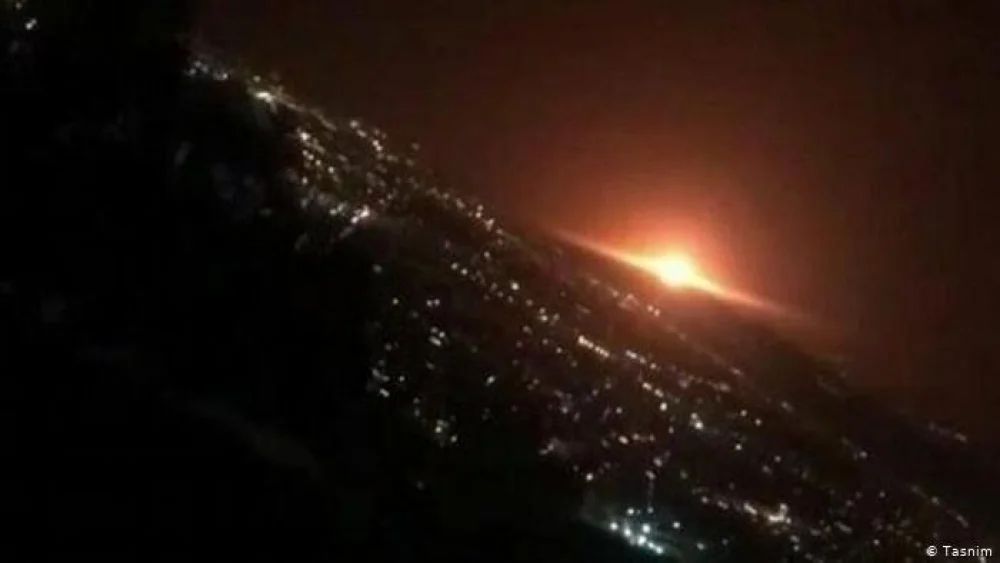
The Israeli airstrikes on Iran last month destroyed a secret nuclear weapons research facility in Parchin, 19 miles southeast of Tehran, Axios reported on Friday.
The clandestine site held sophisticated equipment used for testing explosives needed to detonate nuclear devices, the report read, citing three U.S. officials, one current Israeli official and one former Israeli official.
The Washington-based Institute for Science and International Security acquired high-resolution satellite imagery of the facility, which showed that it was completely destroyed in Israel’s Oct. 26 attack.

Israeli and U.S. intelligence agencies began noticing activity in the Taleghan 2 facility in the Parchin military complex in early 2024, which had been largely inactive since 2003, when the Islamic Republic froze its military nuclear program, according to Axios.
One unnamed U.S. official quoted in the report said: “[The Iranians] conducted scientific activity that could lay the ground for the production of a nuclear weapon. It was a top-secret thing. A small part of the Iranian government knew about this, but most of the Iranian government didn’t.”
Although U.S. President Joe Biden asked Jerusalem not to target Tehran’s nuclear facilities, the site in Parchin was chosen as a target because it was not part of Iran’s declared nuclear program.
This placed the mullah regime in a position where admitting a hit to the site would expose its efforts to resume activity forbidden by the Treaty on the Non-Proliferation of Nuclear Weapons.
Moreover, “The strike was a not-so-subtle message that the Israelis have significant insight into the Iranian system even when it comes to things that were kept top secret and known to a very small group of people in the Iranian government,” the report cited a U.S. official as saying.
Last week, Rafael Grossi, director of the United Nations’ International Atomic Energy Agency, visited Iran for the first time since May.
He is expected to meet with his agency’s board of governors in Vienna this week for a vote on a resolution to censure Tehran for its lack of cooperation with the U.N. nuclear watchdog.
Speaking about the tensions between Israel and Iran, Grossi said during a news conference in Tehran on Thursday that the Islamic Republic’s “nuclear installations should not be attacked.”
Earlier in the week, Israeli Defense Minister Israel Katz suggested that Iran’s nuclear facilities may be targeted.
Iran is “more exposed than ever to strikes on its nuclear facilities. We have the opportunity to achieve our most important goal—to thwart and eliminate the existential threat to the State of Israel,” Katz said.

Israel’s two assaults against Iran’s air defense system this year have left the country vulnerable to future attacks, with all four of Tehran’s Russian-made S-300 surface-to-air missile batteries destroyed, according to U.S. media.
On April 19, Israel took out one of the S-300 systems in response to Tehran’s first-ever direct attack against the Jewish state. On Oct. 26, in response to a second Iranian attack, Israel targeted 20 sites in Iran, destroying the remaining three.
“The majority of Iran’s air defense was taken out,” a senior Israeli official told Fox News.