By Ariel Ben Solomon/JNS.org
In the predominantly Muslim Middle East, the sure way to rally opposition to any concept is to tie it to Israel.
Regional players such as Turkey, Iran and the Iranian terror proxy Hezbollah have done just that with Lebanon-based Hezbollah’s leader, Hassan Nasrallah, recently saying the Sept. 25 Kurdish independence vote was part of a U.S.-Israel plot to divide the region.
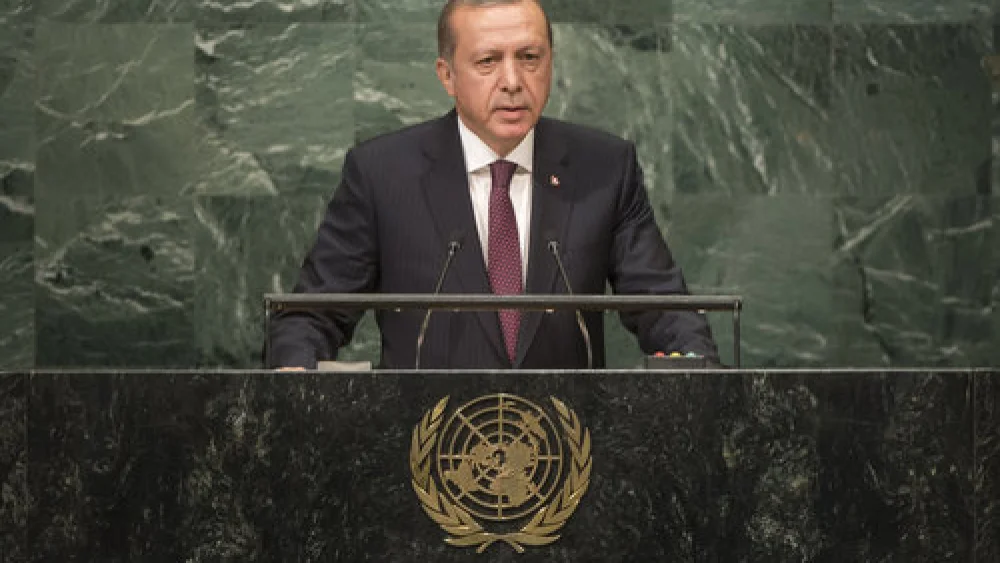
Turkish President Recep Tayyip Erdogan also alleged that the fact that Israeli flags were waved during celebrations for the “yes” vote for independence proved Israel’s Mossad intelligence agency was involved.
“This shows one thing, that this administration [in northern Iraq] has a history with Mossad, they are hand-in-hand together,” Erdogan said in a televised speech, AFP reported.
Israeli Prime Minister Benjamin Netanyahu denied these allegations during a cabinet meeting Oct. 1. Israel has been the only country to officially back the Kurds’ bid for independence.
“Few dispute the Kurds have a moral case for statehood. The problem has always been precedent, which is why its neighbors will seek to nip it in the bud,” Michael Rubin, a resident scholar at the American Enterprise Institute and a former Pentagon official, told JNS.org.
Rubin—whose major research areas include the Middle East, Iran, Kurdistan and diplomacy—noted Turkey and Iran both have Kurdish minorities that would jump at the opportunity to go their own way.
“Almost every regional country has their equivalent of the Kurds: Berbers in Algeria, South Yemenis and Saudi Arabia’s Shi’ite Eastern Province,” he said.
Dr. Mordechai Zaken, an expert on the Kurds and the head of minority affairs at Israel’s Ministry of Public Security, told JNS.org, “The Kurds are entitled to an independent Kurdish national home just like the Jews, and they will sooner or later be granted this statehood.”
“The Middle East goes according to the rules of the marketplace—bargaining for a deal,” said Zaken, author of the book “Jewish Subjects and Their Tribal Chieftains in Kurdistan: A Study in Survival.”
He added that this “bargaining” process usually includes threats, intimidation and exaggeration, but rarely any action.
Zaken, who served as Netanyahu’s adviser on Arab affairs during the latter’s first term as prime minister from 1996-1999, dismissed Turkish and Iranian rhetoric trying to tie the Kurds to Israel.
“The Kurd national issue started long before it had any connection to Israel and before the establishment of the Jewish state,” said Zaken, explaining that the Kurds were promised autonomy in the Treaty of Sèvres of 1920, which broke up the Ottoman Empire. But Turkey opposed and prevented the implementation of the accord and Kurdish autonomy.
Zaken said, “In 100 years nothing has changed,” while the difference today is that Turkey and Iran “are using Israel’s support for the Kurds and exaggerating its role, but the truth is that it has little do with recent developments in Iraqi Kurdistan.”
Asked about Palestinian opposition to Kurdish independence, Zaken replied, “Not only do the Palestinians oppose Kurdish national aspirations, but [so does] the entire Arab nation.”
“The Arab world has never embraced the Kurdish issue as it did the Palestinian one,” he added.
Addressing the irony in the Palestinian position, the American Enterprise Institute’s Rubin remarked, “Such blind adherence to Arab unity undermines every argument Palestinians make for their own independence.”