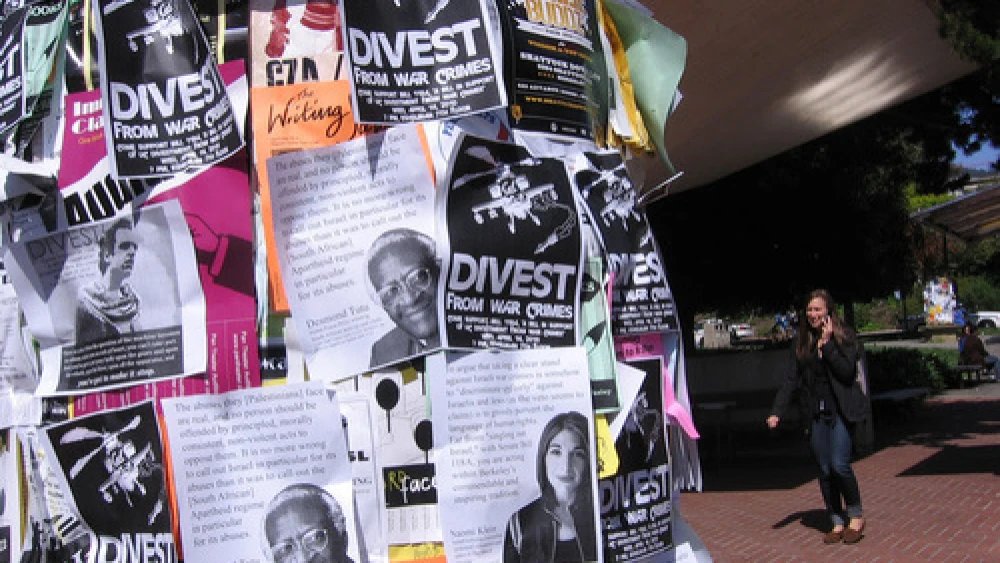
Many students who claim to support the Palestinian cause actually know very little about the Israel-Palestinian conflict, according to a recent survey conducted at the University of California, Berkeley.
Ron E. Hassner, the Helen Diller Family Chair in Israel Studies at UC Berkeley, conducted a survey of 230 students at the university. Despite most of the respondents purporting to care “deeply” about the Israeli occupation of Palestinian territories, “75% of those students cannot locate those territories on a map and 84% cannot name the decade (let alone the year) in which that occupation began,” Hassner wrote in an essay detailing the results.
Shockingly, 25 percent “of these students placed the Palestinian Territories west of Lebanon, in the middle of the Mediterranean Sea,” added Hassner.
Most students also had no idea how many people actually lived in Israel. Only 17 percent of the students gave the correct answer, while others made guesses that ranged from 100,000 to 150 million.
A more moderate stance on the conflict seemed to reflect greater knowledge of the issues, said Hassner. He revealed that the students with more moderate views were likely to know more, and also “more likely to admit gaps in their knowledge.”
The survey wasn’t limited to the Israeli-Palestinian conflict. Rather, students were asked to weigh in on 18 key issues in the Middle East ranging from U.S.-Iran relations, to the civil war in Yemen, to drone warfare. The students were then given a five-point scale to indicate their level of interest in each topic.
The students seemed most interested in the Israeli-Palestinian crisis, while expressing indifference towards other instances of alleged occupation, like the Kurdish struggle for independence in Iraq, the Moroccan occupation in Western Sahara and the Turkish occupation in northern Cyprus.
This article first appeared in Israel Hayom.