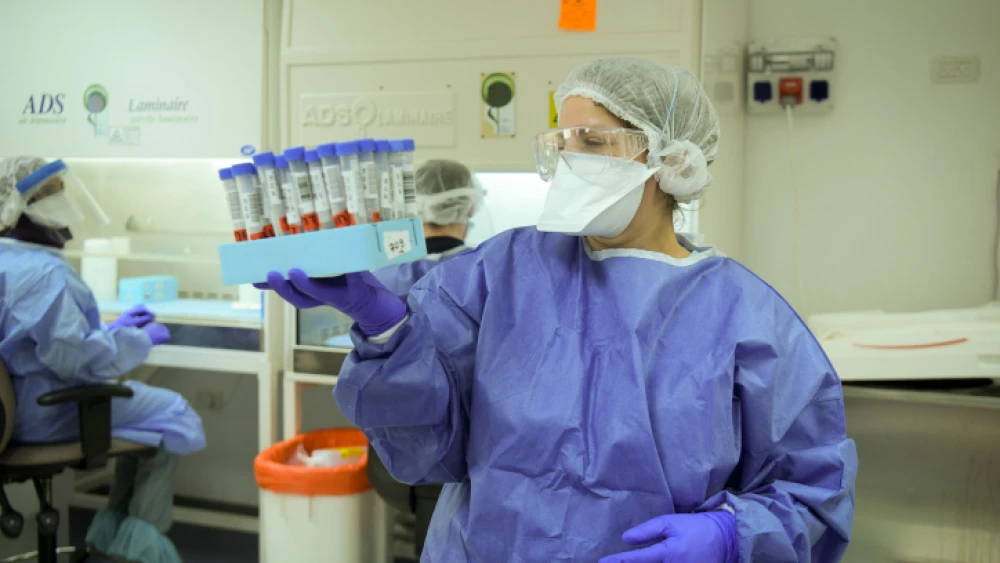
Hundreds of medical staff working at Israel’s coronavirus-testing facilities are exhausted and may soon go on strike, Israel Hayom learned Monday.
The laboratories testing Israelis for COVID-19 have been working around the clock for weeks, yet they are severely understaffed, with lab technicians often working 16- and even 24-hour shifts.
On Monday, their union said unless the Finance Ministry and Treasury find a solution for the staffing problem, they will declare a “go slow,” cutting shifts to eight hours.
This means that thousands of coronavirus tests will go unchecked each day, creating a bottleneck and impeding the efforts to curb the pandemic.
Israeli labs currently decipher some 30,000 COVID-19 tests per day. Health Minister Yuli Edelstein said he wants to double testing capacity, something medical personnel report is currently impossible.
As of Monday afternoon, Israel’s coronavirus tally stood at 62,626 total cases since the start of the pandemic, with 35,076 active cases and 27,077 recovered patients. The national death toll was 473. The number of patients in serious condition was 317, among whom 104 were on ventilators.
Between Sunday and Monday, fewer than 8,000 coronavirus tests were conducted—significantly lower than during recent weeks—with 9.2 percent of the subjects testing positive for the virus. The Health Ministry offered no explanation for the decline in testing over the past few days.
Widespread testing, combined with swift epidemiological assessments, is considered a key strategy in the government’s efforts to contain the second coronavirus outbreak.
Newly appointed coronavirus commissioner Professor Ronni Gamzu said over the weekend that he plans to appoint a team of hospital representatives to report to him if they believe that the health-care system is on the verge of being overwhelmed by the growing infection rate.
According to Health Ministry data, four hospitals—Jerusalem’s Shaare Zedek Medical Center and Hadassah Hospital Ein Kerem, the Sourasky Medical Center in Tel Aviv and the Shamir Medical Center in Be’er Yaakov—have already exceeded their capacity for coronavirus patients.
The coronavirus ward at the Sheba Medical Center at Tel Hashomer was at 90 percent capacity as of Monday.
This article first appeared in Israel Hayom.