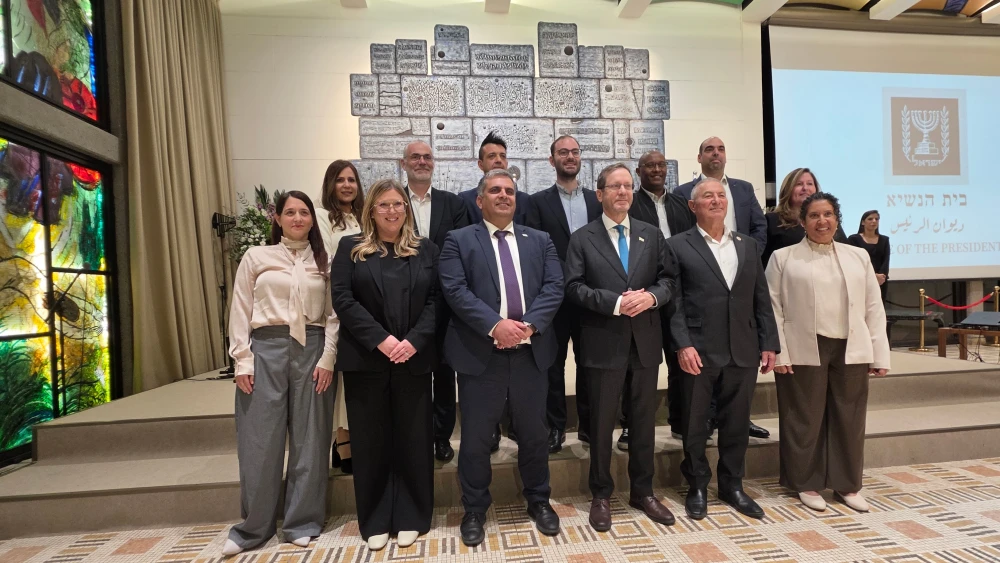
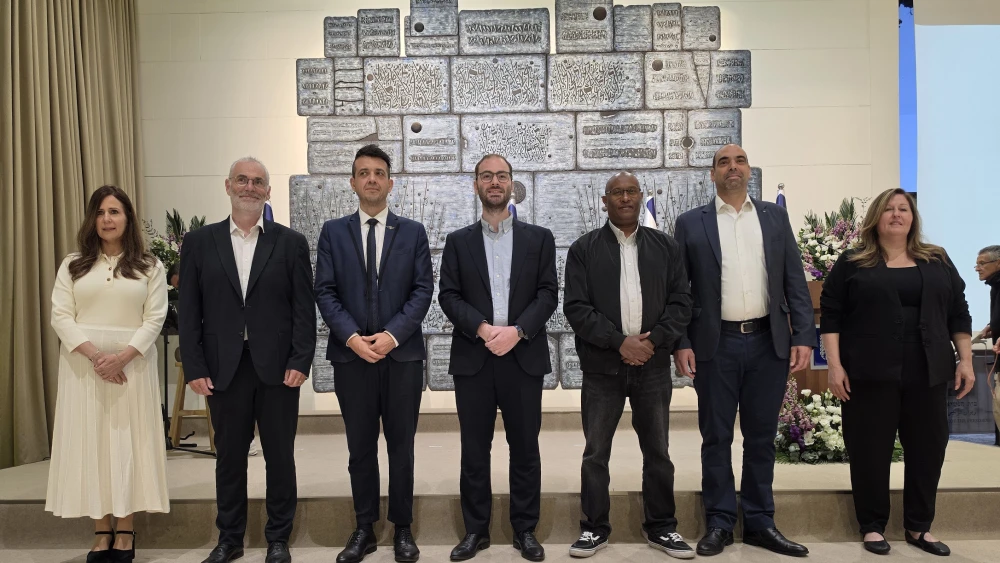
A French-born physiotherapist who mobilized more than 240 volunteers to treat over 20,000 Israeli soldiers was among four individuals and three organizations honored at the President’s Residence in Jerusalem on Tuesday evening for their contributions to Israeli society.
Israeli President Isaac Herzog and Minister of Aliyah and Integration Ofir Sofer presented the ministry’s annual awards recognizing outstanding immigrants at the ceremony, now in its 10th year.
When the Hamas massacre began on Oct. 7, 2023, Fabrice Halfon, a French-born physiotherapist who had made aliyah to Israel, asked himself a simple question: “I am a physiotherapist. What can I do?”
The answer became a nationwide volunteer initiative that has provided treatment to more than 20,000 Israeli soldiers.
Halfon immigrated from France in 2016 after establishing a career in physiotherapy. With more than 20 years of clinical experience, he specializes in respiratory physiotherapy and rehabilitation for infants, children and adults.
Following the Oct. 7 attacks, inspired in part by his own children serving on the front lines, he turned to social media to recruit French-speaking therapists willing to volunteer their professional skills to help soldiers.

The initiative, Les Kinés du Cœur, launched its first mission on Oct. 19, 2023. What began as a small group has grown into a multidisciplinary network of more than 240 volunteers, including physiotherapists, osteopaths, podiatrists and acupuncturists.
The team has visited more than 150 military bases and staging areas across Israel, treating over 20,000 soldiers suffering from muscular strain and injuries associated with carrying heavy combat equipment and spending extended periods in the field.
Beyond physical treatment, the volunteers provide personal attention and emotional support.
For Halfon, the initiative has become a meaningful way to serve the country he chose as his home.
Honoring outstanding immigrants
The other individual recipients represented a range of professions and countries of origin.
Dr. Yael Amiel-Schiff, a couples and family therapist, educational counselor, researcher and lecturer, made aliyah from Belgium in 2012 with her husband and seven children.
Drawing on her personal experience and professional expertise, she helps individuals and families navigate life transitions, family crises and the cultural and psychological challenges of immigration.
Roman Kaplun, who immigrated from St. Petersburg in 2017, brought experience in advertising, filmmaking and digital communications to Israel.
Following the Oct. 7 massacre, he founded OTEF, an independent volunteer media initiative documenting eyewitness testimonies and countering anti-Israel disinformation.
His documentary work includes interviews with survivors of the Nova music festival massacre, residents of communities near Gaza, ZAKA volunteers and IDF soldiers. He has also developed an artificial intelligence-based system to identify and counter coordinated bot-farm propaganda.
Dr. Chalom Zemmour, who made aliyah from Paris in 2018, is a biomedical and nanomedicine researcher affiliated with the Hebrew University of Jerusalem’s School of Pharmacy, Faculty of Medicine, and Center for Nanoscience and Nanotechnology.
Three organizations were also recognized for helping immigrants integrate into Israeli society.
ESRA, founded in 1979, supports English-speaking immigrants through educational, social welfare, cultural and community programs. Its initiatives serve children, university students and families affected by the war, with the assistance of more than 2,000 volunteers and partnerships with government, academic and business institutions.
The Tene Briut Association serves members of Israel’s Ethiopian community, while the Harel Association supports lone soldiers, including young immigrants who come to Israel to serve in the IDF.
The story of a Nobel laureate’s father
In his address, Herzog offered a personal and historical perspective on the contributions of immigrants, beginning with the story of a Jewish teacher from Hungary.
Moshe Hershko taught at a Jewish school in the Hungarian town of Karcag before being taken for forced labor during the Holocaust and subsequently falling into Soviet captivity.
His wife and two sons were also sent to forced labor in Austria. Nearly two-thirds of Karcag’s Jewish population never returned.
The family survived, reunited and immigrated to Israel.
But Hershko faced an unexpected challenge in his new country: He did not know Hebrew.
As Herzog explained, a teacher without the language was like a worker without tools.
Hershko began again, learning Hebrew as an adult, starting with the alphabet. He eventually returned to teaching, trained educators at a seminary and wrote arithmetic textbooks used in schools across Israel.
Generations of Israeli children, including native-born Israelis and children of immigrants, learned mathematics from books written by a man for whom Hebrew had once been a foreign language.
One of those children was Hershko’s son, Avraham, who arrived in Jerusalem at age 12 and went on to win the 2004 Nobel Prize in Chemistry.
For Herzog, the story illustrated the often-unrecognized contributions of immigrants whose influence extends far beyond their own achievements.
“The story of his father, Moshe Hershko, expresses in my eyes the quiet strengths that are revealed to us among our sisters and brothers who immigrate to this land,” he said.
Herzog noted that the distinction between new immigrants and veteran Israelis is often less pronounced than people imagine. Even those born in Israel are shaped by the knowledge, culture and experiences brought by immigrant parents, teachers and neighbors.
The president also reflected on his own family’s history.
His father, Chaim Herzog, who later became Israel’s sixth president, immigrated from Ireland in 1935, while his mother, Aura, arrived from Egypt in 1946.
The revival of Hebrew, he said, was itself an extraordinary example of the immigrant experience, as an ancient language became the everyday language of people who had not been born speaking it.
Reflecting on the Hebrew word oleh (immigrant), Herzog explained that it describes not merely someone who has immigrated, but someone who continues to ascend.
“Immigration is not a moment of landing at Ben-Gurion Airport. It is a direction,” he said.
Addressing the award recipients, he added: “You teach us what language is, what knowledge is, what courage looks like, how one begins anew. You are the teachers of this generation.”
A shared responsibility
Herzog emphasized that encouraging Jews around the world to make aliyah is only part of Israel’s responsibility.
The country must also ensure that immigrants are welcomed with dignity and given opportunities to contribute their skills and experience.
He called for investment in quality Hebrew-language instruction, improved recognition of professional qualifications, greater support for lone soldiers and elderly immigrants, and continued efforts to combat racism.
“This responsibility is shared by all of us!” he declared.
The president also acknowledged the particular challenges faced by immigrants during the war.
When Sofer took office in January 2023, Herzog noted, neither could have anticipated the extraordinary circumstances in which the ministry would operate.
Immigrant families saw their sons and daughters sent to fight, while others who had come to Israel seeking a new life found themselves running to bomb shelters.
“Precisely in these years, tens of thousands chose to immigrate,” Herzog said.
He thanked Sofer, who is concluding his term as minister, for leading the ministry during a period marked by war and significant immigration challenges.
The chairwoman of the awards judging committee, attorney Elyse Schachna, was also recognized at the ceremony.
A Jewish community leader and law lecturer from Melbourne, Australia, Schachna made aliyah three months ago. She previously served as president of Zionism Victoria, having been elected to the position in November 2024.
Leah Aharoni, founder of Our People, an initiative supporting Russian-speaking immigrants and IDF families, welcomed the public recognition of olim (immigrants).
“It was amazing to be at this event, to see the President and the Israeli government recognize olim,” she told JNS. “The country has been built by olim. Aliyah is growing, and it’s great to see.”