Newsletter
Newsletter Support JNS

Top Senate Foreign Relations Democrat meets Syrian president at NATO summit

Sen. Jeanne Shaheen discussed lifting remaining U.S. sanctions on Syria, implementing an agreement with the Syrian Democratic Forces and removing Syria from the U.S. list of state sponsors of terrorism.

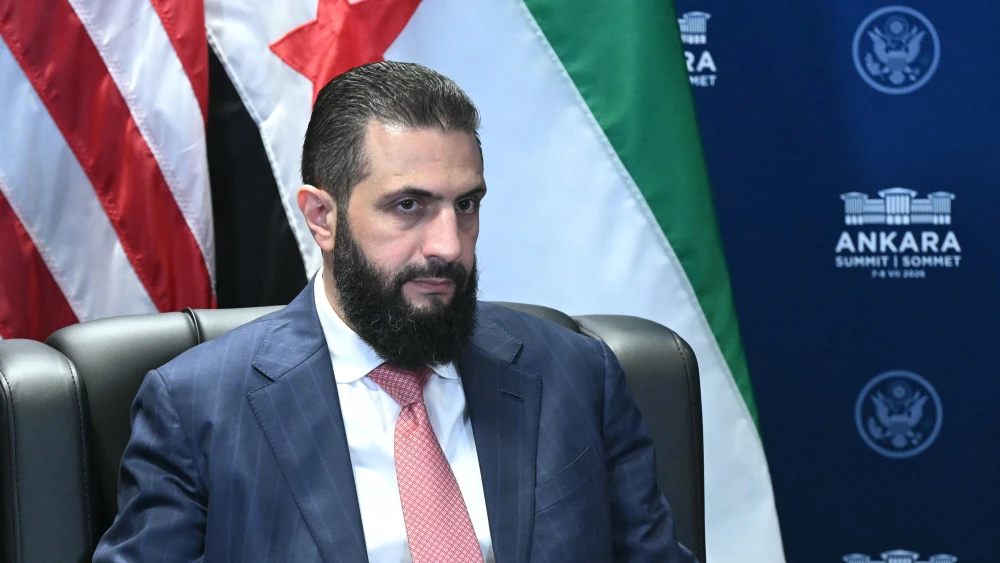
Syrian President Ahmed al-Sharaa meets with U.S. President Donald Trump (not pictured) on the sidelines of the NATO Summit at Bestepe Presidential Compound in Ankara, Turkey, on July 8, 2026. Credit: Saul Loeb/AFP via Getty Images.

Sen. Jeanne Shaheen (D-N.H.), ranking member of the U.S. Senate Foreign Relations Committee and co-chair of the Senate NATO observer group, met with Syrian President Ahmed al-Sharaa on Wednesday on the sidelines of the NATO Summit in Ankara, Turkey, to discuss the future of U.S.-Syria relations.

According to the committee, Shaheen discussed Congress’s repeal of Assad-era Caesar Act sanctions and bipartisan legislation that would eliminate the remaining U.S. sanctions on Syria.

The two also discussed the implementation of the agreement between the Syrian government and the U.S.-backed Syrian Democratic Forces, which the committee described as “an important step toward national reconciliation and a unified Syria.”

Shaheen also reiterated her call for the U.S. State Department to remove Syria from its list of state sponsors of terrorism “in recognition of the new government’s considerable progress in fighting terrorist groups.”
The report concluded that leading chatbots frequently failed to recognize antisemitic tropes in Persian and called on developers to improve the accuracy and quality of multilingual responses.
The Radwan Force is Hezbollah’s commando unit that specializes in cross-border infiltration operations.
A state report finding Jews were targets of three-quarters of hate crimes in California in 2025 “should be a gut-check for our entire society,” Nathan Hochman told JNS.
The Israeli military would have “no contact” with civilians and “no role” in separating the zones from the rest of Gaza, a source tells JNS.
“They just couldn’t figure out how to represent 11% of the city,” stated the writer Avital Chizik-Goldschmidt.
Day Two of the “Contemporary Antisemitism 2026” conference in Haifa explored how Jewish belonging is increasingly contested across digital platforms, popular culture and minority movements.