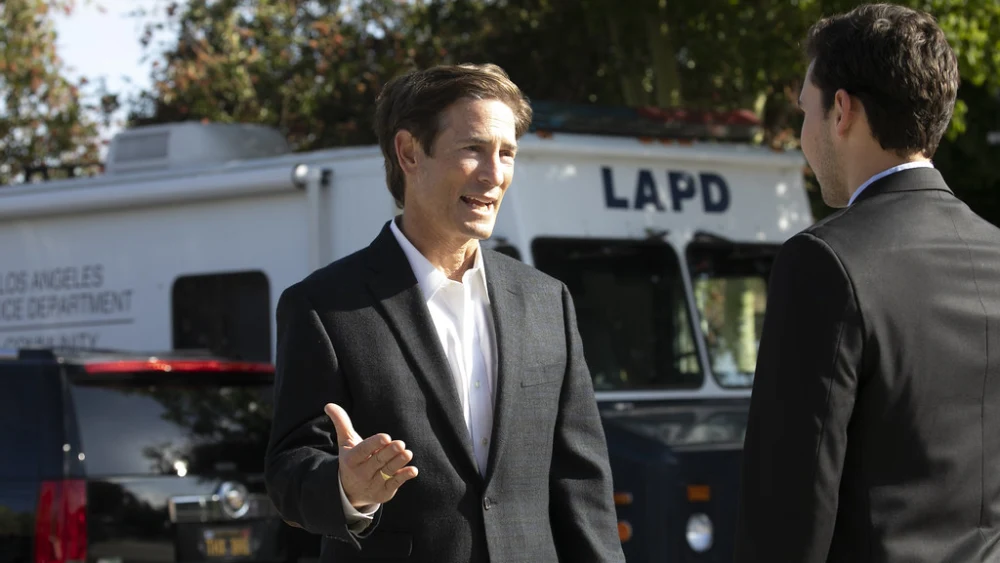
California’s finding in a report that about three-quarters of religion-based hate crimes in the state targeted Jews in 2025 is “a sobering reminder that antisemitism remains one of the most persistent forms of hate,” according to Nathan Hochman, district attorney for Los Angeles County.
“The numbers affirm what many members of Los Angeles County’s Jewish population have long believed,” Hochman, who is Jewish, told JNS. “Fear of antisemitic hate isn’t imagined. It’s measurable, documented and rising.”
“This report should be a gut-check for our entire society, as concentrated hate may start with the Jewish population, but it often never ends there,” he said.
Hochman’s office will “continue to aggressively prosecute hate crimes, work closely with our law enforcement and community partners, and stand with every victim of bias-driven violence,” he told JNS.
The district attorney, who believes in “showing up” to show support for different communities, visits various neighborhood associations and attends festivals and parades.

The Jewish community needs to hear a “very strong response” from both the district attorney and law enforcement about hate crimes, he told JNS.
“We are going to move heaven and earth to go after any of these hate criminals,” he said.
The state isn’t aiming to pack jails “to the breaking point with hate criminals,” according to Hochman.
“Our goal is to deter them in the first place from engaging in these actions,” he said. “That is the type of message that we want to consistently get out. If you only show up once in a while, and you have your press conference once every 18 months, nobody believes that you’re going to consistently do it.”
‘More than just scream’
Hochman told JNS that he and Paul Kim, deputy district attorney in the county’s organized crime division and hate crimes unit, determine if reported incidents can be prosecuted as hate crimes or if they are just hate incidents.
Someone shouting antisemitic slurs while driving past a synagogue “might not rise to the level of a hate crime, because you actually need to do something more than just scream wild statements,” Hochman said.

“If you say, ‘I’m going to kill you,’ you don’t have to wait until someone kills you to actually prosecute that,” he told JNS.
But saying “from the river to the sea” or bearing a flag making a statement like that while driving past a synagogue doesn’t necessarily amount to a hate crime, according to Hochman.
“We’ll certainly note it,” he said. “We’ll make sure that we determine who actually said it, because very often a hate incident can be the precursor for a hate crime.”
Under state law, a hate crime involves infringing on someone’s civil rights, like assaulting someone or damaging their property, according to Hochman.
“You deface a temple. You go ahead and not just scream at somebody, but you scream a threat,” he told JNS. “There’s a whole list of qualifications that trigger a hate crime.”
“That’s what turns what would ordinarily be a criminal threat into a hate crime, where it could turn an assault into a hate crime,” Hochman said.
Under state law, when someone is, say, attacking someone or trying to stab the victim and then shouts “death to the Jews” in the process, the state can bring a hate crime “enhancement.”
“The enhancement that we can put with the attempted murder takes the time for the attempted murder and then adds additional years in prison to the attempted murder, so it becomes an enhancement to the attempted murder,” Hochman told JNS.
“The stand-alone hate crime is good when you don’t have more serious crimes,” he said. “Someone pushes you, you can do an assault crime, but it could also be a hate crime.”
“We might decide that, for various reasons, this is much more of a hate crime than necessarily just an assault,” he said.

If attackers say they are attacking victims because of their faith, or because they are part of another protected group, that’s the easiest way to prove a hate crime, and a “perfect case” is when those statements are recorded while the crime is committed, according to the district attorney. Witnesses can also be called to corroborate whether such statements are made.
Prosecutors and investigators also probe an alleged attacker’s past writings, including social media, to see if there is evidence of hatred toward a particular group. If, say, someone has a copy of “Mein Kampf” in his home with passages about killing Jews highlighted, it wouldn’t be a stretch to think that the person might have said something antisemitic while carrying out a crime, according to Hochman.
“It would be a way that you’d help bolster a particular hate crime case, by showing that that person—it wouldn’t be the only time that they ever said it,” he told JNS.
Change in approach
Hochman told JNS that when he was sworn in, in December 2024, he tried to address what he viewed as “trust issues” that had emerged between his predecessor, George Gascón and others.
He told prosecutors in the district attorney’s office, some 98% of whom supported an effort to recall Gascón, that he wasn’t going to replace his predecessor’s “decarceration” ideology with “another political ideology of mass incarceration.”
Instead, Hochman, with support from his prosecutors, implemented what he told JNS is a “hard middle” approach—looking at each case individually to “determine who the true threats are to our public safety who need to be behind bars, but as importantly, the ones that aren’t.”
“Your first-time nonviolent offender has to be held accountable if they violate society’s laws,” he said. “They’ve got to pay their debt back to society, but that’s where non-prison alternatives come to play.”
Hochman thinks that his predecessor’s approach lacked that “level of attention.”
When Gascón took office in December 2020, he banned the district attorney’s office from filing any enhancements, including hate-crime enhancements, according to Hochman.
“He didn’t believe, basically, in enhancements,” Hochman told JNS. “He brought back the hate-crime enhancement because he got enormous pressure from a variety of communities that had struggled very mightily to get the hate crime legislation passed.”

“These were a lot of communities that supposedly supported him, and so they basically came to him and said, ‘Do you understand that by getting rid of all enhancements, you also got rid of the hate crime enhancement?’” he said.
“I think he had an ‘oops’ moment at some point and said, ‘OK, I’ll put that one back,’ but he didn’t really lead the charge in making sure that law enforcement knew that the district attorney’s office was willing to actively use that enhancement where appropriate,” Hochman said.
The county recorded its highest and second-highest numbers of anti-Jewish hate crimes in 2023 and 2024, respectively.
JNS asked Hochman if he thought his predecessor’s approach to hate crimes had anything to do with that. “The hate criminals didn’t fear for a very long time that there were consequences for their actions,” he said.
“That takes a while to reverse. It’s not something you can reverse overnight,” Hochman told JNS. “But what we do with the hate crime prosecutions that we bring is we advertise them, and we make sure that the community understands that we are serious about going after hate crimes.”
“To the extent that they thought in the old days that you could get a pass, there are no more passes,” he said.
In April, Hochman was one of five elected officials whom the Consulate General of Israel in Los Angeles awarded for their contributions to the U.S.-Israel partnership.
Hochman led a delegation of district attorneys, many non-Jewish, on a trip to Israel in September 2025. He told JNS that the trip offered a close look at various parts of Israel’s legal system, and American prosecutors met with lawyers who work with the Israeli military.
“We learned that there are lawyers embedded with almost every military unit that have to review whether or not a particular target plan meets with legal requirements,” and those attorneys “have a decent amount of say in actually stopping or green-lighting various military operations,” Hochman told JNS.
The Los Angeles district attorney was “enormously impressed” that the Jewish state went “so out of its way to try and meet the international legal requirements.”

“It would have been so much easier in some situations, when they had real targets that they could have taken off the board, but chose not to do a particular operation because of the collateral civilian damage, and other factors that go into a legal calculation, not a military calculation,” he told JNS.
“As someone who’s Jewish and a supporter of Israel my whole life, the fact that they would have lawyers embedded in military units making important calls was just wonderfully impressive,” he said.
Good deeds
Hochman has been involved with the Jewish community for nearly his entire life.
Both of his parents, who were raised Orthodox, served as chairs of the Jewish Federation Los Angeles, and his father served as a regional chair of the Anti-Defamation League. Hochman served on the boards of the local American Jewish Committee chapter and American Jewish University.
“The issues of the Jewish community are my issues,” he told JNS during an interview in his office in downtown Los Angeles in late May.
Hochman grew up attending a Reform synagogue in Los Angeles. He told JNS that his yeshiva-trained father had a complete set of the Talmud, which consists of 63 tractates, in his office and wrote and spoke English, Hebrew and Yiddish fluently. (The district attorney heard his father “curse in all three languages,” he told JNS.)
“What he emphasized, and my mom as well, was some core values, and these are the core values I’ve taken throughout my whole life,” he said.
“The first concept is responsibility—the idea of mitzvot,” he told JNS. “The way it translated is that my dad used to say, ‘The world is based on three things: Torah, prayer and good deeds, gemilut chasadim.’” (That quote is attributed to Simeon the Righteous in the second mishnah of “Ethics of the Fathers.”)
Hochman’s father focused on good deeds in particular and stressed to Hochman and his three siblings that they “have an obligation and a responsibility” to perform mitzvot throughout their lives.
He also taught them that tzedakah is typically translated as “charity,” but the root of the Hebrew word more accurately means “justice.”

“The more good deeds and charity you do in this world, the more just you’re making it,” Hochman told JNS.
His father also taught his children about the importance of tikkun olam, or of “repairing the world.” Hochman understood from that teaching that people inherit an imperfect world, and “our job is to do whatever we can to make it a little bit more perfect.”
Hochman’s family has raised more than $150,000 to deliver wheelchairs worldwide, including in Israel. He told JNS that it started as a bar mitzvah project.
His favorite delivery was in Sderot, where he and his family visited a man who lost his legs from a rocket attack from Gaza and was in a broken wheelchair.
As he tells it, his family told the man they had brought him a brand-new wheelchair. Five “ginormous” Chabad rabbis who were there picked him up and put him in the chair, and then the rabbis and the Hochman family danced around singing “Siman tov, mazal tov.”
“We’re dancing,” Hochman told JNS. “He’s in the wheelchair. He’s getting pushed.”
The man asked Hochman’s son why he did this. “Because we can,” the district attorney’s son told him.
“If you have the ability to help somebody else—total stranger, we’ve never met him before, we were able to help him that time—you actually have an obligation to do it if you can,” Hochman told JNS.
“Those are the values that started with my parents that I’ve done my best to teach my children, and inform what I do here in the DA’s office—that we treat everyone as an individual,” he said. “Everyone is in the image of God, even if they’ve committed some of the most despicable acts on the planet.”
“There is a very strong notion of justice and accountability and responsibility that we’re going to make sure that people understand there’s consequences for your actions,” he added.