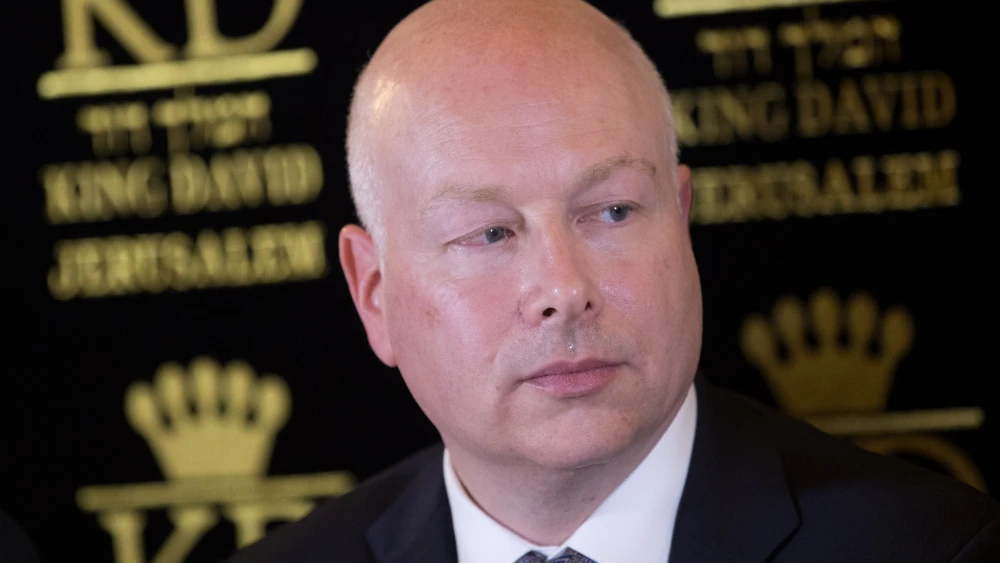
Earlier this month, U.S. President Donald Trump’s special envoy to the Middle East Jason Greenblatt announced his resignation. Among his many achievements, perhaps his most significant may prove to be his involvement in a group that facilitated the death of the Oslo “peace process” framework and created the space for new paradigms for addressing the broader Arab-Israel conflict.
The Oslo Accords, signed 25 years ago, were meant to be a temporary framework for a final-status agreement that would be agreed upon within five years. In reality, it was the beginning of an industry that has undermined Israel’s legitimacy and distanced any chance for an agreement between the Palestinians and Israelis for at least a generation.
This industry comprises think tanks, consultants, NGOs, international organizations, and career bureaucrats who have made their living on the false premise that an agreement between Israel and the Palestinians is just a matter of straightening out small details.
It’s also an industry worth hundreds of millions of dollars, of private donors and government appropriations that have enriched the wrong people, given false impressions of the likelihood of a settlement, stimulated Palestinian violence and obliterated Israel’s political left.
The Oslo industry is a behemoth, jealously guarding its holy of holies: the “land for peace” paradigm. The Bush administration at one point tried to change the paradigm, but made no progress whatsoever. Oslo quickly swallowed up the idea and regurgitated it as a plan that fit its paradigm.
The Oslo industry has retained its hegemony as the only game in town for the past two decades—so much so that differing ideas and alternate paradigms are met with suspicion. Having been demonized as radical propaganda, alternate ideas are rarely entertained by mainstream publications.
Needless to say, this industry could not have consolidated its power toward the end of the 1990s without help from the Israeli government, which kept the Oslo framework on life support as buses and cafes blew up and pedestrians were gunned down. Indeed, as Oslo was about to breathe its last, the Israeli government shocked it back to life with the unilateral withdrawal from Gaza in 2005, a move that bewildered many.
Into this hegemony and industry entered senior Trump adviser Jared Kushner, Greenblatt and their group. While the details of the political side of the vaunted Trump Mideast peace plan have yet to be revealed, the economic side of the plan—lengthy and detailed—is a case study in how to create the foundations for a prosperous society. It was the culmination of a two-year learning session, trying to draw on the lessons of history. The input of all players was to have a stake in making this plan work.
The Palestinian Authority realized with dismay that it was actually being asked to provide constructive solutions that could help its people, and to internalize that it doesn’t possess an inalienable right to all of Judea and Samaria (i.e., the “West Bank”). Unlike past peace plans, there were no predetermined outcomes, and there was also a penalty for not participating.
By including all the regional actors who bear responsibility for perpetuating the Palestinian quagmire, the Trump peace plan will become a paradigm future U.S. administrations will be unable to ignore. It is not an executive summary that can be easily dismissed as recyclable ideas regurgitated from two decades of failures.
The plan’s strength is that is the product of a real effort to find solutions—efforts based on empirical evidence. Ideology didn’t guide the plan; rather, it has been an effort in conflict resolution, where all sides are consulted. Though future administrations may reflexively shun anything that came out of the Trump administration, intellectually honest statesmen may just be tempted to enter a secure room while nobody is watching, study the plan, and try to build on some of the ideas presented therein.
To be brutally honest, the Trump plan will probably fail, because the P.A.—or any Palestinian leadership—cannot make peace at this juncture, and the generosity of Israeli governments to relinquish large swaths of Israel’s heartland has substantially contracted since then-prime minister Ehud Barak’s 97 percent withdrawal offer in 2001.
In fact, it’s the opposite: Palestinian terrorism, in all its forms—missiles, mortars, suicide-bombers, bus bombs, random shootings, lynchings, kidnappings and more—has convinced many Israelis that there is no peace partner.
There’s no overnight revolution that will change the Oslo paradigm to one that has the potential to work, but should the Trump administration receive a second term, this plan, spearheaded by Kushner and Greenblatt, will become the beginning of a paradigm change that will facilitate a process for more realistic ideas to succeed.
The Trump plan will offer new proposals grounded in reality that will open the gates to new ideas and paradigms—a clear and present danger to the Oslo framework.
And once (and while) that happens, the many ideas and paradigms which have been disparaged, shunned and kept at bay over the past 20 years will begin to enter the public discourse. This will lead to a more earnest and reality-based discussion that can provide for a better future in the Middle East.
When that happens, we can look back and say that it was the hard work of Kushner, Greenblatt and company that first set the process in motion.
Gideon Israel is the founder and president of the Jerusalem-Washington Center, which works to strengthen the relationship between the United States and Israel.
This article is republished with permission from The Daily Wire.