


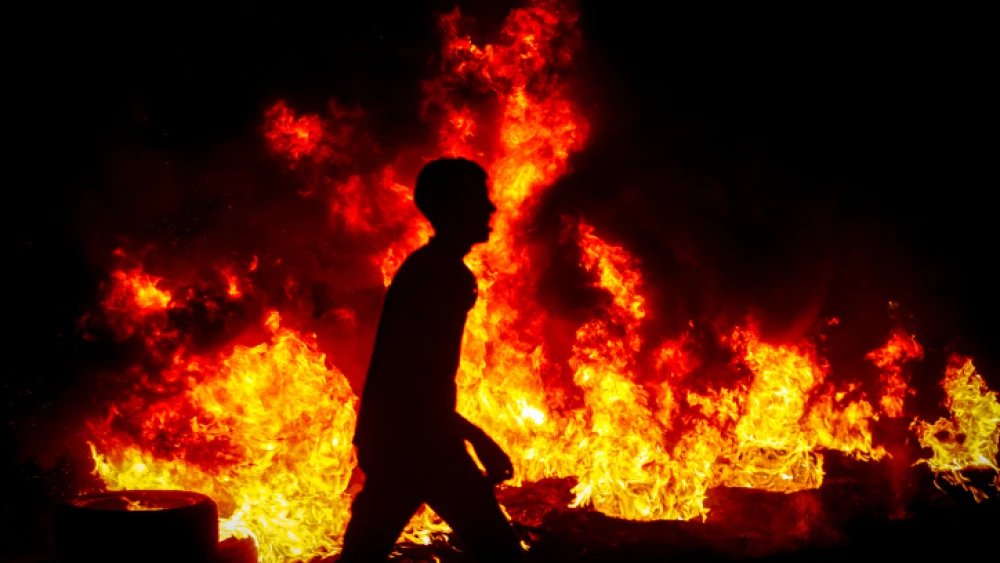
Tensions are high in the Palestinian territories. One could even describe the situation as a powder keg, in particular among young Palestinians, from Jenin in the north to Hebron in the south.
In Jenin, the tensions, the result of various events in recent years, have led to difficult confrontations between hundreds of youths and Palestinian security forces in recent days. Tensions are particularly high following the murder of 21-year-old Mahran Khalilia, a student at the city’s American University, during a brawl with other youths. Numbering in the thousands, his relatives have declared a ban on opening the university, and a majority of its students are now attending classes online.
The degree of tension between the Palestinian public, in particular among the younger generations, and the Palestinian police and security forces is on the rise, and could explode at any minute, resulting in what could transform into an internal Palestinian intifada and a “Palestinian Spring.”
Alongside the difficult economic situation in the territories, the unemployment rate is very high, in particular among academics. Over a year into the coronavirus pandemic, the domestic Palestinian political situation is not at its best either. Elections have not been held for many years, the leaders fulfill their roles without any public support or legitimacy, the Palestinian parliament is irrelevant, the justice system does not work, nor do the police, whose principal task is to maintain the regime’s rule. In addition, the P.A. presidency and its leadership are weaker than ever, and the internal political rift is growing.
All this is leading the Palestinian public to rely on itself and its social leadership, and to revert to tribal laws. This is precisely what led Khalilia’s relatives to join forces and demand such laws be implemented. And according to tribal law, as long as the suspect of a crime remains unpunished, his nuclear and extended family members can be targeted.
To a majority of the Palestinian public, the P.A. is no more than a security mechanism that coordinates security with Israel and maintains P.A. leader Mahmoud Abbas’s and his Fatah’s party rule. It won’t be long before we see a popular uprising that is liable to bring Abbas’s rule to an end in the same way other Arab rulers have had their regimes brought to an end.
Events in the P.A. are likely to spill over into Israel, too. The security mechanisms in Israel and the P.A. are in control of the situation for now but will be hard-pressed to maintain it in the face of a spontaneous uprising.
Special attention must be paid to what is happening in the territories, in particular among Palestinian youths, who can be inspired by others and spark an uprising against their rulers that will alter the situation on both sides of the Green Line.
Jalal Bana is a media adviser and journalist.
This article first appeared in Israel Hayom.


