


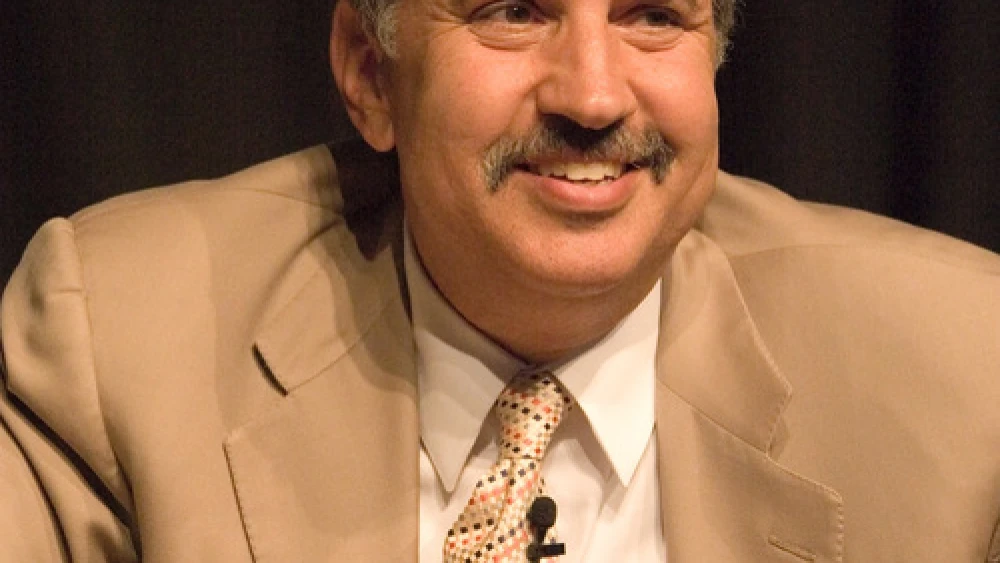

Thomas Friedman long ago became known for his unrelenting criticism of Israel. He was a perfect fit for The New York Times, which has had a Jewish problem—and Jewish publishers—ever since Adolph Ochs purchased the newspaper in 1896. In Friedman’s most recent screed (June 5), his second in 10 days, he criticizes Prime Minister Benjamin Netanyahu for not stopping at “red lights” in his determination to remain in power.
Friedman mirrors his ideological partner, Vermont Sen. Bernie Sanders, who followed a similar trajectory from teenage infatuation with Israel while spending summers working on a kibbutz to Israel-bashing. Friedman has described his high-school years following the Six-Day War as “one big celebration of Israel’s victory.” Indeed, he confessed, his identification with Israel became “insufferable.”
As a Brandeis University undergraduate, on his way to a semester at the Hebrew University, Friedman visited Cairo. Smitten by Arab culture, his embrace of Israel was short-lived. By the time he returned to Brandeis, his once passionate embrace of the Jewish state had yielded to the sharp criticism that has flowed through his writings ever since. Friedman joined a left-wing “Middle East Peace Group” that discounted PLO terrorist attacks against Israel as “not representative” of Palestinians. Endorsing Palestinian statehood, it blamed Israel for Middle East instability.
Serving his apprenticeship as a Times reporter in Lebanon, Friedman was stunned by the massacre of Palestinians—not by Israelis but by Lebanese Christians. Nonetheless, he lacerated the Israeli commander, demanding to know “How could you do this to me, you bastards?” On the front page of the Times, he subsequently confessed, “I buried ... every illusion I ever held about the Jewish state.” He did not mention that he had also buried any commitment to responsible journalism.
Returning to Washington in 1988, Friedman embraced a moral equivalence between Israeli soldiers and Palestinian terrorists. Berating Israel for its “occupation” of “Palestinian” land (biblical Judea and Samaria), he fantasized that his repetitive enumeration of Israel’s failings helped the Jewish state to preserve its moral integrity. His decades-long contributions as a Times columnist have reiterated that self-justifying fantasy.
So it came as no surprise that Friedman’s recent column (June 5) celebrated Netanyahu’s imminent departure as Israel’s longest-serving prime minister. Placing the worst insult first, he described Netanyahu’s ability to make his enemies “even angrier than Donald Trump does.” Indeed, Friedman continued, Netanyahu “was perfectly happy to undermine Israel’s democratic institutions, the press and the rule of law—anything that could restrain his quest to retain power.” He is even “ready to take Israeli society to the edge of civil war to hold on to power.” In his nightmare scenario, Friedman anticipates that “Bibi and his cult followers will ruthlessly use every trick in the book—and out of the book—to stop this transition of power.”
In Friedman’s imagination, the anti-Netanyahu coalition is “the Israeli version of Bidenism”: “a movement of people who believe that society has to repair its torn political fabric ... and restore respect for institutions and for one another.” Bibi, responsible for tearing apart Israel’s political fabric, will finally fade away. Once the new government assumes power and restores “the health of Israel’s democratic institutions, so badly stressed in the Bibi era,” Friedman hallucinates that even peace with Hamas might be forthcoming.
Thomas Friedman notwithstanding, historians are likely to highlight the “Three B’s”—Ben-Gurion, Begin and Bibi—as unmatched political giants in the history of Israel between 1948 and 2021.
Jerold S. Auerbach is the author of “Hebron Jews: Memory and Conflict in the Land of Israel” and “Print to Fit: The New York Times, Zionism and Israel 1896-2016,” which was recently selected for Mosaic by Ruth Wisse and Martin Kramer as a “Best Book” for 2019.



