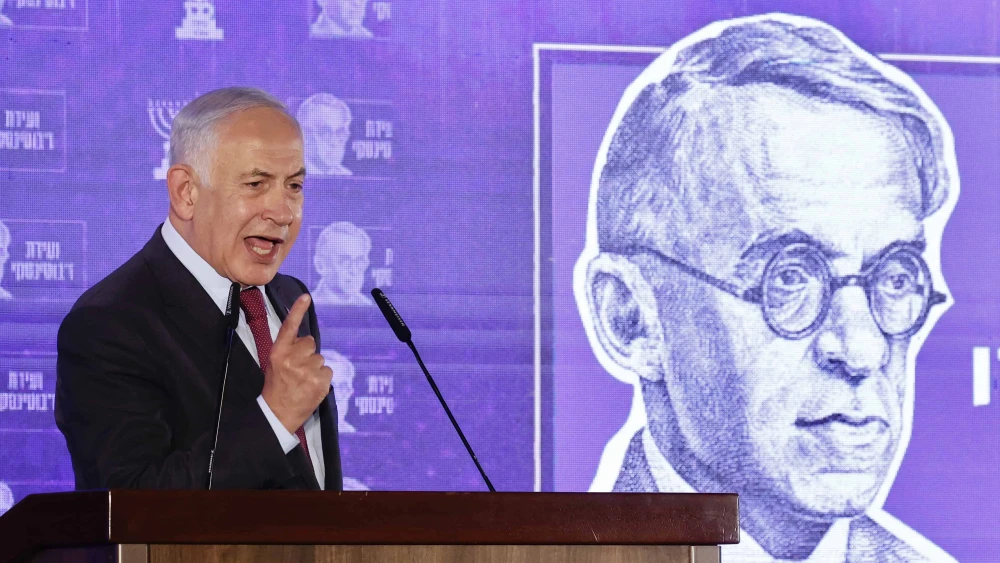

It is a dangerous time to be a Jew.
In Israel, the nation is engaged in what may prove to be the most decisive war in its history—a war that began on Oct. 7, 2023, when Hamas overran its Gaza borders, and slaughtered 1,200 people and kidnapped 251 more. As a result, Jews everywhere again have confronted a familiar pattern: rising antisemitism, moral equivocation and the rapid erosion of the protections that liberal societies once promised were permanent.
More than a century ago, Revisionist Zionist leader Ze’ev Jabotinsky understood this with unsettling precision. Writing in 1910 after racial violence in the United States following the victory of black boxer Jack Johnson over white boxer James J. Jeffries, he described a republic that proclaimed liberty while systematically degrading millions.
His conclusion was not merely descriptive, but diagnostic: Homo homini lupus—man is a wolf to man. This was not rhetoric. It was a rejection of the central illusion of modern politics—that structures alone restrain human hostility.
Jabotinsky argued that rights persist only where they are defended and that equality exists only where it is enforced.
From this premise emerged his doctrine of the Iron Wall, Israel’s current and forever defense police: not aggression for its own sake, but the creation of an undeniable fact of strength so absolute that it compels recognition. Today, Israel cannot be moved. Israel is a nation with overwhelming, unassailable strength—military and political—and its enemies can choose to attack and destroy it, though they will suffer.
Perhaps in time, as a result of that doctrine, Israelis can achieve genuine negotiations and peace. This is the axis on which the present turns.
The confrontation with Iran is not a peripheral one, nor is it a misunderstanding. It is essentially a statement that the United States and Israel will not accept vulnerability in the face of barbarism.
Jabotinsky would not have entertained restraint if faced with openly declared annihilationism. But he also carries a second, often neglected implication: Strength must be anchored in a universal claim, and every individual possesses irreducible dignity. His insistence that “every man is a king” was the moral justification for power. A state that defends itself does so as the guarantor of that dignity for its citizens.
From that perspective, the Iranian regime and the Iranian people are not identical. The former rests on coercion; the latter endures it.
Jabotinsky, who recognized both the brutality of mobs and the aspirations of individuals trapped within them, would have realized that the Iron Wall is directed at regimes that are terrible, not at the populations that suffer under them. And yet he would also have understood that history requires action and urged the Iranian people to rise up, just as Israeli Prime Minister Benjamin Netanyahu, a student of Jabotinsky, does today.
Jabotinsky’s warning remains intact and perhaps more urgent than when first written: Those who entrust their survival to the conscience of others misunderstand the structure of history. Justice must be secured, defended and, when necessary, imposed against those who would erase it.
To safeguard Jabotinsky’s legacy is to apply it. It is to recognize that Jewish sovereignty is not simply a political achievement, but a permanent obligation—to ensure that the conditions of Jewish defenselessness never return. And it is to accept that in a world that repeatedly descends into predation, the refusal to wield power is not moral restraint but strategic negligence.
So, as Israelis sit in bomb shelters throughout the country, they also proudly recognize that a Jewish army fights proudly and strongly for the Jewish nation and the Jewish people. They are following the lessons of the great Ze’ev Jabotinsky.