Newsletter
Newsletter Support JNS

Palestinian National Council renounces all agreements with Israel, including Oslo

Despite the announcement, nothing has seemingly changed on the ground; the PLO and the Palestinian Authority have not said they were stopping security coordination.

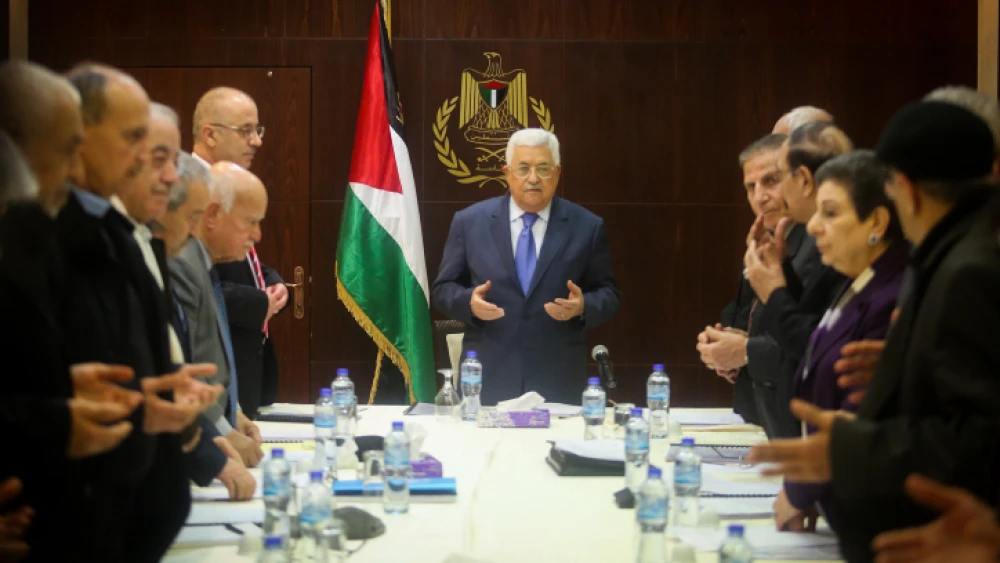
Palestinian Authority leader Mahmoud Abbas at a meeting of the executive committee of the Palestine Liberation Organization in the city of Ramallah in the West Bank, on Feb. 13, 2017. Photo by Flash90.

Palestinian National Council deputy chairman Ali Faisal said there is a binding Palestinian decision to “renounce ... all agreements with Israel.”

According to a report by Palestinian Media Watch, Faisal also said that from the Palestinian leadership’s point of view, the Palestinians “have entered a path of resistance in all its forms,” indicating that this includes violence as well.

“The decision of the [Palestinian] National Council was a recommendation to the [Palestinian Liberation Organization] Central Council to renounce all the commitments of the Oslo Accords and stop the security coordination [with Israel],” stated Faisal.

“The Central Council decided to renounce the commitments of all the agreements with the State of Israel, whether by the PLO or the Palestinian Authority,” he added.

The PNC is the top authority in the PLO, and it formulates policies and programs.

According to PMW, despite the announcement, nothing has seemingly changed on the ground; the PLO and the P.A. have not said they were stopping security coordination.

“I think they allowed it to go on too long—the protests, everything,” Jonathan (“Jay”) Sures, one of 26 regents of the public school system, told JNS.
“It’s not about improving Israel’s image. It’s not about fighting back the media war,” Talia Dekel-Fleissig told JNS. “It’s about making sure that the public understands what’s actually going on.”
The film was also nixed by both of Australia’s national public broadcasters.
“It’s not a decisive shift to a new phase of the war,” Jason Brodsky, policy director at United Against Nuclear Iran, told JNS. “Rather it is a reminder that the U.S. has the will to police the Strait of Hormuz.”