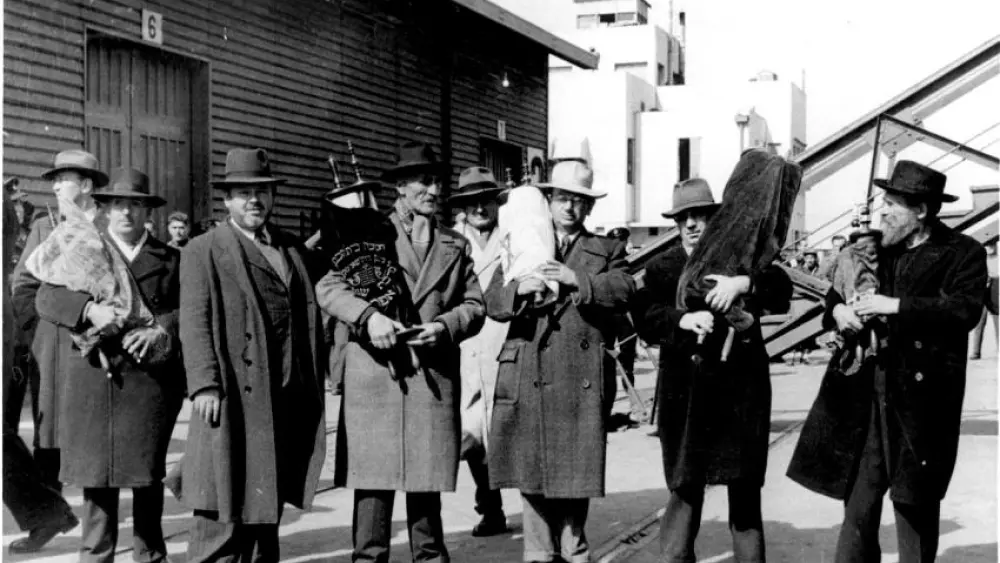
Several U.S. senators and representatives sponsored the fifth annual Congressional Holocaust Commemoration, held under the theme of “Jewish Refugees in the Far East and Beyond.”
Sephardic Heritage International-DC (SHIN-DC), which focuses on “Sephardic and other under-represented Jewish communities in international affairs,” organized Thursday’s event, held at the Hart Senate Building in Washington.
Franz Afraim Katzir is the director of SHIN-DC, the State of Maryland’s commissioner for Middle Eastern American affairs and the founder of the Sephardic Heritage Project. He said he was happy that the event was able to resume in person following Zoom meetings held during the coronavirus pandemic.
“This program will build on our pandemic-time 2021 commemoration,” Katzir said ahead of the event, referring to when Pfizer chairman and CEO Albert Bourla shared his family’s harsh experiences during the Holocaust.
Bourla is a Greek-American Jew who led the international effort to develop a COVID-19 vaccine.
This year’s event also built on the 2022 commemoration that featured “David Baruch, a Greek Holocaust survivor, Nobuki Sugihara, son of Righteous Among the Nations Japanese diplomat Chiune Sugihara…and Nat Lewin, a Holocaust survivor who received his transit visa from Mr. Sugihara,” Katzir said.
The speakers included Eric Kisch, who was born in Vienna in 1937 and whose family obtained visas to move to Shanghai.
“It was a terrible time for the adults,” Kisch told the attendees. “But for the children, we had a lot of fun. We were able to roam around the city…we even collected shrapnel from bombings.”
Kisch also remembers the hardships. Flooding from monsoon rains was common, rendering the extreme poverty of the refugees even more difficult. An Allied air raid on the city on July 17, 1945, accidentally killed many Jewish refugees and caused untold destruction to their homes.
Well-established Sephardic business families such as the Kadoories and the Sassoons helped to ease the financial situation for the refugees.
Another speaker was S. David Moche, the son of Baghdadi Jews who had moved to Kobe, Japan. His family helped the Sephardic Jewish community improve the lives of European Jewish refugees to Japan who had been granted exit visas by Chiune Sugihara, the empire’s vice consul in Kaunas, Lithuania.
Moche lived in Japan for most of his life. “There is no antisemitism in Japan,” he told the audience. “The Japanese for years didn’t come forward with how they had saved so many Jews. They had simply seen [Sugihara’s stamp on] the immigration documents and allowed people in. They warned us of incoming Allied air raids so our women and children could escape to the mountains.” Moche also shared pleasant memories of growing up as a Jewish child in Japan.
Tomoaki Ishigaki, minister for congressional affairs at the Japanese embassy in Washington, spoke of the importance of Holocaust commemoration, noting he had visited countless Holocaust museums and memorials worldwide.
Other speakers at the event included Adam Neufeld of the Anti-Defamation League, who highlighted the importance of continuing Holocaust education as the years go on; U.S. Senator Ben Cardin of Maryland, who (via pre-recorded message) highlighted the importance of fighting antisemitism at a time when it is becoming normalized throughout the Western world; and ambassadors from Morocco, Greece, Turkey, Bulgaria, Germany, Israel, Austria and Japan, who all joined Holocaust survivors and their families in lighting memorial candles.
The event concluded with the Trio Sefardi ensemble, protégés of the Sephardic singer Flory Jagoda, who was a Holocaust refugee from Bosnia and died in 2021. The ensemble played two songs to commemorate the destruction of Sephardic Jewry in the Balkans.