Authentic Israeli and Jewish stories matter now more than ever. Film, television, social media, literature—all wield soft, nuanced, human power to push back against a Pew Research Center survey this spring finding that 60% of Americans view Israel unfavorably.
At its gathering from Nov. 12-15 in San Diego, the Jewish National Fund-USA’s Global Conference for Israel: 125 Years and Just Getting Started! spotlighted some of the Jewish community’s most powerful storytellers, using their creative genius to speak their truths to antisemitic and anti-Zionist narratives.
San Diego’s legendary sunshine broke through gray rain clouds to warm as many as 3,000 conference-goers, primarily from around the United States and Israel.

Laid-back San Diego vibes established an upbeat mood unperturbed by a handful of protesters from the fringe hate group Westboro Baptist Church on Friday, the first full day of the conference. A woman shaded by a pink bonnet wore a powder-blue T-shirt emblazoned with “Jews Killed Jesus” and an Israeli flag wrapped around her waist.
“Those Westboro people hate everyone but themselves,” said a member of JNF’s security detail, keeping a close eye on the
Gaylord Pacific Resort & Convention Center’s heavily guarded front entrance.
Ever since the Hamas-led terrorist attacks in southern Israel on Oct. 7, 2023, the organization has invested in security measures and law enforcement to keep the thousands of people drawn to support Israel safe. The conference held in Denver just weeks after Oct. 7 drew protesters who screamed at attendees, at one point throwing stones at the venue and cracking a glass window. As much as $1 million was spent on 100-plus heavily armed tactical police.
This year, three levels of security protected attendees: San Diego Police Department officers in SUVS, hotel security guards and private JNF security.
The event welcomed 300 college students; some 200 high school students, including Muss High School Israel alumni; young adults; longtime supporters; and newcomers. Also attending were dozens of the organization’s Israeli affiliates and more than 22 mayors, government officials and regional leaders from both Israel’s north and south. More than 40% of attendees were under the age of 40.

‘We are here for you in this battle’
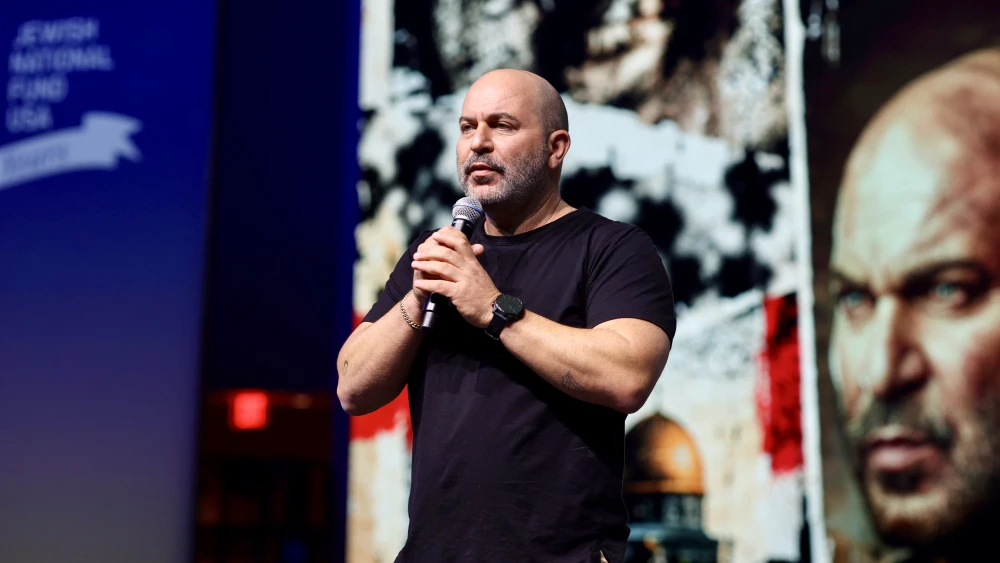
On a brighter note, attendees heard from renowned speakers, including international Israeli TV star Lior Raz (the co-creator and main actor on the Israeli hit series “Fauda”); award-winning Jewish-American author Dara Horn (People Love Dead Jews and The Final Solution to the Jewish Question: A Love Story for the Living); and Ben Carasso, an 11-year-old Israeli wunderkind activist and social-media influencer.
Raz has become a global sensation/sex symbol for playing the role of Doron Kabilio, the muscular commander of an elite undercover Israeli counter-terrorism unit, as part of the action thriller “Fauda” (Arabic for “chaos”) streaming on Netflix. Two episodes in Season 5, released in October, cover some of the events of Oct. 7 with stark realism.
Raz told the JNF attendees crowding to hear him, “We never realized how big ‘Fauda’ would be. It’s a ‘top 10’ show in so many countries around the world, Arab countries, too—in Lebanon, it’s No. 1.”
“Why do so many people love the show?” he asked rhetorically. “Because we are ready for peace more than our governments are ready for peace.”
He said he takes pride in the “Fauda” team’s powerful depiction of Oct. 7. “People watching the show understand Oct. 7 really happened and that Israel is in trauma from it,” he said, a fact many Americans have not experienced firsthand.

Tourism to Israel declined by nearly 70% in 2024 following the events of Oct. 7—falling from 3.01 million visitors in 2023 to 961,300 in 2024. Repeated regional military escalations disrupted partial tourism recoveries in 2025 and 2026, and Israel’s tourist economy continues to suffer.
Raz had advice for the American conference audience: “If we said racism instead of antisemitism, people would understand more what we’re facing.” He emphasized the need to fight back. “We’re not in the 1940s anymore. When we take a mezuzah off the door, this is how we lose. They have to know we are here, and we are strong.”
He made three asks of American Jews. The first, to be proud Jews and speak up against claims that Israel is committing genocide. Second, specifically to business owners, to ask their human-resources staff to comb through employees’ social-media posts and fire anyone who supports Hamas. And third, to stop donating to universities that support the anti-Israel BDS movement.
Raz concluded by saying, “We Israelis are here for you in this battle.” The audience gave him a resounding ovation, as he turned his back to take a selfie with his multitude of fans.
A panel titled “Israel in Focus—Film, Television, and Global Impact” following Raz’s talk included Israeli actress Swell Ariel Or, star of the hit Netflix series “The Beauty Queen of Jerusalem.” The 27-year-old made a salient point regarding the nature of Israeli film and television, saying “we are the only country in the Middle East where we are allowed to use film and TV to explore freely, where it’s not propaganda, and there’s no censorship.”

‘So much more ignorance than malice’
No contemporary conference is complete without a panel exploring social media. JNF-USA offered a particularly insightful discussion titled “From Likes to Leadership: The Power of Social Media in Shaping Israel’s Future,” featuring 11-year-old activist and influencer Ben Carasso (aka the “spokeskid” of Israel); Yechiel Jacobs, Israeli comedian and content creator; and Eli Wininger, a 34-year-old native Los Angeleno, Israeli Defense Forces Special Forces veteran and ultra-marathoner.
Wininger explained that he returned to Israel after Oct. 7 to defend the country, not to become an activist or an influencer. But after he heard Israel being called a genocidal monster, he decided to speak out. “Everyone has a phone and can advocate,” he said.
The reality on the ground he experienced in Gaza conflicted with claims of genocide. “In Gaza, I saw fellow Israeli soldiers almost die running into buildings to save Palestinian families, and I had to tell that story,” he said.
Comedian Jacobs created humorous pro-Israel videos to break through anti-Zionist spaces after Oct. 7. He now has 1.7 million followers from all over the world on his social-media accounts. “Israelis told me my content gave them permission to laugh after Oct. 7,” Jacobs said.
Cherubic-faced, young Israeli Carasso stole the show with his preternatural wisdom expressed in clear English. He posted his first video online addressing the Oct. 7 invasion when he was 8. The poignant video reflecting the attack’s toll through a child’s eyes went viral.
But even a child can’t escape the hate of online trolling.

“Someone commented on one of my posts that I should go to Auschwitz like my grandfather. But I don’t let them take me down,” he said. Carasso’s resilience and tenacity led the Israeli Citizen Spokesperson’s Office to name him the “Official Spokeskid for Israel.” His content is available on YouTube and Instagram.
The recipient of three National Jewish Book Awards, novelist and essayist Dara Horn ranks as one of American Jewry’s most respected contemporary writers. Her provocatively titled 2021 essay collection People Love Dead Jews created a sensation for its brilliant analysis of resurgent antisemitism. Horn dominated the conference main stage late Friday, telling the rapt crowd that after the book was published, “Every Jew in America came to me with horror stories and asked for help.”
These pleas led to the September release of her second essay collection, The Final Solution to the Jewish Question: A Love Story for the Living. It argues that Judaism is a 3,000-year anti-tyrannical, countercultural movement and that antisemitism—fueled by tyrants since ancient times—is the Big Lie that “Jews are responsible for destroying whatever a society values the most.”
She said she believes that “there’s so much more ignorance than malice to antisemitism in America, which leads to an opportunity to educate.”
Horn said the response to People Love Dead Jews “dragged” her into “the solution business,” and led her to create The Tell Institute to reframe what students and the broader public know about Jewish civilization; the dynamics of 2,200-plus years of antisemitism; and the ideas that shape free pluralistic societies.
Three days of speakers and presentations come down to one main idea: shared futures.
As Russell F. Robinson, the organization’s CEO, summed up: “This is what leading the way looks like. Nearly 3,000 people here, and thousands more watching at home, coming together as one people, one movement, for one extraordinary mission.”