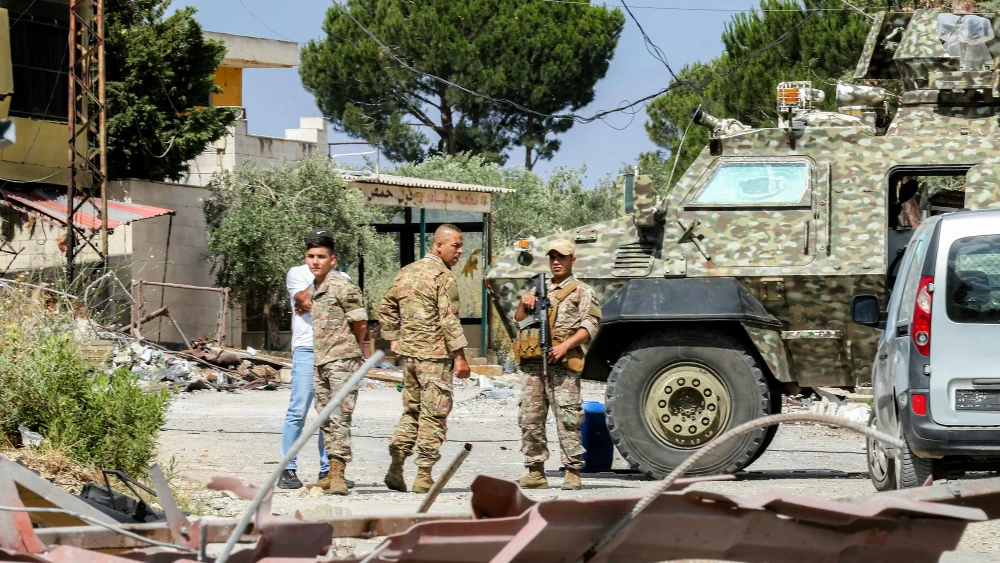

As Western nations led by the United States and including the Netherlands, France, Germany and Britain explore initiatives to train and equip the Lebanese Armed Forces, Israeli observers are warning that providing weapons and tactical instruction will not be enough to enable the LAF to overcome Hezbollah.
The international effort aims to transform the Lebanese military into a force capable of taking sovereign control of the country and dismantling Hezbollah’s remaining terror infrastructure, while being able to stand up to terror operatives.
However, analysts argue that the success of this monumental task hinges not just on military hardware, but also on the political courage of the Lebanese government, the sectarian loyalty of the rank-and-file soldiers, and the willingness of the LAF to engage with Hezbollah operatives.
More than arms and training
Lt. Col. (res.) Orna Mizrahi, a senior researcher at the Institute for National Security Studies in Tel Aviv and former deputy national security adviser for foreign policy, said that international backing is crucial, but it must address the deep-rooted systemic issues within the Lebanese military.
“It is good and nice that they are giving them capabilities in terms of means, meaning equipment and weapons, but it is not enough,” Mizrahi told JNS. “It is not enough to just give them equipment and weapons; they need help in other dimensions.”
She explained that beyond the functional training of troops, the international coalition must tackle the complex issue of troop identity and vetting.
“There needs to be an assessment of who is handling Hezbollah, ensuring that they are not people affiliated with Hezbollah or working for it, but rather people whose loyalty is given to the state and to the state’s interest in dismantling Hezbollah and implementing the framework agreement with Israel,” Mizrahi argued.
The challenge of loyalty
A major obstacle to this institutional loyalty, she noted, is the severe economic disparity between the Lebanese state and Iranian-backed proxies.
“One of the important things is, of course, is raising salaries. Today, a soldier in the Lebanese army receives a quarter of the salary of a terrorist or militant. They receive about four times as much as Lebanese army soldiers,” Mizrahi said.
She added that there was previously no reason for Shi’ites to join the army instead of working for Hezbollah, which paid them significantly more and provided them with comprehensive socioeconomic services.
Addressing reports that a specialized unit is being formed within the Lebanese army to handle Hezbollah, Mizrahi cautioned against repeating historical sectarian Lebanese mistakes.
“We must always be careful that it is not only Christians and that it does not become a reflection of what happened with the South Lebanon Army in its time,” she cautioned, referring to the armed force established by Israel in the 1980s that served as an ally to help control the previous security zone. “It needs to be a force that represents the Lebanese state, which relies on components from the entire population,” she stated.
For the Israeli defense establishment to trust the Lebanese military, Mizrahi argued, the IDF and the Israeli public need to see actual combat friction between the Lebanese military and Hezbollah.
“Israel will want to see that there is a true commitment to carrying out the mission, even to the point of a willingness to reach violent clashes with Hezbollah, and not doing it only in peaceful ways as has happened until now,” Mizrahi stated.
She added that strong American oversight is required to ensure Hezbollah does not rearm or return to the area, noting that Israel desires a direct military dialogue with the Lebanese army under American supervision, though the Lebanese side currently maintains reservations about that happening.
No quick fix
Maj. Gen. (res.) Eyal Ben-Reuven, a former deputy commander of IDF Northern Command and an ex-head of IDF military colleges, told JNS, “The current Lebanese government, and the weakness of Hezbollah, alongside the closure of the Syrian axis and the situation in Iran, constitute a perhaps one-time opportunity to change the situation in Lebanon.”
He cautioned, however, that Western training programs must be paired with realistic expectations and long-term strategic patience.
“Bringing the Lebanese army to an effective operational capability depends on the will, readiness and patience for a change that is not achievable in a quick fix,” he argued. “Diplomatic and military coordination work is required, based on an agreement that the IDF, in addition to its role as the defender of Israel, also supports the Lebanese army in its action against Hezbollah, in military activity, in training, and in weapons.”
Ben-Reuven emphasized that American backing is vital not just for strengthening the LAF but for providing the economic lifeline necessary to encourage the Lebanese government and public to support a sovereign agenda. This agenda, he said, must include Lebanese recognition of Israel, taking territorial responsibility based on Lebanese army forces, and weakening Hezbollah to the point of dismantling its main power.
He added that while Israel must remain prepared for crises during this process that could require comprehensive Israeli military solutions, the ultimate goal should be progress toward realizing an agreement between the states.
“The leading criterion must be real activity in the field,” he said. “A willingness to act that is composed of capability, and military and governmental courage to act against Hezbollah. An additional criterion is cooperation with the American inspector, as well as continuous dialogue between military commanders and statespersons to solve problems.”
Ben-Reuven stressed that terror infrastructures must be destroyed, preferably by the Lebanese force, and that future activities by Hezbollah must be outlawed.
“It is clear that right now we seem far from that possible reality, but this should be an agreement that we strive for, and as stated, out of an understanding that the deal’s realization is a long-term process,” Ben-Reuven concluded.
A changing strategic landscape
Col. (res.) Barak Ben-Zur, a former IDF Military Intelligence officer and ex-head of a research unit at the Israel Security Agency (Shin Bet), said that the combination of Israeli military pressure and regional strategic changes has forced a reckoning that could make initiatives such as rebuilding the Lebanese army more viable.
“The Shi’ite community in Lebanon is at a crossroads for the first time since the formation of the strategic connection with the Khomeini regime in Iran, with Syrian consent, very close to the revolution in Iran in 1979,” Ben-Zur stated.
He outlined a series of significant changes in recent years that have isolated Hezbollah and degraded its operational capabilities, beginning with its primary patron.
“Iran is in a violent conflict with the U.S. and its allies in the region. In this conflict it absorbed, and is absorbing military blows, which makes it difficult for it to transfer continuous support to Hezbollah,” Ben-Zur assessed.
The collapse of the traditional logistics and smuggling routes in Syria with the fall of the Assad regime has further harmed the terror organization’s position.
“The dismantling of the Bashar Assad regime and the rise of a force hostile to Iran and Hezbollah—the Sunni Ahmed al-Sharaa government in Syria—brought about the loss of many assets,” he added, listing the loss of military and intelligence presence in Syria, the severing of the open corridor for transferring personnel and weapons, and the cessation of extensive economic assistance.
Ben-Zur pointed to the devastating kinetic damage inflicted directly upon Hezbollah by the IDF in recent months as the catalyst for internal Lebanese political shifts.
“Hezbollah suffered a military and moral blow from Israel, the most severe since its establishment,” Ben-Zur assessed. “The other factions in Lebanon learned about Hezbollah’s situation faster than other elements learned it, and one of the immediate results of this is the tightening of the connection with the U.S.”