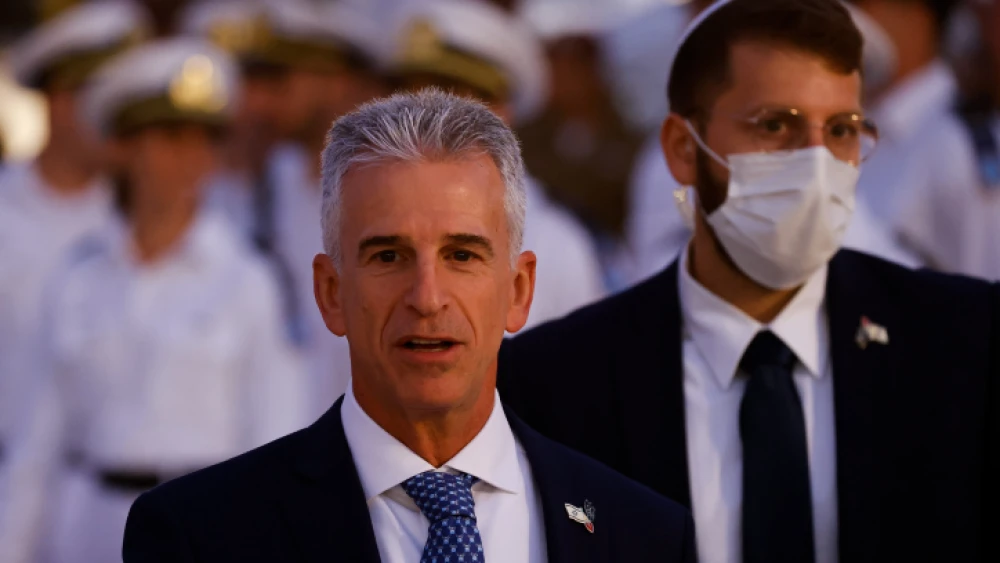
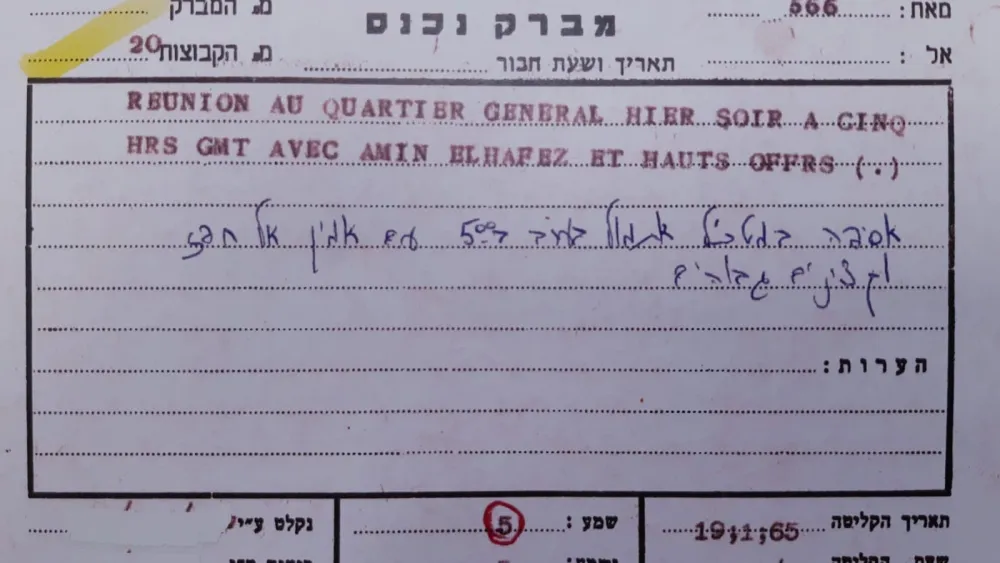
Mossad Director David Barnea on Monday publicly revealed for the first time the last telegram the intelligence agency received from spy Eli Cohen prior to his capture in Syria.
The telegram, which was revealed during the dedication of the Eli Cohen Museum in Herzliya, is dated Feb. 19, 1965, the day on which Cohen is believed to have been captured. In it, Cohen reports on a Syrian General Staff meeting held the previous evening with the participation of then Syrian President Amin al-Hafez.
“I will honor this holy place and reveal, for the first time, following in-depth research that was carried out recently, that Eli Cohen was not captured due to the quantity of his transmissions or pressure from headquarters to transmit too frequently,” said Barnea. “Eli Cohen was captured because his transmissions were simply intercepted and triangulated by the enemy. This is now an intelligence fact.”
Cohen’s capture has been the subject of conjecture over the years, with some arguing that he was caught because the Mossad demanded that he transmit too much information, compromising his position.
“Eli Cohen was among our best agents,” said Barnea. “He continues to influence us and instill in us a fighting spirit, courage, values and devotion—even from the depths of history,” said Barnea. “He is a source of inspiration not only to today’s agents but to all Mossad employees in their various positions. We all learn from him, even today. From his Zionism, his sacrifice and his dedication.”
The Mossad will give the museum a copy of Cohen’s last telegram; the original will be kept in Israel’s National Archives.