The United Nations has repeatedly said that it won’t fire Francesca Albanese, its special rapporteur for the Palestinians, despite her repeated antisemitic statements, because she is one of what it considers its “independent experts.”
After Albanese referred, in remarks about Israel, to a “common enemy of humanity,” which was widely seen as a remark about the Jewish state, the top diplomats in Austria, Germany and Italy called for her resignation. In recent days, France has also said that she should be dismissed.
The Italian foreign minister stated in Italian that Albanese’s “conduct, statements and initiatives are not appropriate for the position she holds within an organization dedicated to peace and security.” The Austrian foreign minister wrote in German that the U.N. adviser “spreads incitement” in a way that “undermines the impartiality and highest standards that the role of a U.N. representative requires.”
The German foreign minister said, also in German, that Albanese “has made numerous inappropriate remarks in the past” and is “untenable in her position.”
France’s foreign minister made a similar statement on Wednesday, referring to Albanese’s “outrageous and reprehensible remarks” directed “not at the Israeli government, whose policies may be criticized, but at Israel as a people and as a nation, which is absolutely unacceptable.”
Jean-Noel Barrot, the French minister, added that Albanese is “a political activist who stirs up hate.” France will demand her resignation “with firmness” at this month’s U.N. Human Rights Council session.
Albanese said this week that her remark referred to a “system” that allowed a “genocide” to take place in Gaza.
Speaking last Saturday via video conference at a forum organized by Qatar’s Al Jazeera network in Doha, she accused Israel of the “planning and making of a genocide.”
“It’s also true that never before has the global community seen the challenges that we all face, we who do not control large amounts of financial, algorithms and weapons,” she said.
The belief that Jews control wealth and technology is considered widely to be antisemitic—in fact, an age-old trope that has rippled across the world.
Albanese also said Western media defends Israel by “amplifying the pro-apartheid, the genocidal narrative.” (The forum included a senior Hamas official, Khaled Mashal, and the Iranian foreign minister.)
Albanese’s long record of antisemitism, which the American, French and German governments have decried, includes accusing the Jewish state of using dogs to commit rape and stating that Washington is “subjugated by the Jewish lobby.” She has yet to delete a public post in which she suggested that a newspaper reporter that a Palestinian doctor was raped in Israeli prison. The paper made no such claim.
In July, the Trump administration sanctioned Albanese after she intimidated American companies doing business in Israel.
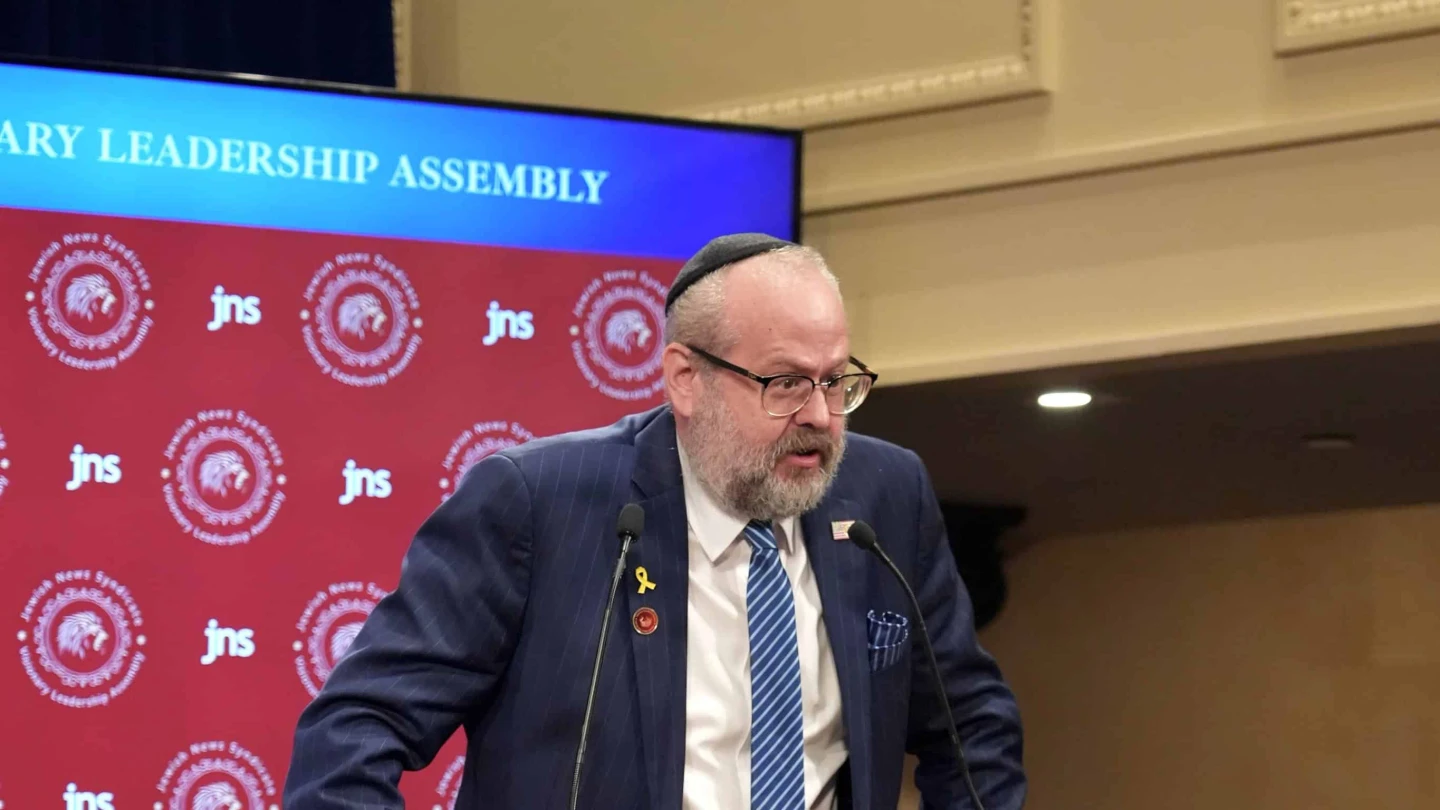
Stéphane Dujarric, spokesman for U.N. Secretary-General António Guterres, spoke to reporters about Albanese on Thursday.
“We don’t agree with much of what she says,” he said. “We wouldn’t use the language that she’s using.”
“If member states are not happy with what one or more of the special rapporteurs are saying, it is their responsibility to get involved in the work of the Human Rights Council, to get involved and push for the direction they wish to push for,” he said.