In a break from longstanding tradition, the rabbi, cantor and ritual director at Congregation Shaarey Zedek, a large Conservative synagogue in Southfield, Mich., penned a letter to the congregation’s 1,000-member households urging everyone, Democrat and Republican alike, to vote in the Aug. 4 Democratic Senate primary.
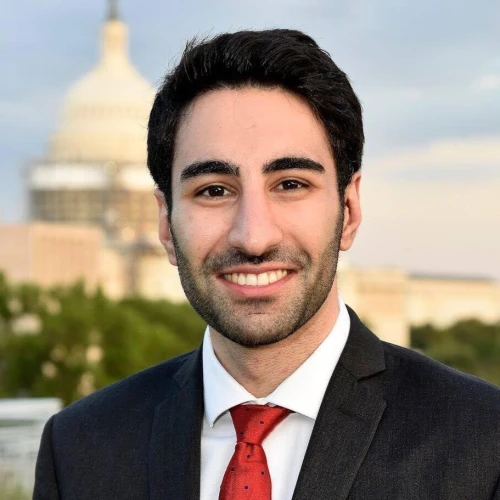
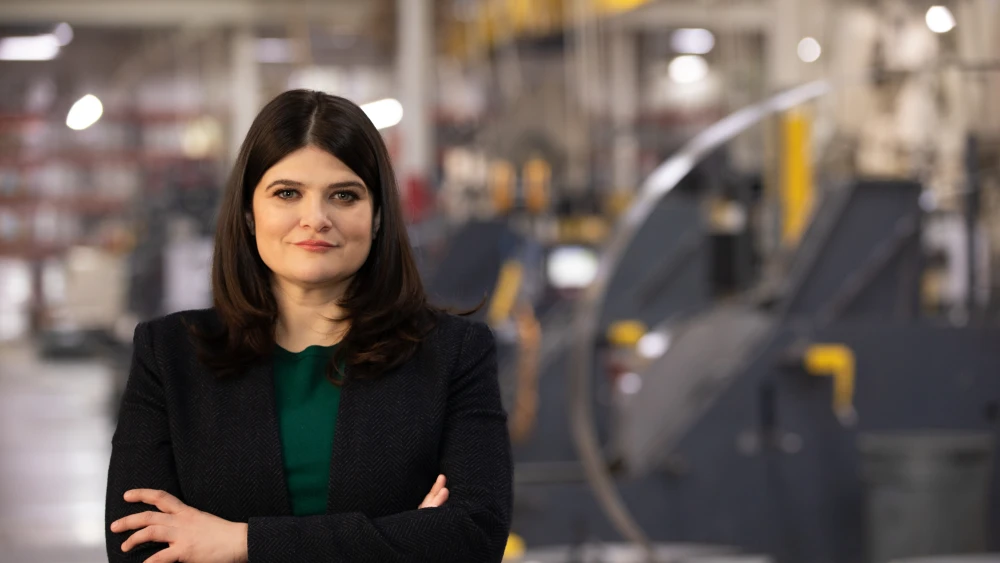
Rep. Haley Stevens (D-Mich.), whom AIPAC has endorsed, is running against Dr. Abdul El-Sayed, a former Detroit public health official who has accused Israel of “apartheid” and “genocide.”
The day after Oct. 7, before the Israeli military entered Gaza to root out Hamas, El-Sayed stated that “Attacking civilians is vile. I condemn it. Full stop. But all civilians, right?”
“The Israeli military is about to unleash on innocent civilians in Gaza, as it has over and again,” he stated. “If you really condemn attacks on civilians, don’t go silent when they are Palestinian civilians.”
Rabbi Aaron Starr, rabbi of Shaarey Zedek and president of the Michigan Board of Rabbis, told JNS that Stevens, who is serving her fourth term representing an area north of Detroit, has been “an ongoing friend of the Jewish community.”
“She called me after Oct. 7, and I have hosted her in my home for Passover Seder,” he said. “She genuinely cares about the lives of all Americans and is not engaged in the rhetoric of hate and division.”
Starr declined to speak directly about El-Sayed except to say, “Look at what he says about ‘genocide’ and who his funders are.”
“If it’s Stevens against the Republican candidate, Stevens is more likely to win in November,” the rabbi told JNS. “But she has to win the nomination first.”
In their letter, Starr and colleagues wrote that they “believe this election carries unusual significance for the Jewish community.” They didn’t name either candidate but wrote that they were asking congregants to take part in the Democratic primary, which is open, meaning those who aren’t registered Democrats can still vote.
They urged members to “support in this primary the candidate whose record, actions and rhetoric demonstrate the strongest commitment to protecting Jewish lives by combating antisemitism, seeking federal security funding for American Jewish communities and supporting Israel’s security and right to exist as a Jewish state.”
The March 12 truck-ramming attack against Temple Israel, a Reform congregation in West Bloomfield Township, a Detroit suburb, took place about 10 miles from Starr’s synagogue.
“We recognize that this request is unusual,” the trio wrote. “Synagogues should not become partisan institutions, and reasonable people can disagree on many political issues. Yet there are moments when issues affecting Jewish safety and security rise above ordinary political considerations.”
Starr told JNS from Jerusalem, where he is studying at the Shalom Hartman Institute, that the American Israel Public Affairs Committee has “become a litmus test for Democratic politics across the country.”
“Americans should be far more nervous about the influence of foreign governments, like Qatar and China, in our education and politics, but AIPAC is singled out,” he said. “When it is, it is a dog whistle suggesting that Jews have too much power and influence.”
Recent polling in the race has suggested that El-Sayed leads Stevens by an average of about five percentage points, but Mallory McMorrow, a Michigan state senator who dropped out of the Senate race on July 5, has polled at about 7.7% on average, more than the gap between the other two candidates.

Like Zohran Mamdani, mayor of New York City, El-Sayed is a progressive Muslim, but unlike Mamdani, he is not a democratic socialist.
Sens. Bernie Sanders (I-Vt.) and Chris Van Hollen (D-Md.) have endorsed El-Sayed, as have Reps. Alexandria Ocasio-Cortez (D-N.Y.), Ro Khanna (D-Calif.), Rashida Tlaib (D-Mich.), among other members of Congress.
“I oppose direct blank-check funding to foreign militaries—including Egypt, Israel, Saudi Arabia, the UAE and others,” he states on his campaign site.
“Right now, our tax dollars and American-made weapons are being used to perpetrate a genocide in Gaza, illegal settlements in the West Bank and Jerusalem and the attempted annexation of Southern Lebanon,” he states. “That must end.”
“I support immediate and comprehensive enforcement of U.S. laws that condition the provision of military aid and sales, and I support an immediate arms embargo on Israel and reject the false differentiation between ‘offensive’ and ‘defensive’ weapons,” he adds.
Stevens, who has represented Michigan’s 11th Congressional District since 2019, has drawn endorsements from Michigan Attorney General Dana Nessel, as well as Sens. Catherine Cortez Masto (D-Nev.), Chris Coons (D-Del.) and Ruben Gallego (D-Ariz.) and Reps. Nancy Pelosi (D-Calif.) and Brad Schneider (D-Ill.), among other members of Congress.
Senate Minority Leader Chuck Schumer (D-N.Y.) has said he is supporting Stevens, although he isn’t listed as an endorser on her campaign website.
Her campaign site also doesn’t list AIPAC as an endorser but does say that the Michigan Democratic Jewish Caucus and the Jewish Democratic Council of America endorsed her.
The seat for which Stevens and El-Sayed are competing is being vacated by Sen. Gary Peters (D-Mich.), who is retiring.
Former congressman Mike Rogers is running as a Republican in the race. The main photo on the “meet Mike” section of his campaign site shows him with U.S. President Donald Trump.
Steven Ingber, CEO of the Jewish Federation of Detroit, told JNS that “we know that who we elect matters enormously for the future of Jewish life and our communal safety.”
“I urge every member of the Detroit Jewish community to vote in both the Michigan primary on Aug. 4 and the general election on Nov. 3 for every office on the ballot,” he said. “It is essential for each of us to carefully consider the candidates and their positions.”
“I cannot say it strongly enough. Voting is the most important action each of us can take to put leaders in place who will support our values, our families and our Jewish community,” he said.