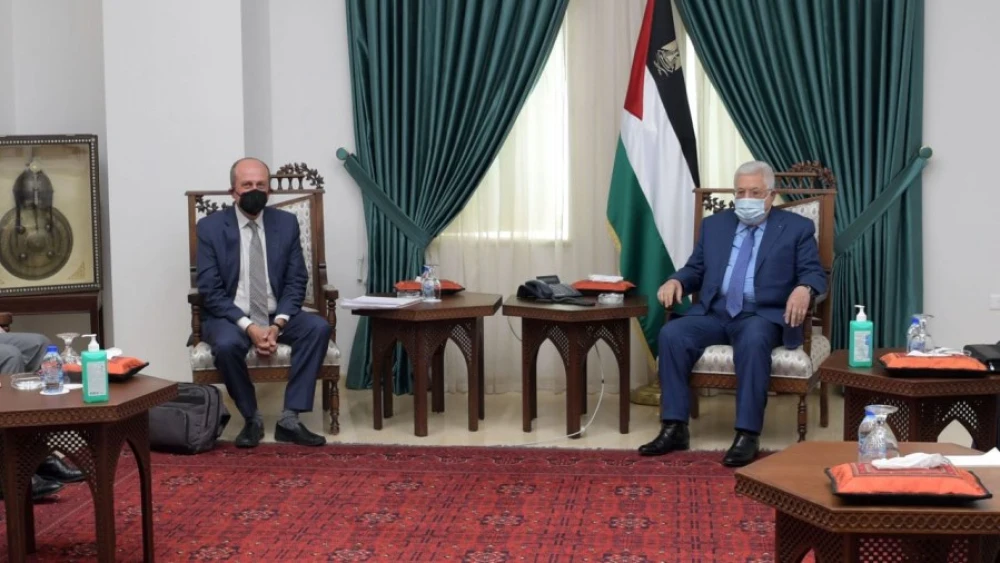
The Biden administration renewed the US-Palestinian Economic Dialogue (USPED) group on Tuesday that had been frozen by the Trump administration.
The meeting, which was held virtually, was the first in five years and brought together senior-level officials from a number of U.S. government agencies and the Palestinian Authority to discuss current and future areas of economic development.
Those who participated in the meeting included Deputy Assistant Secretary for Israel and Palestinian Affairs Hady Amr, U.S. Palestinian Affairs Unit Chief George Noll and Deputy Assistant Secretary for Treasury Eric Meyer.
Palestinian representatives included Palestinian Minister of National Economy Khaled Al-Osaily, governor of the Palestine Monetary Authority Feras Melhem, and Minister of Information Technology and Communication Ishaq Sider.
In her opening remarks, Lempert underscored the Biden administration’s belief that “the Palestinian people deserve to live in freedom, security, and prosperity.”
“Growing the Palestinian economy will also play a critical role in advancing our overarching political goal: a negotiated two-state solution, with a viable Palestinian state living side by side in peace and security with Israel,” she said.
According to a U.S. State Department readout, the two sides discussed topics such as infrastructure development, access to American markets and regulations, free trade, financial issues, renewable energy and environmental initiatives, connecting Palestinian and American businesses, and addressing obstacles to Palestinian economic development. The dialogue also included a discussion of international trade relations.
The meeting comes as part of a broader push by the Biden administration to restore ties with the Palestinians that had been largely severed under the Trump administration.
The P.A. had broken off ties with Trump following his recognition of Jerusalem as Israel’s capital in 2017, as Trump cut their funding as a result of its policy of financially supporting terrorists or their families, known as “pay to slay.”
Earlier this year, the Biden administration restored some $235 million in U.S. aid to the Palestinians and has been pushing to reopen the U.S. consulate for Palestinians in Jerusalem.
Following the meeting, the State Department said it outlined programs that could support the P.A.’s efforts regarding financial issues, trade and promoting foreign investment.