


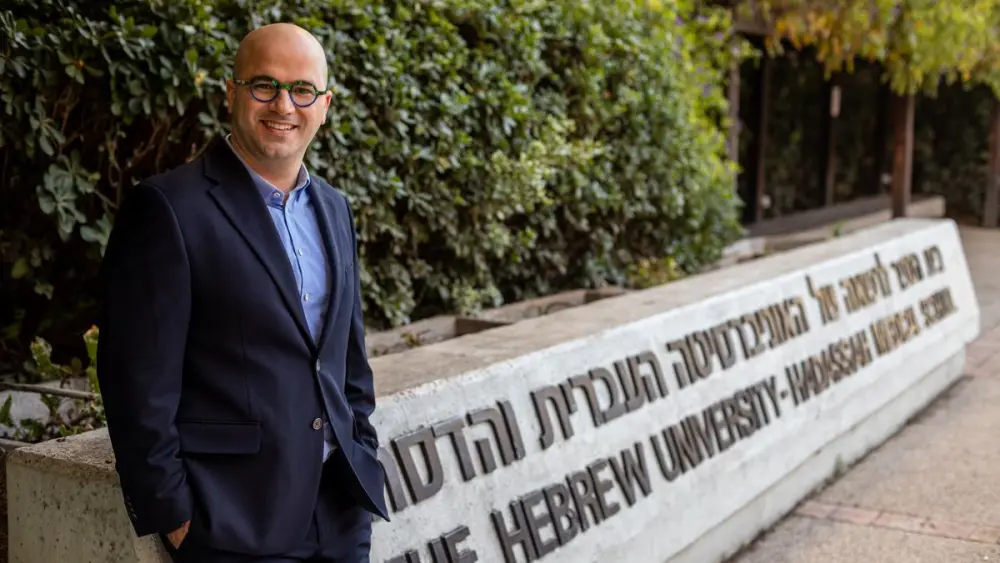
Scientists at the Hebrew University of Jerusalem have identified a new molecular mechanism for autism, potentially opening up new methods of treatment.
Dr. Haitham Amal and his team at the university’s School of Pharmacy in the Faculty of Medicine discovered a direct connection between nitric-oxide (NO) levels in the brain and behaviors associated with autism spectrum disorder (ASD).
Their research was published on May 22 in the Advanced Science journal.
In the study, titled, “The NO Answer for Autism Spectrum Disorder,” researchers found elevated nitric-oxide indicators in stem cells and blood samples taken from low-functioning autistic patients, and in the brains of mice with a genetic form of autism. Nitric oxide is a free-radical neurotransmitter naturally contained in the mammalian body.
The team studied mice treated with drugs that increased nitric oxide levels, and induced autism-like behaviors. They then used a drug to block the production of nitric oxide and found a decline in such behaviors.
They also found that by blocking the production of nitric oxide in mice, they were able to reverse the autism-like behaviors, molecular biomarkers and brain-cell structural changes associated with elevated nitric-oxide levels.
The Hebrew University study was funded by the Satell Family Foundation and the Neubauer Family Foundation, as well as grants from the Eagles Autism Foundation, the U.S. Department of Defense (DoD), the Israeli Science Foundation (ISF), the National Institute of Psychobiology in Israel (NIPI), the Israeli Council for Higher Education, and the Berettler Centre for Research in Molecular Pharmacology and Therapeutics.
‘Pinpointing part of the mechanism that may lead to autism’
In studies of brain cells derived from the stem cells of patients with a genetic form of autism, they were also able to reduce biomarkers of elevated nitric oxide.
“This is the first step in developing a drug that might address autism,” said Amal. “Very few molecular mechanisms are known in autism,” he added.
He noted that it is already well established that nitric oxide is elevated in patients with Alzheimer’s disease, schizophrenia and bipolar disorder. However, he added, we currently have no knowledge of the human normal baseline level for nitric oxide.
“We know that when there is an increase in calcium levels, it increases the production of nitric oxide. We are working at pinpointing part of the mechanism that may lead to autism,” he said.
ASD is a neurological and developmental disorder that affects communication, learning and behavior. Known as a “spectrum” disorder, there is wide variation in the type and severity of symptoms.
At the high end of the spectrum, people with ASD can be extremely intelligent but may have challenges interpreting social cues, making eye contact and empathizing with others. They may engage in repetitive behaviors like rocking or shaking, make noises (called “stimming”) and get anxious when things appear disordered or beyond their usual routines.
But those same “repetitive motions” can produce intricately designed paintings, graphic design, computer programs or musical compositions and can calm them when they are feeling overwhelmed. And their obsessions with specific topics can make them quirky and brilliant experts on esoteric subjects.
At the low end of the spectrum, communication can grind to a stop. Some are non-verbal or lose their speech function early in life, and some lack the ability to perform many basic necessary tasks.
According to the World Health Organization, it is estimated that worldwide about one in 100 children have autism. In Israel, approximately 30,000 children under age 18 are currently diagnosed with ASD. Israel has special education “communications” programs with therapeutic services from nursery school on.
The Israel Defense Forces even has a special unit, called Titkadmu, for teens on the autism spectrum.
Developing a drug is a long-term prospect’
To date, there is no pharmacologic “cure” for ASD, although anti-anxiety and anti-psychotic drugs, as well as stimulants, can be used to address some of the symptoms known to accompany the developmental disorder.
Children diagnosed with ASD are currently treated with physical and occupational and behavioral therapy, and the Israeli educational system offers early intervention as well as special communication classes and eventually mainstreaming options that help children develop social skills.
For the more severely affected, there are dedicated communications schools.
According to Amal, the Hebrew University is already in the process of developing a drug together with a U.S. pharmaceutical company. However, the process is in very initial states and likely won’t be ready for clinical trials for several years yet, he added.
The drug is being designed to reduce oxidative stress on the brain, he said.
Amal, who began his journey on ASD and Alzheimer’s disease in a postdoctoral fellowship at MIT, has published more than 23 papers on cancer, autism, Alzheimer’s disease and other brain disorders. It was during his time at MIT that he first published a paper demonstrating a link between nitric oxide and autism.
According to Amal, using a nitric oxide inhibitor to reduce nitric oxide would be thoroughly different from any of the medications currently being used to address autism, and also from the antipsychotics used to treat bipolar disorder and schizophrenia.
However, he emphasized that it would be years yet before a drug was ready for clinical testing.
“Developing a drug is a long-term prospect,” explained Amal. “We will test toxicological studies to satisfy FDA regulations. If there is a problem at any point, it could slow down the process. After the toxicological studies are complete and it passes the test, they can first start human clinical trials.”


