Six months after the conceptzia, or conceptual framework, of the political system and security establishment was shattered on Oct. 7 by the Hamas onslaught, is Israel once again convincing itself that its deterrence is working?
A disturbing report by the Middle East Media Research Institute (MEMRI) might prove otherwise. The same Jerusalem-based institute that warned in the summer of an impending war in September-October is now warning that Iran is attempting to bring about the immediate overthrow of the regime in Jordan.
“Prime Minister Benjamin Netanyahu and Israel’s security apparatuses maintain that Israeli airstrikes in Syria and Lebanon will prevent Iran from consolidating its presence in Syria. But this concept is wrong,” Ayelet Savyon, director of the MEMRI Iran Media Studies project, writes.
“This is because Iran’s operations against Israel have two dimensions: The first is direct Iranian action against Israel, which Tehran is currently avoiding—not because it is deterred, but because it is not deviating from its grand plan that prioritizes undermining pro-West Arab regimes.
“The second is its use of its proxies, i.e. the “popular resistance” organizations in the various Arab countries, which has been Iran’s modus operandi since the 1979 Islamic Revolution, and particularly in recent years,” she adds.
“The Israeli airstrikes are not deterring Iran from using its proxies, since this Iranian approach has been a cornerstone of its political-military and religious strategy since the Islamic Revolution. This strategy’s two main aims are consolidating its presence in the region and eliminating Israel, without getting dragged into a regional war before its preparations to do so are completed,” Savyon says.
Indeed, a journalist with close ties to Hezbollah recently made it clear that Secretary-General Hassan Nasrallah has stated Iran will retaliate by “slapping Israel in the face,” though he avoided using violent descriptors like “hit” or “punch.”
The essence of his message was that a response is inevitable, whether it happens tomorrow or in 10 years. He noted the numerous challenges in executing such a response, indicating the United States. “We need to be realistic,” he said.
Additionally, Yahya Safavi, senior adviser to Iran’s supreme leader Ayatollah Ali Khamenei, has threatened that Tehran has the right to target Israel’s diplomatic representations worldwide.
Ambition to overthrow a Sunni regime
In an interview with Israel Hayom, Savyon explains that “the Iranians are very cautious in their statements, especially regarding their ambition to overthrow a Sunni Arab regime.
“They always try to obscure their involvement, issuing general threats and declaring the goals they aim to achieve, yet they are involved in actions on the ground—like sending weapons to Gaza, Jordan, etc.” Savyon also points out that there has been a direct order from Khamenei since 2014 to smuggle ammunition into Judea and Samaria.
According to Savyon, from the Iranian perspective “the payback” for the assassination of Mohammad Reza Zahedi, Iran’s top commander in Syria, reportedly by Israel, could manifest in various strategic dimensions, such as framing Israel as a state sponsor of terrorism to incur international diplomatic consequences.
Iran could initiate operations through previously inactive fronts such as Jordan, aiming to destabilize King Abdullah’s regime This is a move that would have a “domino effect” on the rest of the moderate Sunni Arab states, thwarting the Saudi-American-Israeli normalization project. And Iran could initiate military actions against Israel from Judea and Samaria, according to Savyon.
“The Iranians operate through networks they establish, for instance in Jordan, leveraging drug smuggling networks and subsequently using this infrastructure to smuggle weapons. They also engage in the establishment of religious frameworks to disseminate the Islamist message,” she says.
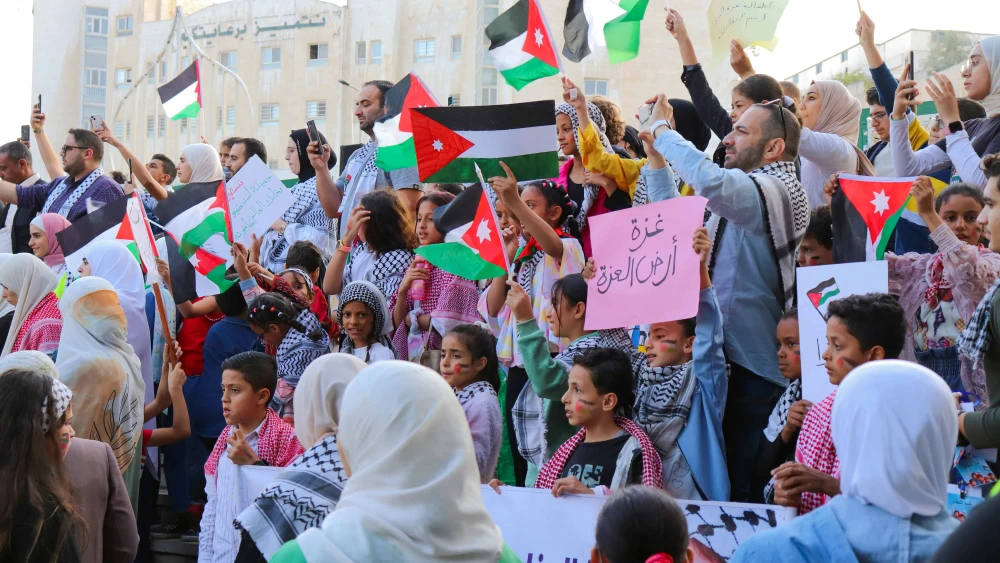
As for Jordan, public demonstrations have escalated significantly, with participants actively congregating for over two weeks, sharply amplifying their anti-Israel rhetoric. The protesters have called for attacks in areas such as Eilat and the Jordan Valley, explicitly stating their desire to breach the border with the intention of killing and abducting Israeli soldiers.
The report also said that Saudi writer Khaled al-Ghanami wrote in a recent article, titled “Jordan Is a Red Line,” that “the moderate axis that is represented by Saudi Arabia, Egypt and the UAE will not sit idly by if it sees any harm to Jordan such as a declaration of war ...”
Originally published by Israel Hayom.