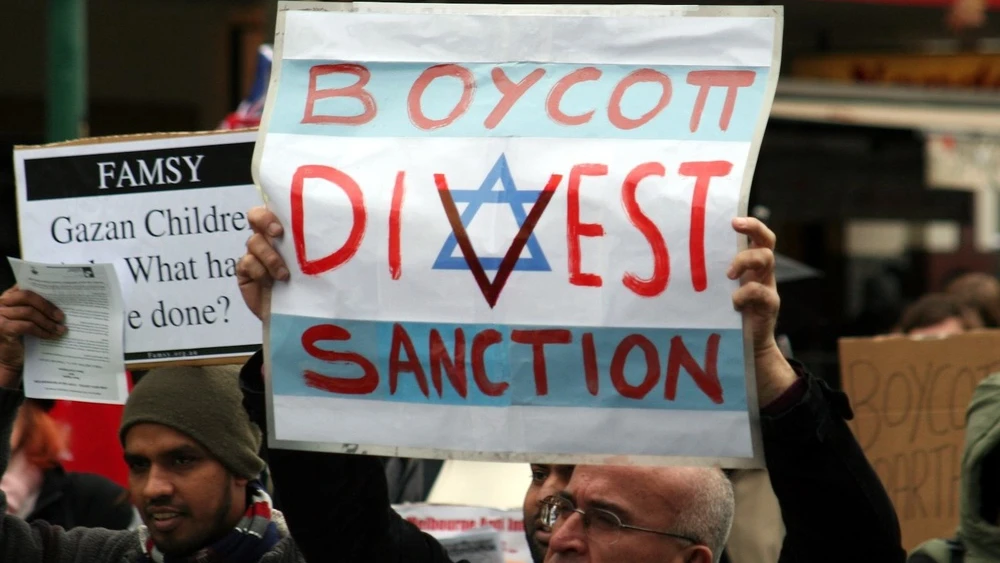
Israel’s Strategic Affairs Ministry on Jan. 7 published a list of 20 organizations affiliated with the BDS movement that will be barred from entering the country, marking the Israeli government’s first major step to ban entities that seek to undermine the Jewish state since legislation targeting such groups was passed last year.
Israeli Strategic Affairs Minister Gilad Erdan referred to the list’s publication as “another step in our work to thwart anti-Israel boycott organizations.”
“The state of Israel will actively prevent such groups from spreading their falsehoods and odious methods from within the country,” he said.
Interior Minister Aryeh Deri, whose ministry will enforce the ban, said that BDS activists “are trying to exploit the law and our hospitality to act against Israel and to defame the country. I will act against this by every means.”
Prof. Gerald Steinberg, founder and president of the NGO Monitor watchdog group, told JNS that the government’s move signals that Israel “won’t turn a blind eye to those who work to delegitimize it, but the downside is that it also serves to raise the profiles of these groups.”
According to the Israeli government, people in senior positions in the blacklisted organizations as well as key activists—even if they do not hold official positions—will be denied entry, Haaretz reported. Additionally, mayors and establishment figures who actively promote boycotts will also be prevented from entering, as will activists arriving in Israel as part of delegations initiated by one of the blacklisted groups.
The list’s publication comes after the Israeli Knesset last year passed legislation that denies entry visas to known BDS activists. The list, which includes BDS groups from the U.S., Europe, South America and South Africa, will be enforced in March.
Blacklisted groups
The European groups included on the list are the France-Palestine Solidarity Association, BDS France, BDS Italy, European Coordination of Committees and Associations for Palestine, Friends of Al-Aqsa, Ireland Palestine Solidarity Campaign, Palestine Committee of Norway, Palestine Solidarity Association of Sweden, Palestine Solidarity Campaign, War on Want and BDS Kampagne.
The U.S.-based groups on the list are the American Friends Service Committee (AFSC), American Muslims for Palestine, Code Pink, Jewish Voice for Peace (JVP), Students for Justice in Palestine (SJP) and U.S. Campaign for Palestinian Rights. The other organizations on Israel’s list are BDS Chile, BDS South Africa and BDS National Committee.
The American groups on the blacklist have taken extreme stances on Israel in recent years, including accusing Israel of being an “apartheid state” and featuring convicted terrorists as speakers at conferences.
AFSC is among the leaders of BDS efforts on U.S. campuses and churches; has accused Israel of “slow and systematic ethnic cleansing;” and rejects dialogue between Israelis and Palestinians, according to NGO Monitor.
JVP last year hosted convicted Palestinian terrorist Rasmea Odeh, who played a role in a 1969 Jerusalem bombing that killed two Hebrew University students, as a speaker at a conference in Chicago.
Reaction
“Israel’s decision to specifically ban JVP is disconcerting but not surprising,” tweeted JVP.
New Israel Fund CEO Daniel Sokatch said in a statement that “banning political opposition is the policy of autocracies, not democracies.”
“Our position is principled: We do not support the BDS movement. We oppose the government’s travel ban and all its actions to punish those with whom it disagrees,” he said.
NGO Monitor’s Steinberg said any country has the right to decide who can enter, and he does not find it surprising that “groups which demonize and advocate boycotts of the Jewish state find themselves barred from visiting it.”
“While the groups listed aren’t the only ones involved in anti-Israel political warfare, they are among the worst,” Steinberg said. “AFSC is today a leader of BDS on campuses and in churches across North America. JVP and SJP work closely together towards the same goals.”
The publication of the blacklist came a week after the government approved some $75 million to combat BDS. Some of the funding will be used to create a nonprofit organization comprised of Israeli government officials and foreign donors.