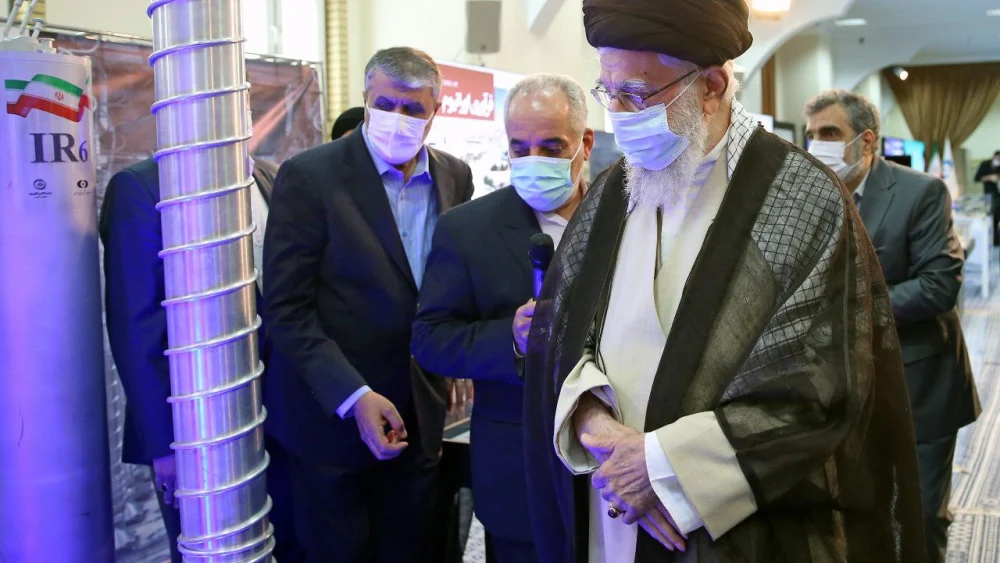
The Islamic Republic will weaponize its nuclear program if Israel “threatens its existence,” an adviser to Supreme Leader Ali Khamenei said on Thursday.
“If the Zionist regime [Israel] dares to damage Iran’s nuclear facilities, our level of deterrence will be different. We have no decision to produce a nuclear bomb, but if the existence of Iran is threatened, we will have to change our nuclear doctrine,” Kamal Kharrazi said, the ISNA news agency reported.
The head of the Strategic Council for Foreign Relations added that Tehran has already signaled that it has the capacity to build a nuclear bomb.
Kharrazi’s comments come after last month’s retaliatory strike by Israel on Iran, which destroyed parts of the Islamic regime’s Shikari Air Base near Isfahan.
The attack came five days after Iran launched an unprecedented attack of more than 300 drones and missiles at Israel, in the first-ever direct attack on the Jewish state from Iranian soil. According to the Israel Defense Forces, 99% of the threats were shot down in a joint mission of Israel, the United States, Britain and several Arab neighbors. Tehran claimed the attack was retaliation for an April 1 strike that killed a top Iranian general in Damascus.
A day before the Israeli response on April 19, the Islamic Republic threatened to reconsider its official nuclear doctrine.
“A review of our nuclear doctrine and politics as well as considerations previously communicated is entirely possible,” said Maj. Gen. Ahmad Haghtalab, the Islamic Revolutionary Guard Corps commander responsible for safeguarding Iran’s nuclear sites, Reuters reported.
Threats “against Iran’s nuclear facilities make it possible to revise and deviate from the declared nuclear policies and considerations,” he added, according to the semi-official Tasnim News Agency.
“Our hands are on the trigger,” threatened Haghtalab, saying that the IRGC has identified Israel’s nuclear facilities.
Iran has maintained that its nuclear program is strictly peaceful while it has continued to ramp up its uranium enrichment. In recent years, the regime has claimed that Supreme Leader Ali Khamenei issued a fatwa religious edict outlawing weapons of mass destruction.
Western powers say there is no credible civilian explanation for Tehran’s nuclear activities. In 2022, the International Atomic Energy Agency issued a report saying it could not “provide assurances that Iran’s nuclear program is exclusively peaceful.”
Iran’s nuclear chief said on Tuesday, at a joint press conference in Isfahan, that talks with the International Atomic Energy Agency have been positive.
IAEA chief Rafael Grossi arrived in Iran on Monday to try and bolster oversight of Tehran’s nuclear program, based on a March 4, 2023, “Joint Statement” signed between his group and the Atomic Energy Organization of Iran (AEOI).
Grossi said that the IAEA and Iran have agreed on “tangible and operational steps” to implement the Joint Statement. He dismissed the idea of creating a new agreement.
Grossi told German media last month that Iran was “weeks, rather than months,” away from having a nuclear bomb.