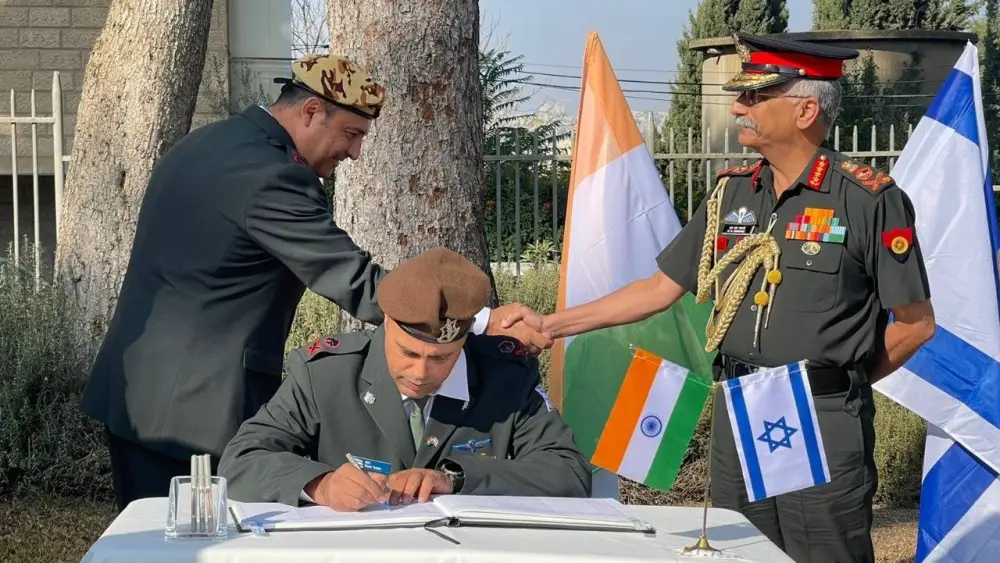
Israel and India are set to expand their cooperation further just weeks after a historic visit by India’s Chief of Army Staff Gen. Manoj Mukund Naravane.
Navarne met with senior Israel Defense Forces officials, including Chief of Staff Lt. Gen. Aviv Kochavi, and IDF Ground Forces Commander Maj. Gen. Tamir Yadai. He heard multiple briefings on Israel’s military capabilities, and the visit is perceived by Israeli defense officials as having enriched and strengthened both the personal and professional connection between the two militaries.
Naravane also toured sites that hold historical significance to both countries, including the Indian cemetery in Jerusalem and the Yad Vashem World Holocaust Remembrance Center. The visit is seen as the latest signal of the deep military and diplomatic connection between Israel and India.
Looking ahead, both countries seek to expand their collaboration in several areas, including the strengthening of their militaries.
Professor Efraim Inbar, president of the Jerusalem Institute for Strategy and Security, told JNS that Israel enjoys a “comfortable strategic partnership” with the current Indian government and its prime minister, Narendra Modi.
“They view Israel as a strategic partner,” said Inbar. “India is interested in a multilateral world, in which India is an important country. Israel fits in with this vision.”
He cited India’s ongoing fight against international terrorism and jihadist movements as causing Indian decision-makers to sense that they are facing similar challenges that Israel does.
“The ethnic-religious conflict in Kashmir followed a messy partition, like the partition here,” said Inbar. “They correctly see similarities.”
However, India also perceives a second threatening front—China—one that in India’s threat perception overshadows the Pakistani-Kashmir front, according to Inbar.
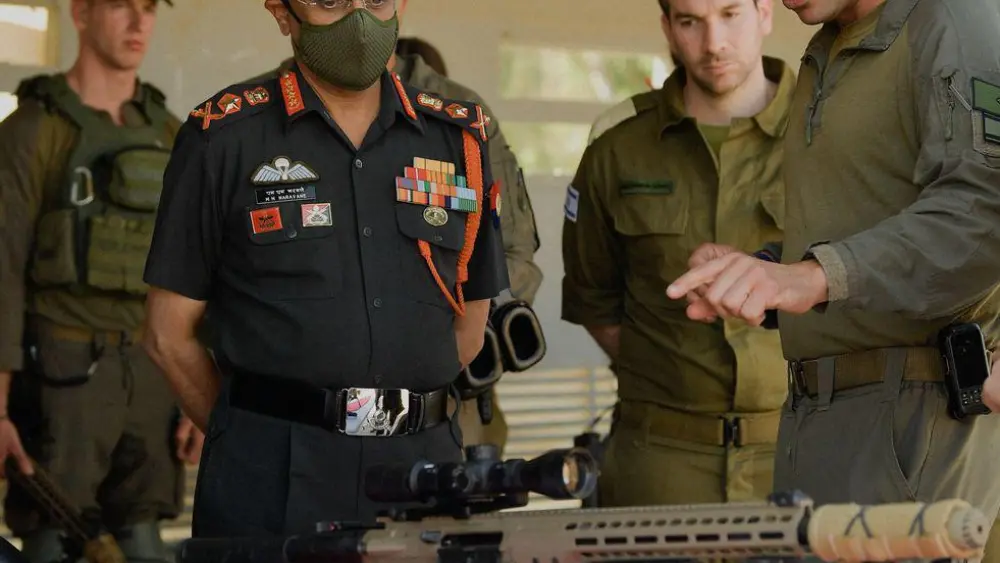
At the start of the month, India media reported that the Indian Army deployed four Israel Aerospace Industries (IAI)-produced Heron drones to surveil Chinese military movements in the Ladakh sector.
“India has a large defense budget. Its total procurement of defense products is around $8 billion per year. A significant amount of this goes to Israeli products,” said Inbar.
‘Indian officers visit Israel in significant numbers’
In 2017, IAI announced a mega-contract worth more than $1.6 billion for the supply of advanced medium-range surface-to-air missiles and missile-defense systems to the Indian Army. A year later, IAI announced that it has been awarded an additional, $777 million mega-contract for supply of the marine version of the Barak 8 active missile-defense system, for seven ships of the Indian navy. The contract was entered into with Indian state-owned company Bharat Electronics Limited, which serves as the main contractor in the project.
“India has a ‘Make in India’ policy, and the United States is less willing to conduct technology transfers. Israel is more flexible on this and on co-production,” explained Inbar. “Israel does not sell large platforms but rather focuses on a certain niche where it has a big advantage.”
“India values the skills that have developed here—not only in defense, but also in technology and other sectors,” he added. “Indian officers visit Israel in significant numbers.”
This fall, India was one of eight countries taking part in the Israeli Air Force’s Blue Flag international air drill held in southern Israel, which saw a combined 70 aircraft fly out of Uvda Air Force Base north of Eilat.
It was the first time that India sent a squadron to take part in an Israeli exercise, deploying Mirage jets.
Indian fighter-jet pilots told JNS at the time that the exercise provided them with “good training value,” and that combination of fourth- and fifth-generation aircraft is something they have yet experienced back home.
“The future of this relationship will just more prosperous,” said Inbar.