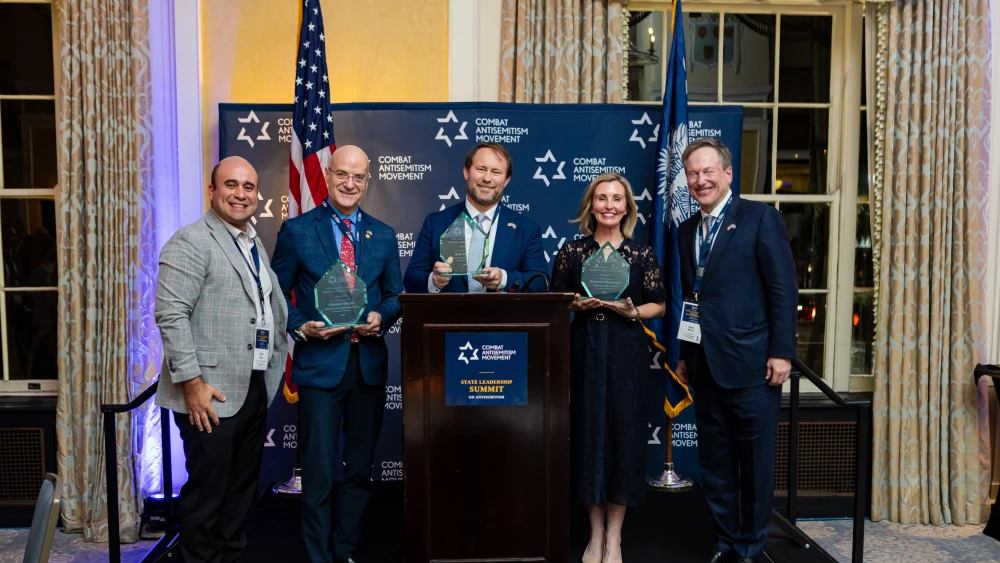
Nearly 150 lawmakers and executive officials from more than 20 U.S. states gathered in Charleston, S.C., this week for the Combat Antisemitism Movement’s (CAM) annual State Leadership Summit, pledging to strengthen efforts to counter antisemitism and support Israel and Jewish communities.
South Carolina Gov.-elect and Attorney General Alan Wilson, who delivered the keynote address at Wednesday’s opening dinner, received CAM’s Francis Salvador Award, named after the first Jewish person killed in the American Revolutionary War.
“I don’t care what your politics are. I don’t care where you come from or what you believe. But if you come to South Carolina, you will come to a state that embraces the Jewish people,” Wilson said.
“There is hate out there, and we know that antisemitism happens even in South Carolina. But you know that you have a state that will always stand with Israel and will always stand with the Jewish people. And as long as I’m the governor of the state of South Carolina, I will always stand with you,” he added.
Three state lawmakers—Wisconsin Assemblyman Ron Tusler, Missouri Rep. George Hruza and Oklahoma Sen. Kristen Thompson—were honored for their leadership in advancing legislation to combat antisemitism.
Charleston Mayor William Cogswell Jr. also addressed the gathering, emphasizing the city’s longstanding Jewish heritage.
“Charleston’s Jewish community has been part of our story since the very beginning,” Cogswell said. “That legacy and history belongs to all of us, and it is important to honor and protect it against the hate and rising antisemitism that we see in our world today.”
Other speakers included former Auburn University men’s basketball coach Bruce Pearl; Eddie Rubin, whose two children were present during a thwarted terrorist attack at Temple Israel in West Bloomfield, Mich., in March; and Tom and Ofir Alon, survivors of the Oct. 7, 2023, Hamas massacre at Kibbutz Kfar Aza in southern Israel.
CAM founder Adam Beren warned that antisemitism was spreading across American institutions, including schools, social media and government.
“The enemies of America, foreign and domestic, are not only at the gates, they’re inside the gates,” Beren said.
“It doesn’t matter if you’re from a red or blue state, and it doesn’t matter if you’re a Democrat or a Republican,” he added. “We need people who are going to be courageous and stand up for America and stand up for what’s right, and I want to thank everyone here for being those kinds of people.”
Tracking state legislation
A highlight of the summit was Thursday’s unveiling of CAM’s State Action Tracker, an online database designed to monitor and assess state-level policies and legislative measures addressing antisemitism.
The summit also featured a panel of students from Stanford University, California Polytechnic State University-San Luis Obispo and the University of Texas at Austin, who shared their experiences confronting antisemitism on campus.
Other sessions focused on legislative strategies, the role of state attorneys general in enforcing anti-discrimination laws, foreign influence and extremist funding, online antisemitism, Jewish identity and the results of the 2026 U.S. midterm elections.
CAM said it has prioritized educating state lawmakers about antisemitism and potential legislative responses over the past two years.
Since April 2025, nine states—Arkansas, Georgia, Kansas, Kentucky, Missouri, Nevada, Oklahoma, Tennessee and Wisconsin—have enacted laws addressing antisemitism, according to the organization.
The Charleston gathering followed CAM’s inaugural State Leadership Summit in Kansas City, Mo., in June 2025, which brought together participants from 17 states.