Newsletter
Newsletter Support JNS

Israeli computational model promises gene-based breast-cancer screening

The research, which was published in the Journal of Medical Genetics, was based on a large-scale international study that included the genomic data of approximately 250,000 women.

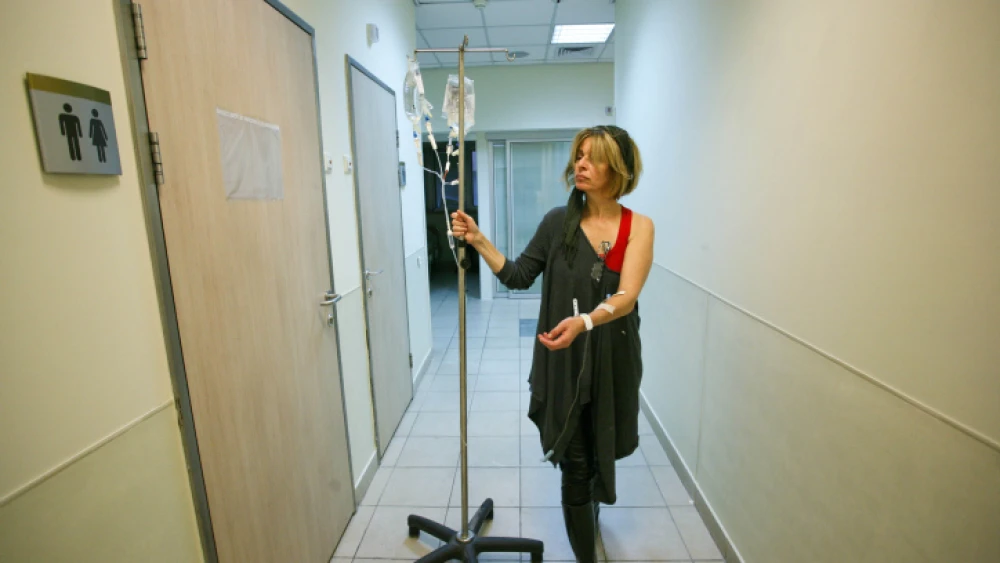
A woman is treated with chemotherapy for breast cancer. Photo by Chen Leopold/Flash90.

Tel Aviv University researchers on Tuesday announced the development of a computational model to predict increased genetic risk for breast cancer.

The model will enable, for the first time in Israel, the determination of a personal genetic risk score for breast cancer based on an individual’s genetic profile.

The technique, which could form the basis for the implementation of a personalized early detection policy, may save lives and enable a more efficient use of the health system’s resources, the university said in a press release.

The research, which was published in the Journal of Medical Genetics., was based on a large-scale international study that included the genomic data of about a quarter of a million women with and without breast cancer, and applied its findings to about 2,000 Israeli women.

“Our method will allow the health system to move to a personalized early detection policy... those who are identified as being at high risk will be tested from a younger age and more frequently,” said professor Rani Elkon of the Department of Human Molecular Genetics and Biochemistry at TAU’s School of Medicine.

Breast cancer is the second leading cause of cancer death in women around the world, after lung cancer. While steadily on the decline over the last several decades, the chances are that 1 in 39 women, or 2.5%, will succumb to the disease.

In a draft report delivered to the U.S. president, the commission also called for improved religious accommodations for U.S. service members.
Salah Salem Sarsour, accused of concealing Israeli military court convictions on immigration forms, argued his detention was part of a Trump admin effort to target the pro-Palestinian movement.
CENTCOM stated that the strikes targeted missile, drone and radar facilities after the Islamic Republic attacked a cargo ship in the Strait of Hormuz, calling the assault a violation of the ceasefire.
Now that the primaries are over, “we hope that everyone will come together and be united,” Christine Quinn, chair of the executive committee of the New York State Democratic Party, told JNS.
An Iranian official warned on Friday that the safety of ships passing through the Strait of Hormuz without Iran’s permission “cannot be guaranteed.”
“We have put the train back on the tracks and going in the right direction,” said Yechiel Leiter, Israeli ambassador in Washington. “Final destination? Peace between our two countries.”
Benny Gantz, JNS editor-in-chief Jonathan S. Tobin, Gilad Erdan, Mosab Hassan Yousef, Nissim Black and leading voices in security, diplomacy, media, law and Jewish communal affairs headline the summit’s third day in Jerusalem.

