Newsletter
Newsletter Support JNS

Report: Israel-China corona-lab deal stalls over DNA database access

Israel’s largest HMO refuses to work with a Chinese government firm that is supposed to be supplying six fully outfitted testing labs, for fear of compromising the DNA data of its 4.9 million members.

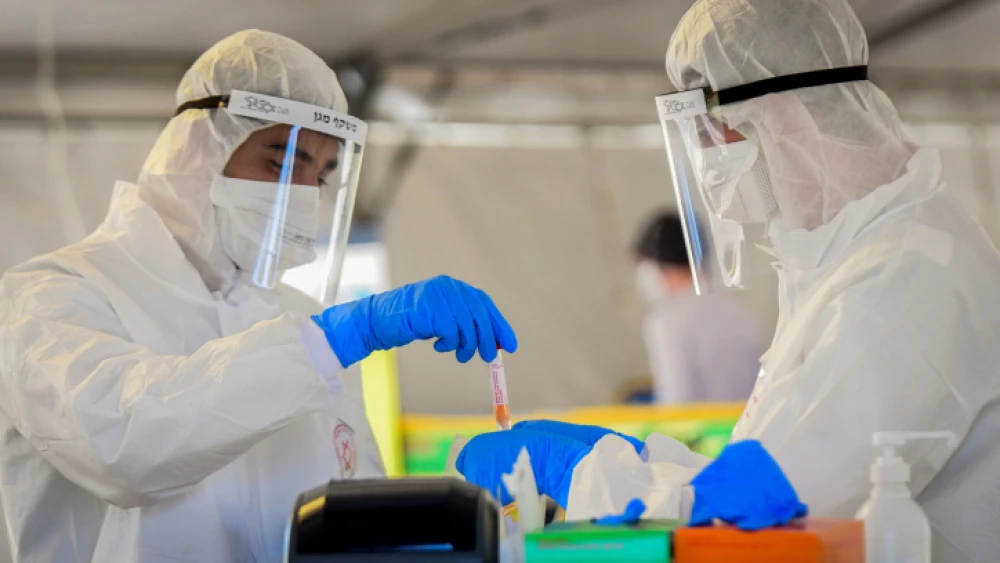
Magen David Adom medical team members handle a coronavirus test sample at a drive-through testing site in Tel Aviv on March 22, 2020. Photo by Flash90.

Israel’ largest health-care provider, Clalit, has decided not to cooperate with a Chinese government company on coronavirus testing for fear that it would compromise the DNA data of its 4.9 million members, the N12 news site reported on Sunday.

The Israeli government intended to contract for the Chinese firm to supply six coronavirus testing laboratory facilities, complete with equipment and testing kits. However, Israel’s desire to protect its DNA database is holding up the deal.

The N12 report noted that no country gives other nations access to its DNA database, which is considered a sensitive national asset that can be used for good purposes, such as developing medicines, but that can also be exploited.

Israel is negotiating to add a clause to the contract that would bar China from accessing the DNA database, the report said.

The delay in the finalization of the deal is apparently one factor why Israel is not conducting the daily number of tests it aimed to be carrying out by this time.

This article first appeared in Israel Hayom.

In a draft report delivered to the U.S. president, the commission also called for improved religious accommodations for U.S. service members.
Salah Salem Sarsour, accused of concealing Israeli military court convictions on immigration forms, argued his detention was part of a Trump admin effort to target the pro-Palestinian movement.
CENTCOM stated that the strikes targeted missile, drone and radar facilities after the Islamic Republic attacked a cargo ship in the Strait of Hormuz, calling the assault a violation of the ceasefire.
Now that the primaries are over, “we hope that everyone will come together and be united,” Christine Quinn, chair of the executive committee of the New York State Democratic Party, told JNS.
An Iranian official warned on Friday that the safety of ships passing through the Strait of Hormuz without Iran’s permission “cannot be guaranteed.”
“We have put the train back on the tracks and going in the right direction,” said Yechiel Leiter, Israeli ambassador in Washington. “Final destination? Peace between our two countries.”
Benny Gantz, JNS editor-in-chief Jonathan S. Tobin, Gilad Erdan, Mosab Hassan Yousef, Nissim Black and leading voices in security, diplomacy, media, law and Jewish communal affairs headline the summit’s third day in Jerusalem.

