A contract recently signed to lease a cutting-edge Unmanned Aerial Vehicle (UAV) that was developed and manufactured by Israel Aerospace Industries (IAI) to assist in European Union border protection missions represents a major step in the use of the technology in the civilian sphere, a company executive has told JNS.
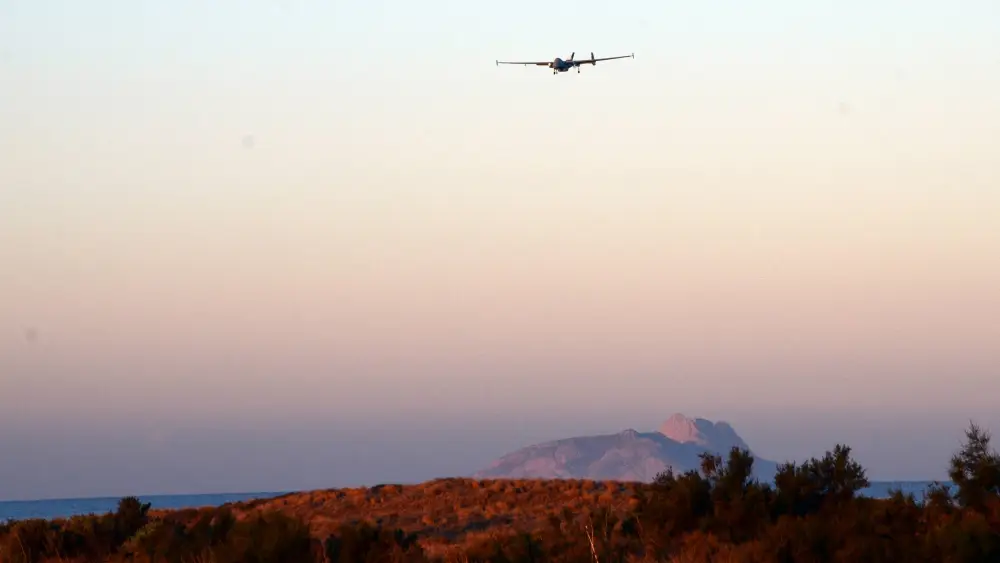
In November, IAI announced that it had won a tender, together with Airbus, potentially worth tens of millions of dollars for the leasing of its Maritime Heron UAV to Frontex, which is the European Union’s Border and Coast Guard Agency.
IAI and Airbus will be responsible for the full service of naval patrols, flight equipment and maintenance for four years in southern European countries, with a focus on surveilling the Mediterranean Sea region.
The Israeli Navy uses this same system for many of its own surveillance and intelligence-gathering missions.
‘Our system is highly automatic’
Orna Shemesh, director of Marketing and Business Development at IAI’s MALAT Division, told JNS that IAI has led the field of military UAVs for five decades, and is currently making significant efforts to enter the civilian markets.
“Our cooperation with Airbus goes back many years,” she said, noting that Airbus has operated IAI’s Heron system on behalf of the German Air Force in Afghanistan and in Mali for the last decade.
In the current tender, Airbus will provide the flight service, including maintenance. The aircraft will take off from sites as chosen by Frontex in cooperation with hosting countries in southern Europe.
“The Heron’s missions will be to assist in border protection—surveillance of borders to monitor who is entering and to identify whether they are terrorists or criminals, smugglers or polluters,” said Shemesh.
The Heron platform carries an onboard advanced naval radar that can detect objects at long ranges and alerts operators of suspicious activity.
The system uses a combination of satellite communications and line-of-sight communications to remain in touch with ground stations. When needed, it can fly at low altitude using a sophisticated day and night camera that is “relatively new in our arsenal” to detect suspicious activities, she added.
“The information gathered can then be of use to our customers in any way they see fit,” said Shemesh.
The Heron families of UAVs have to date amassed some 500,000 flight hours around the clock in all-weather conditions.
“Our system is highly automatic. We are big believers in automation for efficient management of missions in any area,” stated Shemesh. This includes automatic takeoffs and landings, and automated tasks carried out in the ground control stations.
“The flip side of the coin,” she stressed, “is that when we fly the UAVS, and certainly when flying in civilian airspace, as we do in Europe, a person must always be in the loop.”
Human operators must speak to air-control stations—much like pilots on aircraft do—as the unmanned aircraft moves through the air.
Some 50 nation-state clients operate IAI’s military drones around the world. For sea security missions, Shemesh noted that smaller drones that can conduct vertical takeoffs and landings from ships. This will be a key trend in the future.
IAI recently purchased 50 percent of Israeli Bluebird Aero Systems, which specializes in making vertical take-off platforms.