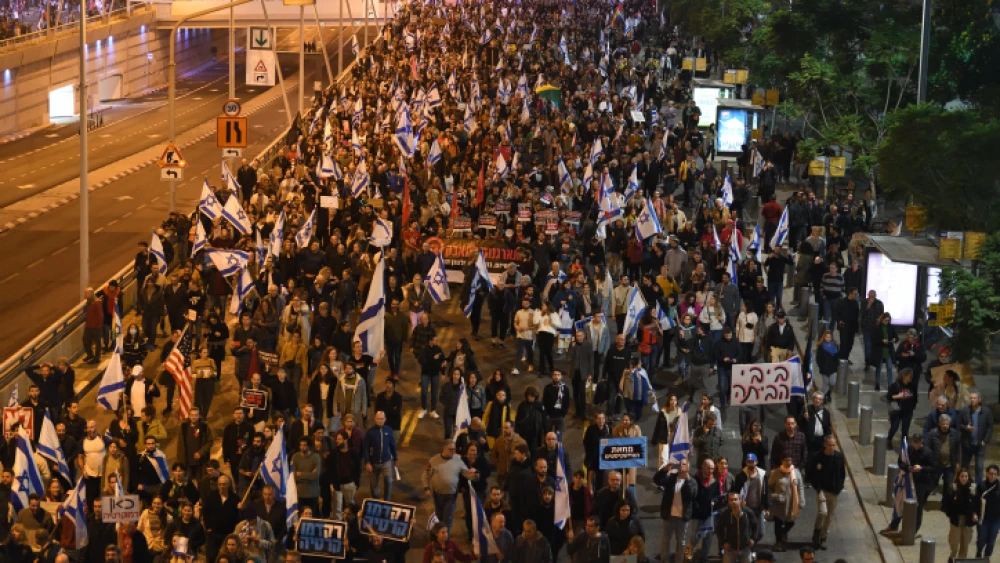
Organizers of mass Saturday night protests against the Netanyahu government’s planned judicial reform called for a nationwide strike during a press conference on Tuesday.
“We call on the citizens to notify the workplaces today that they will not work on Monday and go out into the streets. This is the most important struggle for the state—the struggle for Israel’s independence as a Jewish and democratic state,” the organizers said.
Former Minister of Defense and IDF Chief of Staff Lt. Gen. (res.) Moshe Ya’alon, one of the protest leaders, asked that business owners allow their employees to go out and protest on Monday.
“Rule of the majority is not the tyranny of the majority in any democracy,” he said.
“The current government intends to crush the judiciary because of the personal entanglements of the prime minister, ministers and Knesset members who were convicted of violations of the law, Ya’alon said. “That’s why I define them as a criminal and illegal government, with a black flag flying over it.”
The organizers chose Monday because that’s when the first vote in the Knesset plenum concerning judicial reform will take place.
“This is the day when the first laws of the dictatorship are supposed to be passed, and we call on citizens to go up to Jerusalem to demonstrate in front of the Knesset starting at noon,” the organizers said in a statement.
"[Prime Minister Benjamin] Netanyahu’s plan to underhandedly pass the laws of his dictatorship will run up against the people of Israel, more determined than ever to preserve their independence,” they said.
MK Simcha Rothman, the chairman of the Knesset Constitution, Law and Justice Committee overseeing the government’s judicial reform plan, returned from the U.S. recently confident that he had allayed concerns from allies about the repercussions proposed to Israel’s judicial system.
“All democratic countries elect their judges in a democratic manner, except Israel,” Rothman, from the Religious Zionism Party, said. “If [what the government is proposing in terms of judicial selection] means we don’t have an independent judiciary, then that means no democratic country in the world would have one either.”
“We are trying to undo what a group of oligarchs, who sat in one room, decided with zero public debate,” he continued. “To tell us we’re not listening to anyone—that’s not true. We are solving a problem that was made by people doing exactly that.”
Reform advocates argue that the Supreme Court has no right to overturn Knesset laws. In 1995, then-Supreme Court President Aharon Barak announced a “constitutional revolution.” Barak based his decision on two Basic Laws (basic laws are considered to have greater legal stature than regular laws) passed in the early 1990s—Basic Law: Human Dignity and Liberty and Basic Law: Freedom of Occupation. Barak declared they were “the supreme law of the land and constitute part of Israel’s constitution.” He has since become the bête noire of reform advocates, described as a kind of “evil genius.”
Reform advocates point out that lawmakers who voted on those basic laws didn’t know they were creating a constitution at the time, noting that Basic Law: Freedom of Occupation passed by a vote of 32 to 21 towards the end of the 12th Knesset when lawmakers’ attention was already turned to the next election.