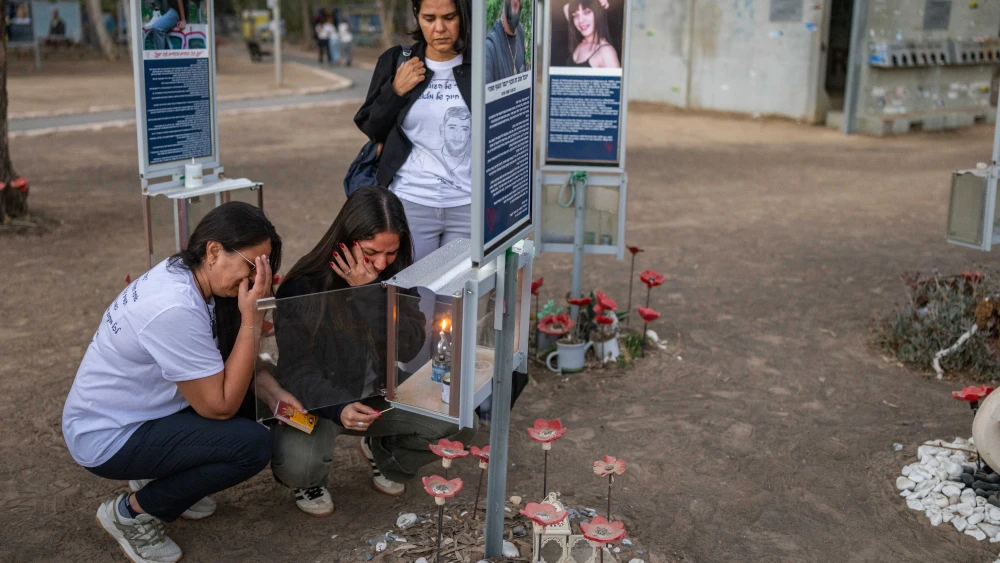
Three years after the Hamas-led terrorist attacks in southern Israel on Oct. 7, 2023, 79% of the survivors of the Nova music festival have been recognized as having a psychiatric disability, while only about 60% have entered full-time employment, according to Efrat Atun, CEO of SafeHeart, which provides mental-health care to survivors.
The third anniversary of the massacre comes amid renewed psychological distress among survivors, with more seeking psychiatric treatment than a year ago, Atun told JNS on Tuesday. SafeHeart’s team handling complex cases is “flooded with cases,” she said.
About three-quarters of Nova survivors were between 18 and 24 when they attended the festival, Atun said. Some 364 people were killed at the festival near Kibbutz Re’im, accounting for nearly one-third of the approximately 1,200 people killed on Oct. 7.
She added that recurring security escalations can trigger trauma symptoms and prolong recovery.
“The massacre interrupted their lives just as they were getting started,” Atun told JNS. “From previous years, we know that distress peaks precisely when the spotlight fades. That is why continuity of care matters now more than ever.”
Ayelet Cohen-Wieder, a clinical psychologist who works with SafeHeart, told JNS that inadequate government funding, bureaucratic obstacles and a failure to rebuild public trust were hampering survivors’ recovery.
Asked whether Israel’s mental-health services were meeting survivors’ needs, she replied, “Not enough at all.”
Cohen-Wieder rated the state’s response at three or four out of 10, citing insufficient funding and limited access to treatment. She said only a small portion of SafeHeart’s budget comes from the government through the National Insurance Institute and Health Ministry, with most of its funding coming from donations.
She also criticized the process of seeking assistance through the Israel Ministry of Defense, saying that its bureaucratic complexity causes some people to abandon their claims without receiving the help they need.
“Our government didn’t learn what they have to learn,” Cohen-Wieder said.
Civilian volunteers mobilized immediately after the attack to fill what she described as a vacuum left by government institutions.
SafeHeart began operating on Oct. 7, 2023, when therapists and organizers of safe spaces at festivals mobilized to help survivors, according to Atun. Trauma therapists from Israel’s festival and safe-space communities founded the organization, and the Health Ministry and National Insurance Institute now recognize it as a provider of mental-health services for festival survivors.
Its network has provided more than 75,000 hours of therapy to survivors, Atun told JNS. About 400 therapists specializing in trauma, including practitioners familiar with psychedelic experiences, provide long-term individual treatment to more than 1,000 survivors, she added.
Cohen-Wieder estimated that roughly half of the organization’s survivors had made substantial progress in integrating the trauma into their lives. Some have created music, shared their experiences internationally or developed startups addressing stress and anxiety.
But progress can coexist with acute anxiety, she said, and renewed security threats can cause setbacks.
“Every alarm could cause you to freeze for a day, or sometimes more than a day,” Cohen-Wieder told JNS.