At three Manhattan cafes this Yom Hashoah, history was not delivered from a podium or in a book. It was spoken over coffee, across small tables, among ordinary afternoon crowds.
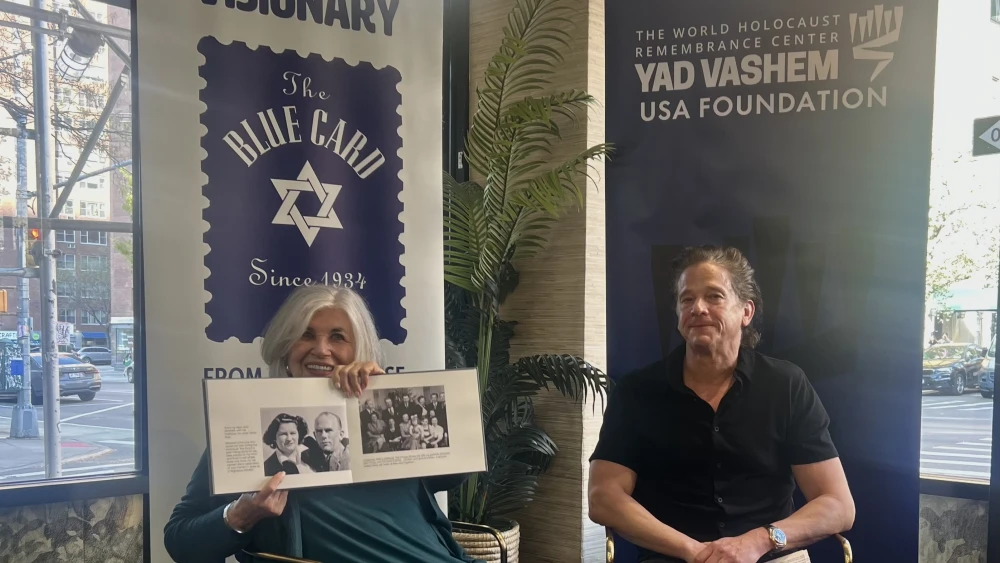
Yad Vashem USA Foundation and The Blue Card’s “sip and listen” series brought Holocaust survivors to three venues, Effy’s Café, Caffe Aronne and Patis Bakery to share their stories informally with community members.
“We wanted to bring this to a place where people feel comfortable for a conversation,” Alyssa Sadoff, events director at the foundation, told JNS. “It’s a lot less threatening when you’re sitting around, drinking coffee and having a one-on-one conversation. It’s more personal.”
Organizers selected such informal settings to reach people who might not normally attend a Holocaust remembrance event, according to Sadoff. Held around Yom Hashoah, the events were unstructured, open-ended conversations with survivors.

“They come in, get a cup of coffee and say, ‘What’s happening?’” she told JNS. “It makes it really nice for them.”
JNS attended the April 14 gathering at Patis Bakery, where Adrienne Petrook, 84, told some 30 attendees about her life shaped by hiding, displacement and rebuilding across continents.
Born in Budapest in 1941, Petrook was just two-and-a-half years old when her parents sent her to live in hiding in a rural Hungarian village. Petrook, who spoke during a moderated conversation with entrepreneur Ari Ackerman, recalled her mother saying that “the children must survive, because they are the future.”
Hidden in a village of just a few thousand people, she spent much of her early childhood indoors, protected by strangers who risked their safety. Her memories from the period are fragmented but vivid—food shared by caretakers, a doll traded for basic goods and a childhood lived in hiding.
After the war, Petrook’s family reunited in Budapest. Her father had survived forced labor and escaped, hiding in an elevator shaft, and her mother used false documents to move safely through the city. But postwar life in Hungary remained unstable, and the family, which felt unsafe there as Jews, opted to leave.
When asked about her identity and how she sees herself today, Petrook said: “I’m a proud Jew, but I want to conceal that from everyone else. Look at what’s going on today and look at what was going on in Europe in the 1940s.”

The family immigrated to the United States in 1950. “We came to America with $7 and the clothes on our backs,” Petrook said.
She told attendees that she felt like an outsider in Queens, where she struggled with language, identity and belonging. She learned for the first time, after arriving stateside, that she was Jewish—a fact that her parents had deliberately hidden from her for years.
Deeply traumatized by the war, her father rejected religion entirely. Her mother maintained only quiet, selective traditions. Over time, Petrook said that she rebuilt her Jewish identity on her own terms, later ensuring that her children were raised with Jewish education and connection.
For Ackerman, the conversation was about both memory and urgency. “We have to remember what happened to us, so it never happens again,” he told JNS. “We all have to be active listeners, active participants.”
He also voiced concern about rising Jew-hatred, drawing parallels to pre-Holocaust Europe. “It feels like it’s happening all over,” he said. “That’s what is very scary to me.”
Ackerman said his public advocacy increased significantly after Oct. 7, as he began sharing more of his message on social media that reaches millions.

“This is our moment to step up and be vocal,” he said.
Masha Pearl, executive director of The Blue Card, a nonprofit that helps Holocaust survivors, said that cafe settings make things easier for both community members and survivors, who are telling their stories.
“We want to create an intimate feeling of being in a coffee shop, where the survivor can feel relaxed, and people can feel relaxed,” she told JNS. “It’s not a stiff environment. That really fosters conversation.”
“We want them to walk away with a deeper understanding of survivors’ stories and optimism in life despite everything they went through,” she said.
Deborah Rubien, of Queens, N.Y., told JNS that the cafe setting changed her experience of Holocaust remembrance.
“I have always been interested in hearing survivors’ stories, and I don’t have much opportunity,” she said. “The intimacy of the event was appealing.”
“I’m going to tell everybody I know what I heard,” she said.