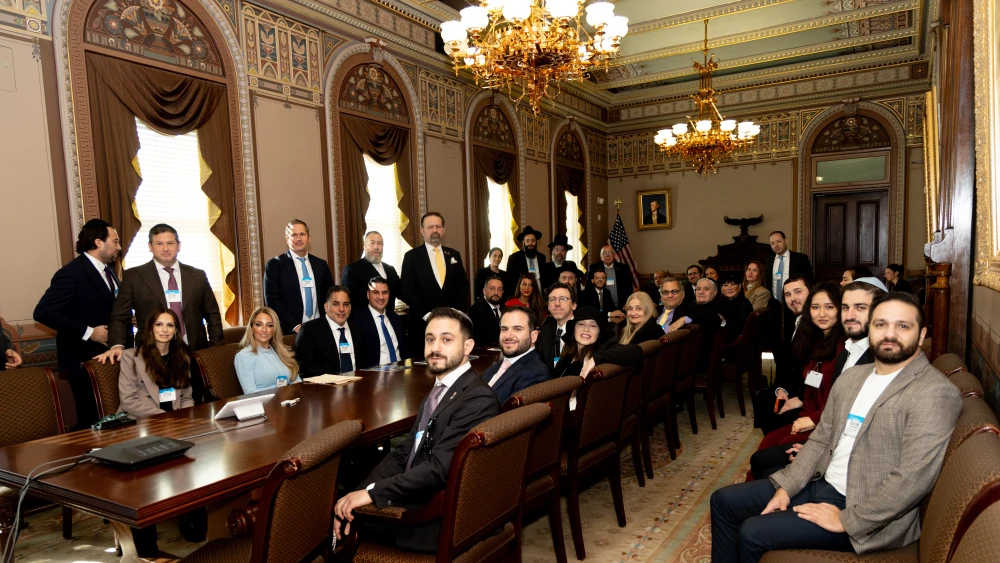
A delegation of some 50 people, including an unusually wide array of Sephardic rabbis and community leaders, held a meeting at the White House earlier this month.
“Greater Sephardic communities have been underrepresented both within the Jewish community and more broadly in civic life,” Jason Guberman, executive director of the American Sephardi Federation, told JNS.
The meetings at the White House and in the Capitol on Nov. 18 and 19 were a “historic first, bringing together rabbis and communal leaders from all the major Greater Sephardic communities across the United States,” according to Guberman, who attended the meetings.
Guberman credited Allen Yehuda Azoulay, founder of the Sephardic Legacy Series, with organizing the gatherings, which he said brought together “Babylonians, Bukharans, Egyptians, Moroccans, Persians, Spanish and Portuguese and Syrians.”
Those leaders and communities haven’t always been represented collectively in national Jewish and civic life, he told JNS.
“American Sephardi leaders bring a different perspective, one rooted in the knowledge that we do not exist to resist antisemitism but rather to achieve a positive purpose in the world,” he said.
He said that the American Sephardi Federation engages with the U.S. government in a way that is “communal, cultural, historical and diplomatic rather than political.”

Ezra Friedlander, founder and CEO of Project Legacy, also helped organize the event, which he told JNS was “an opportunity for the emerging Sephardic community, which is emerging as a major powerhouse in American Jewish life, to make their voices heard, which they did.”
He said that the mission met with “very high-ranking officials in the White House and in Congress,” and with members of the diplomatic community.
“We had serious discussions about the number one issue being antisemitism, both on the global stage, but also here in the United States and what is being done,” he said.
The group had a briefing within the White House complex and a breakfast in the Capitol, he told JNS. It also held discussion about creating a national organization to represent Sephardic interests.
Azoulay said that the delegation marked a milestone in his nearly two-decade effort to increase Sephardic Jewish representation and recognition in U.S. public life.
“Leading this delegation to the White House and Capitol Hill was an important milestone,” he told JNS. “More importantly, it was the beginning of something much greater.”
“Our goal is to establish a unified national Sephardic voice in Washington, bringing together Sephardic organizations and community leaders from across America to strengthen political advocacy, combat antisemitism, support Israel and ensure our community has a meaningful seat at the table where decisions are made,” he said.
At the Eisenhower Executive Office Building, the delegation received a briefing from Sebastian Gorka, deputy assistant to the U.S. president and senior director for counterterrorism at the National Security Council. It also toured the White House.
Leo Terrell, senior counsel to the assistant U.S. attorney general for civil rights and head of the federal Task Force to Combat Antisemitism, also addressed participants, and the group had breakfast in the Capitol with Reps. Buddy Carter (R-Ga.), Grace Meng (D-N.Y.), Tom Suozzi (D-N.Y.) and Joe Wilson (R-S.C.).
Ambassadors and other diplomats from Paraguay, Kosovo, Hungary, Oman, Switzerland, Bosnia and Herzegovina, Burkina Faso, Thailand and Togo also met with the group.
The delegation included Rabbi Shlomo Farhi of Edmond J. Safra Synagogue, an Orthodox Sephardic congregation on Manhattan’s Upper East Side, and Rabbi Moshe Douek of Congregation Sharee Tefila Bene Moshe, an Orthodox Sephardic synagogue in Eastontown, N.J.
“Sephardic Jews have been part of America’s history since 1654,” Azoulay told JNS. “It is time we take a more prominent role in shaping its future.”