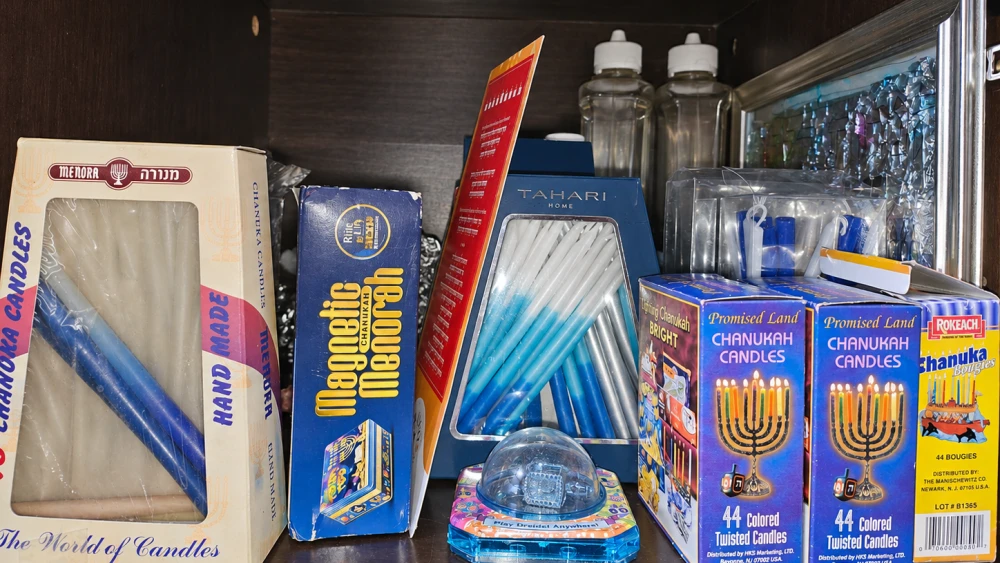
Chanukah celebrates both the Maccabean military victory and liberation of the Jewish Temple and the miracle of a single jug of pure olive oil, typically sufficient only to light the menorah for a single day, lasting for eight days.
A minor “miracle” that echoes that Temple-era one, sources told JNS, can be finding sufficient candles left over from previous Chanukah holidays in one’s home to light a Chanukah menorah—called a chanukiah—for the entire holiday.
Rabbi Steven Burg, CEO of Aish, told JNS that the impulse to hold on to extra candles reflects the Jewish concept that “nothing is insignificant.”
“Everything in this world has the potential to be used for something sacred,” he said.
The rabbi noted the Biblical story in which Jacob ended up wrestling with an angel after turning to retrieve some small vessels left behind. Rashi, the renowned 11th-century commentator, noted that Jacob went to get “these little vessels that might otherwise have seemed insignificant,” Burg told JNS.
“We love the mitzvah so much that we overprepare,” he said. “We buy extra candles, because you never know who’s coming, where we’ll be or what we might need.”
JNS ran an informal survey between Nov. 9 and 15 that drew responses from 87 Jewish women on behalf of their households. Nearly 80% live in the United States, about 10% in Israel, about 8% in Canada and 1% in Australia.
Some 90% of those who responded said that they had leftover candles from prior years, and 49% said that they had enough—44 candles—to light at least one menorah for all eight nights. More than a quarter (26%) had enough candles to light multiple menorahs with leftover candles.

“We usually have leftover candles, but then my mom goes out and buys new ones anyway,” one respondent said.
Another said that she sometimes uses extra Chanukah candles for birthdays.
“I buy too many every year,” a respondent wrote. “I live in a place that doesn’t have a large Jewish population, so I tend to over-buy in hopes they’ll continue to have items I need.”
The largest age groups to take the survey were 36-45 and 46-55. About 45% identified as Orthodox or Modern Orthodox. Others identified as Conservative, Reform, Reconstructionist, Chabad and Dati Leumi.
The informal results reminded Burg of a White House Chanukah party that he attended years ago. An organizer told him that they always keep extra aluminum foil on hand. Burg assumed it was to make sure the White House kitchen was kosher.
The organizer laughed and said, “No, it’s because all the women ask for it.”
When Burg looked around, guests were wrapping Chanukah cookies in foil and slipping them into their purses. Burg asked one about the cookies. “They’re for my grandchildren,” she told him.
“I thought, ‘How Jewish is that?’” he said. “Even at the White House, we’re thinking about what we can bring home to make someone else happy.”
“Whether it’s a little vessel that Yaakov refused to leave behind, an extra Chanukah candle saved for next year or a cookie brought home for a grandchild, we believe that everything has value and everything can be used to bring more light, more holiness and more joy into the world,” Burg told JNS.
“Perhaps that’s the real little Chanukah miracle here,” the rabbi said. “We buy more light than we need, and somehow, year after year, there’s always more light left to share.”
‘A wonderful problem to have’
Mirit Shalvi, senior vice president of marketing and strategic partnerships at Kayco, parent company of Manischewitz, which sells Chanukah candles, told JNS that “Chanukah is one of those holidays where the anticipation is part of the celebration.”
“Families begin preparing weeks in advance, shopping for everything from candles and chocolate gelt to ingredients for latkes and sufganiyot,” Shalvi said. “With Chanukah beginning at sundown on Dec. 4 this year, we expect holiday shopping to build throughout November, especially as families begin planning their celebrations.”

“Buying candles is one of those little rituals that signals the holiday is almost here,” she said. “Chanukah candles don’t really have an expiration date, so there’s no need to worry about keeping them fresh in the traditional sense.”
“The key is proper storage,” she told JNS.
Shalvi recommended keeping candles in their original packaging “in a cool, dry place, away from direct sunlight or heat, which can cause them to soften, bend or stick together.”
“If someone has a drawer full of leftover Chanukah candles, I say that’s a wonderful problem to have,” she told JNS. “It means there’s been a lot of light and celebration in that home.”
“If you have candles left over from last year, there’s no reason not to use them, as long as they’re in good condition, fit securely in your menorah and can be burned safely,” she said.
“Chanukah is about celebrating light, and there’s something meaningful about carrying a little of last year’s celebration into the next,” she said.
Hedy Cardozo, a social worker in Rye Brook, N.Y., who took the informal survey, told JNS that she keeps her household’s leftover Chanukah candles stored in a sideboard drawer with “other candles, serving flatware and yarmulkes.”
She has “only a few left from last year,” and she always buys blue, white and silver candles, so they won’t mismatch.
Cardozo buys a brand new package of candles from Home Goods or Target, and she starts by lighting the menorah each year with the leftover candles before opening a new box, she told JNS.
Jodi Shapiro, a student in Haifa, in Israel, who is from Beachwood, Ohio, told JNS that “our leftovers are the colors that we don’t like as much but we eventually use them.”
“I’ve definitely pieced together lighting from mismatched leftovers,” she told JNS after taking the informal survey.
She has also reached for the supply during the rest of the year to “transfer an existing flame on Yom Tov,” she said.