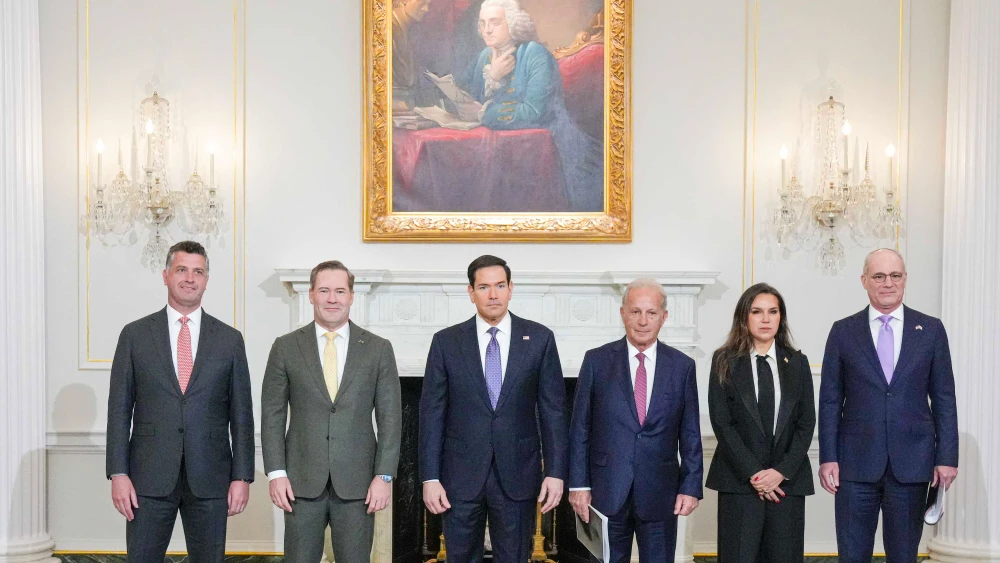

Never before have Israel and Lebanon conducted face-to-face talks at such a high diplomatic level, with the flags of the two countries—still formally at war—placed side by side. But since Tuesday in Washington, senior officials from both governments have begun discussions, joined by U.S. Secretary of State Marco Rubio, Lebanese Ambassador Nada Hamadeh and Israeli Ambassador Yechiel Leiter—an opportunity, at last, for an exchange of ideas and a measure of hope.
Both the Lebanese and Israeli governments appear willing to speak seriously, even at such a difficult moment. Yet looming in the background is Hezbollah, which has already declared it will never disarm—the central issue of the dialogue.
The question is decisive and nearly impossible to resolve, yet it could also offer a possible pathway toward easing tensions in the broader war between the United States and Iran. Lebanon could become a strategic currency in negotiations over the Strait of Hormuz and potentially help extend the current ceasefire. In such a scenario, U.S. President Donald Trump could press more forcefully on the issue of enriched uranium, without which there will be no real exit from the conflict.
Meanwhile, clashes on the ground continue. An IDF soldier was killed and three others were wounded on Tuesday in a difficult theater of war, as Israeli strikes in Lebanon targeted Hezbollah’s armed presence in Southern Lebanon and the Bekaa Valley.
Hezbollah has launched attacks twice during the current war: first after Oct. 7, firing some 12,000 rockets in coordination with Hamas. That attack failed strategically but forced the evacuation of northern Israel. Many communities remain largely empty, with only a few residents remaining under constant bombardment, while Israeli forces operate in Bint Jbeil, a Hezbollah stronghold.
A November 2024 agreement with the Lebanese government envisioned the disarmament and withdrawal of Hezbollah forces. That did not occur, and recent attacks have underscored the government’s limited ability to impose its authority. The United States is now urging restraint, while parts of Europe place responsibility on Israel.
Beirut has remained relatively calm for three days, yet fighting continues in southern Lebanon. Israeli television screens—even during Yom Hashoah commemorations, which focused on Holocaust survivors—continued to display updated lists of areas where civilians were instructed to seek shelter.
Any agreement that would allow Israeli forces to withdraw will require guarantees that currently collide with reality: the Lebanese government does not exercise full control over all armed forces operating on its territory.
Lebanon continues to suffer from deep internal fractures and from a history of external domination—first Syrian, then Iranian—that weakened the state and impoverished its population.
Hezbollah cannot realistically expect to maintain both its weapons and territorial control indefinitely, as doing so would ensure the continuation of conflict with Israel, which has repeatedly sought to neutralize the organization but has also found itself drawn back into repeated confrontations.
In northern Israel, the suffering of displaced residents continues, with many forced to leave their homes or spend nights in bomb shelters. Lebanon, too, faces internal strain, including the displacement of Shi’ite populations, while other religious and ethnic communities increasingly express frustration with Hezbollah’s role in prolonging the conflict.
While the Lebanese government is searching for a path that avoids internal confrontation, Israel is unlikely to accept compromises that allow an armed force committed to its destruction to remain in place.
Lebanon today represents more than its geographic borders. It is a significant strategic card in the broader war now underway—the strongest Iranian proxy, engaged in conflict largely to defend the Islamic Republic even before defending itself.