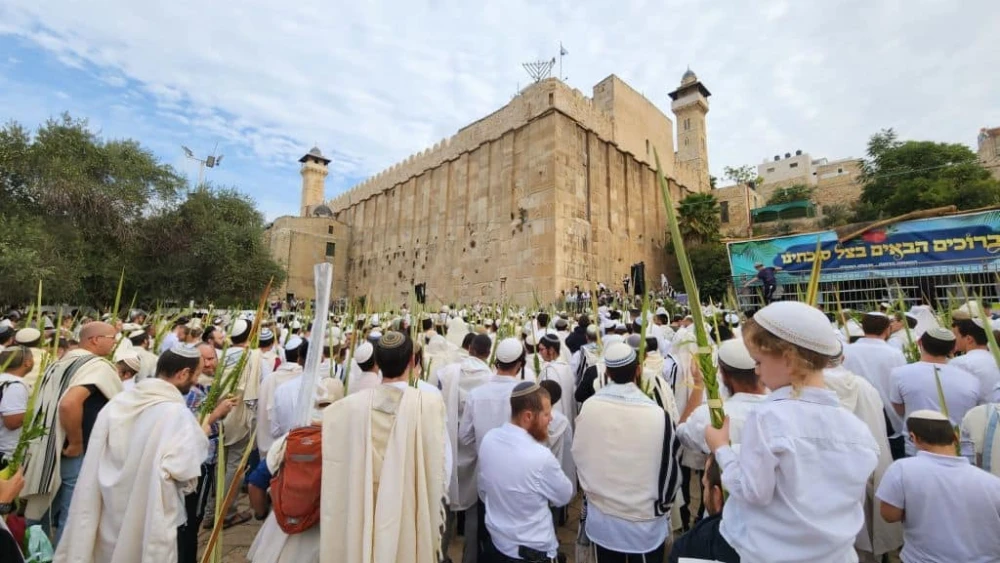
While the traditional Priestly Blessing at the Western Wall in Jerusalem’s Old City is the best known Israeli highlight of the Sukkot holiday, thousands of Jews visited Hebron and its Tomb of the Patriarchs on Tuesday.
The tomb is the burial place of the biblical patriarchs Abraham, Isaac and Jacob, along with their wives, and is Israel’s second-most visited holy site.
“Thousands of participants at Hallel prayer in the place where our ancestors lived,” tweeted Israeli Heritage Minister Amihai Eliyahu. “This is the place where we feel the deep connection with them. Hebron, forever and ever.”
The tweet was accompanied by a video showing Jews in prayer.
Visitors enjoyed guided tours of the holy site, and musicians provided entertainment.
For security reasons, the tomb is divided into Jewish and Muslim areas. A rotation system allows Jews and Muslims to occasionally visit each other’s side on certain holidays. Jews were able to visit Isaac’s tomb on Monday and Tuesday.
Sukkot is a festive week-long holiday associated with the end of the harvest season and comes shortly after the more solemn High Holidays. It is celebrated by eating and sleeping in outdoor booths called sukkot. Fronds of palm, willow and myrtle are traditionally waved with a citron during morning prayers.
The current structure around the Tomb of the Patriarchs was built by King Herod the Great 2,000 years ago. Byzantine and Crusader conquerors turned the site into a church. During the Mamluk conquest, the site was converted into a mosque and Jews were banned from going past the seventh step of a staircase outside the building.
Israel captured Hebron from the Jordanians during the 1967 Six-Day War, making it available to worshippers of all faiths.
An elevator making the tomb fully accessible was inaugurated in June. The $1.6 million project also included a sloped path linking the parking area to the tomb.