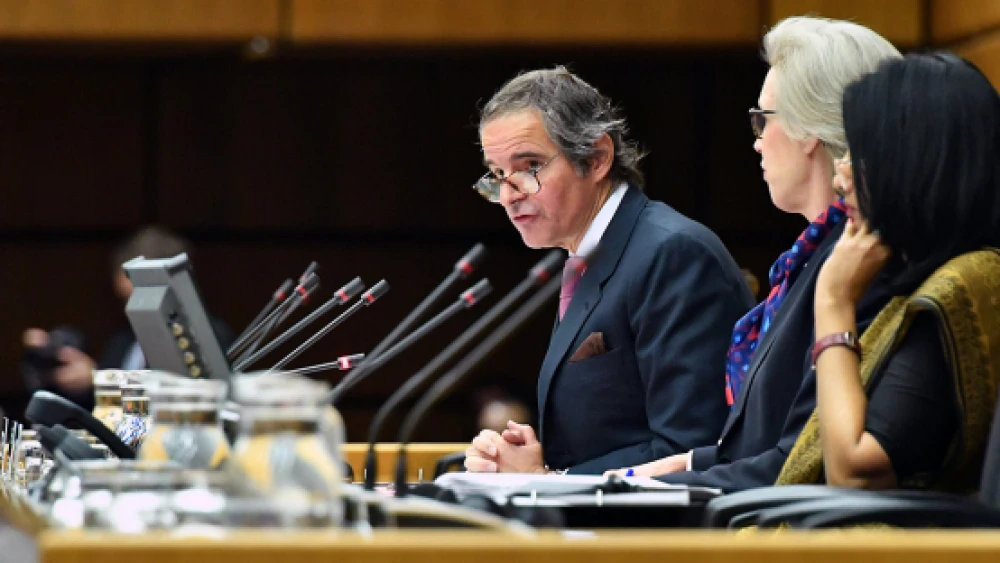
Amid ongoing talks in Vienna regarding a possible U.S. return to the 2015 nuclear agreement with Iran, the head of the United Nations’ nuclear watchdog warned in an interview published on Tuesday that “you cannot put the genie back in the bottle.”
International Atomic Energy Agency director general Rafael Grossi told the Financial Times that while most of the measures taken by Iran since the United States unilaterally exited the Joint Comprehensive Plan of Action (JCPOA) in 2018 could be reversed, the level of research and development that has taken place since then is an “issue.”
“The Iranian program has grown, become more sophisticated, so the linear return to 2015 is no longer possible. What you can do is keep their activities below the parameters of 2015,” he said.
The only way to accomplish this, he said, is through verification.
Grossi noted that Iran has now stockpiled 10 times the 300 kilograms (661 pounds) of enriched uranium stipulated by the accord, including some to near-weapons grade.
Iran announced on April 13 that it had notified the IAEA of its intent to begin enriching uranium to 60 percent purity, far above the 3.67 percent level stipulated by the JCPOA. Iran had already begun enriching uranium to the 20 percent level in the preceding months. The nuclear watchdog confirmed just days later that Iran had indeed begun the process of enriching to 60 percent, at its Natanz nuclear facility.
“A country enriching at 60 percent is a very serious thing—only countries making bombs are reaching this level,” Grossi told the Financial Times. “Sixty percent is almost weapons grade, commercial enrichment is 2, 3 [percent].”
While it is Iran’s “sovereign right” to develop its nuclear program, he said, “This is a degree that requires a vigilant eye.”
“It’s obvious that with a program with the degree of ambition, sophistication that Iran has, you need a very robust, very strong verification system ... otherwise it becomes very fragile,” he added.
Iran restricted its cooperation with IAEA inspectors in February, although it agreed to allow some monitoring to continue for a three-month period that was extended this week until June 24, six days after Iran’s presidential elections.
Grossi told the Financial Times that the arrangement would ultimately be “unsustainable.”
“We are entering a phase where we have to take [things] ... one week at a time and see how the other process [the Vienna negotiations] evolves,” said Grossi.