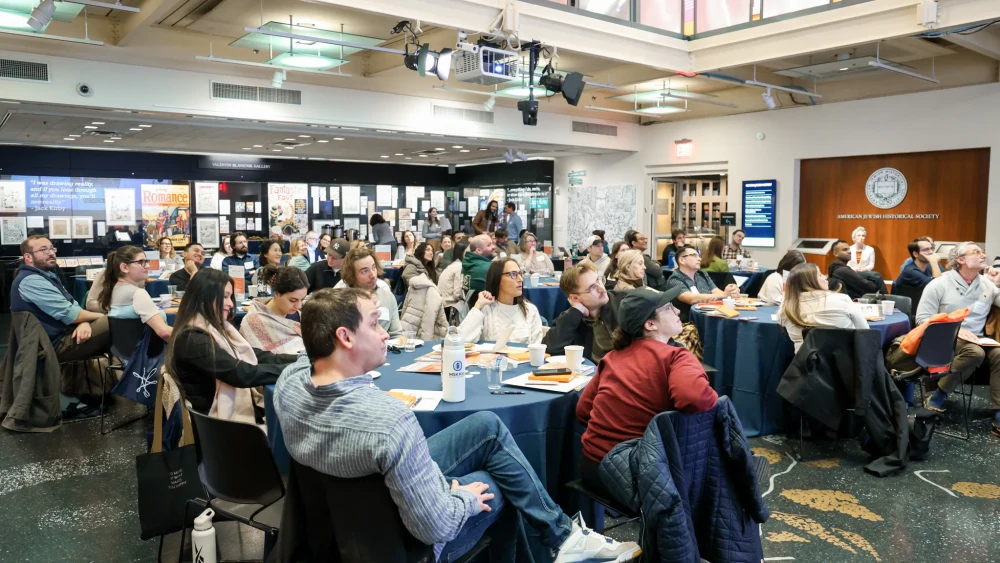
The Center for Jewish-Inclusive Learning, a division of The Jewish Education Project, hosted K-12 educators, curriculum specialists and instructional leaders at its Nov. 16 conference, “Jews in the Curriculum: Opportunities & Challenges in Humanities Classrooms.” The full-day gathering at the Center for Jewish History in Manhattan helped English language arts and social studies educators deepen their understanding of Jewish history and identity and explore practical tools and resources for incorporating the Jewish story into their teaching.
The conference featured Mijal Bitton, a scholar; Daniel Braunfeld and Juan Castellanos of Facing History & Ourselves; and Natalia Mehlman Petrzela, professor of history at The New School. Speakers explored the complexity of Jewish identity, the Jewish people’s place in world history and opportunities to strengthen how schools teach Jewish history and contemporary issues.
“At a time when understanding across differences feels increasingly important, we have an opportunity and a responsibility to ensure that the Jewish experience is meaningfully represented in our classrooms,” said David Bryfman, CEO of The Jewish Education Project. “This conference created space for humanities teachers to ask questions, challenge assumptions, engage with experts, and gain practical tools for bringing Jewish stories, voices, and perspectives into their teaching. Ultimately, this is about helping students develop a richer understanding of the Jewish experience and the complex, diverse world in which we live.”
Through presentations and interactive workshops, participants examined approaches to teaching about antisemitism, the Holocaust, Israel and other historical and contemporary issues. The program offered educators with varying levels of familiarity with Jewish history opportunities to build knowledge, explore resources and strengthen classroom instruction.
Breakout workshops included “Dismantling Antisemitism in a Polarized World: Moving Beyond the Binary” with Zachary Schaffer; “Teaching the History of the Arab-Israeli Conflict Using Primary Sources” with the Institute for Curriculum Services (ICS); “Contemporary Issues in Holocaust Education” with Echoes & Reflections; “Weaving Jewish Voices into World History” with Project Mosaics; and “Between the Lines: Teaching Critical Media Literacy Across Humanities” with ConnectED.

For an English language arts high school teacher in Queens, the conference sparked an idea for a classroom project inviting students to explore misunderstood aspects of their identities.
“Why do we have to simplify it? Why not let them struggle with the complexity?” she said. She envisioned students selecting artifacts that express how they define themselves, potentially creating a classroom or a grade-wide museum. “That’s something that I’m very excited to do and I can do soon.”
A ninth- and tenth-grade social studies teacher in Manhattan highlighted both practical teaching resources and the opportunity to connect with fellow educators. A session with Facing History & Ourselves introduced her to a resource she found helpful to teach students about the diversity of the Jewish people. She said, “It’s just nice to be in community with teachers who also care about this issue and this topic and are trying to navigate it in the most humane way.”
The conference reflects the Center for Jewish-Inclusive Learning’s ongoing commitment to helping educators navigate complex conversations about Jewish identity and history with greater knowledge, confidence and cultural competence. Through partnerships with public and independent schools, the center provides curated resources, professional development and consultation to support Jewish-inclusive learning environments.
The gathering builds on the Center for Jewish-Inclusive Learning’s broader efforts, including its May “Educational Leadership Conference on Antisemitism & Jewish Inclusion,” which brought together more than 200 New York City district leaders, educators and counselors. The center also maintains a digital resource library to help teachers incorporate Jewish history, identity and perspectives into their classrooms.