


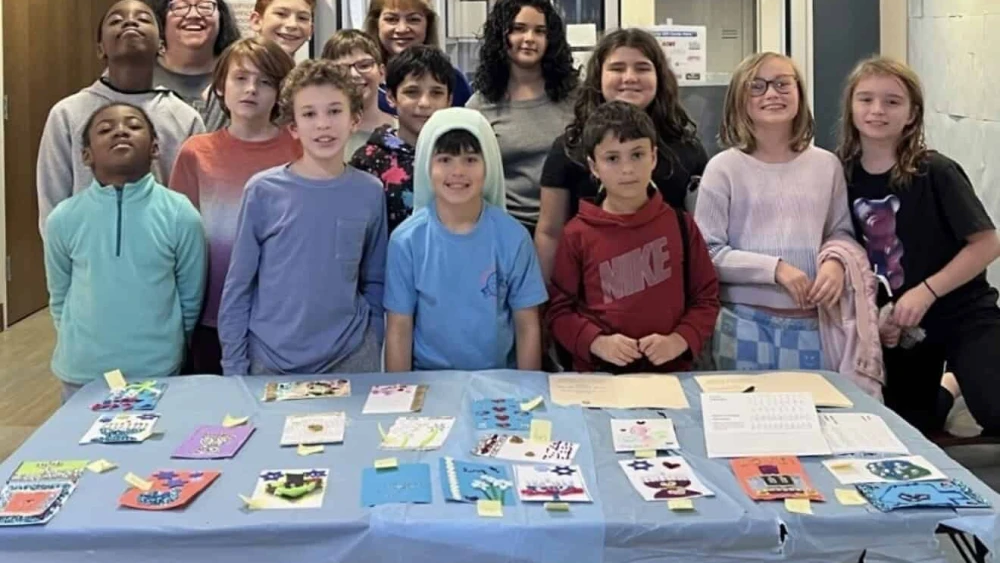
As Chanukah draws near, JBI Library is bringing the holiday to life in a way that can be felt—literally. Earlier this fall, the organization, which provides free accessible Jewish materials for people who are blind, have low vision or have a print disability, launched its first-ever Tactile Chanukah Card Initiative.
More than 100 groups requested pre-brailled, large print cards from JBI; volunteers then added tactile artwork—fabric, raised shapes and textured materials—so that the designs can be experienced by touch.
For blind and low-vision recipients, the decorations transformed a simple holiday greeting into something they could feel, not just read, bringing joy to many who might otherwise experience the holiday in isolation. More than 3,500 completed cards have been sent, and the organization is expecting thousands more that will continue to go out in the coming weeks as completed designs are returned to JBI Library.
“The holidays are a time of togetherness, but it can be easy to overlook the importance of inclusive traditions—whether that be lighting a candle, reading a prayer, preparing and sharing a meal, attending a gathering, or giving a card—where people with disabilities can fully participate,” said JBI executive director Michelle Shapiro Abraham.
“This simple activity of tactile-card creation not only encourages us to think about what an accessible holiday tradition might look like, but also brings us together to create, celebrate and build connections throughout our community of clergy, educators, volunteers, patrons and community members,” she said.
For many recipients, the cards have already made a deep impact. One patron, Deborah from Lake Tapps, Wash., wrote: “I received the most wonderful surprise in my mailbox over the weekend—a tactile Hanukkah card made by Becca at Congregation Beth Emeth in Albany, N.Y. I can’t tell you how much it means to be thought of.”
JBI patron Sharlene Wills wrote: “I wanted to extend my heartfelt thanks for the beautiful, tactile Chanukah card which I received from Rebecca of Maryland. It is so much more meaningful to me, a blind person, to receive a card that I can truly appreciate—for the braille inscription, and the fact that the picture and design are tactile. What a lovely thing to do for us!”
Volunteers report feeling equally inspired. At Congregation Emanu-El in New York City, the Women of Emanu-El created some 140 cards in a single afternoon. Women of Emanu-El initiative leader and JBI board member Andrea Brown said, “The enthusiasm in the room was palpable. Several people immediately volunteered for future JBI projects. It felt wonderful to do something ‘crafty’ and know the cards will be appreciated.”
This project wouldn’t have happened without generous funding provided by donors, including Brown, who saw the potential for this project to reach thousands of people who can now refer friends and loved ones to JBI, educate people of all ages about blindness and low vision, and make JBI’s patrons feel connected and cared for during the holiday season.
The project is already strengthening connections across Jewish communities. Many leaders and volunteers—some learning about JBI for the first time—are sharing news of JBI’s other free services also, which include a large circulating library of Jewish-interest books, accessible book clubs and “chat hours,” and cultural and educational programming that ranges from guest speakers, to poetry and memoir workshops, to Judaism 101 courses and Jewish holiday and food events free and inclusive for those who are blind, have low vision or other print disabilities that make reading traditional print books a challenge.
“Every handmade card is a reminder that no one celebrates alone,” said Shapiro Abraham. “We’re grateful to every group helping us bring warmth and connection to people who might otherwise feel isolated during the holidays.”
Learn more at: https://jbilibrary.org/news/jbi-library-2025-chanukah-card-project.



