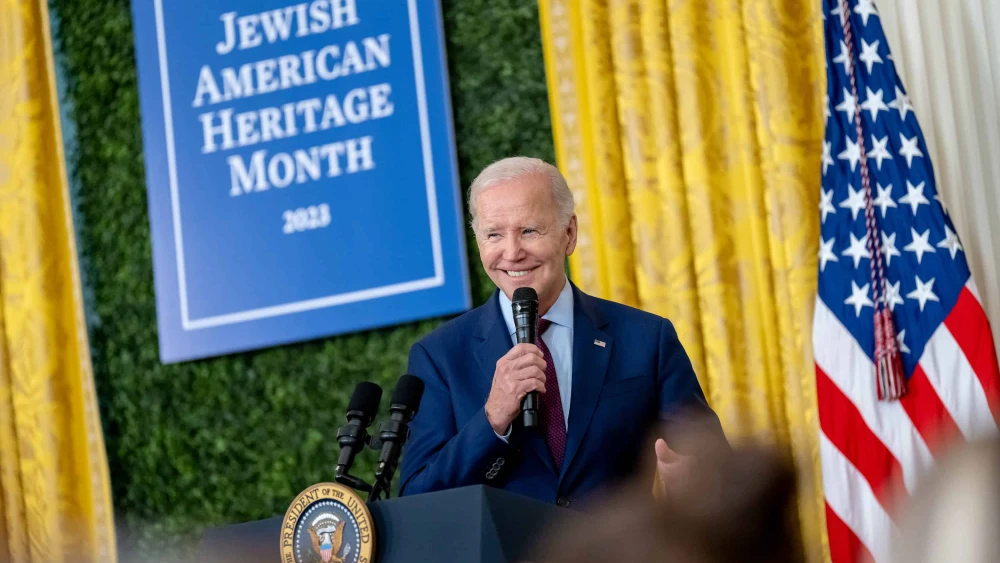
There are positive signs that threats to the American Jewish community are being taken seriously. The U.S. National Strategy to Counter Antisemitism, released in May, was a historic move by the White House. Now, there is an expansion of civil-rights protections for Jewish Americans. Words are being put into action, but more concrete steps are still needed.
The Biden administration recently announced that eight cabinet-level agencies are broadening their interpretation of the Civil Rights Act of 1964 to tackle antisemitism in federally funded programs and activities, just as the U.S. Department of Education has done since 2004.
Title VI of the Act prohibits discrimination on the basis of race, color or national origin—but not religion—in programs or activities receiving federal financial assistance. The White House decision adopts the so-called “Marcus Doctrine,” which provides protection to groups like Jewish Americans who share ethnicity or ancestry.
This announcement follows a push to expand Title VI protections by Kenneth L. Marcus, founder of the Louis D. Brandeis Center for Human Rights Under Law, to include faith-based groups, like Jews and Sikhs, among others, that have shared ethnic, ancestral or “peoplehood” characteristics. In 2004, on behalf of the U.S. Department of Education, Marcus clarified that Title VI protections must extend equally to Jews to the same extent as other ethnic or racial groups.
This policy was affirmed in 2010 by the Obama Justice and Education Departments after a concerted effort by several Jewish organizations. In 2019, this same policy became a key component of the Trump Executive Order on Combating Antisemitism. Former President Donald Trump’s order extended the Marcus Doctrine beyond the Education Department to other federal agencies. Until this announcement, those agencies had not formally affirmed adherence to this policy.
The new Title VI protections will be applied to eight federal agencies: the Departments of Agriculture; Health and Human Services; Homeland Security; Housing and Urban Development; Interior; Labor; Treasury; and Transportation. The protections already were under review at the Departments of Education and Justice. Islamophobia and other forms of ethno-religious discrimination also will be covered, provided that they include ethnic or ancestral bias.
The Health and Human Services Office for Civil Rights responded by asserting: “Americans deserve to receive the care they need regardless of what they look like or believe in.” HHS provided this example: “An ER patient requests that a hospital change his attending physician because the patient associates the physician’s surname with Judaism and/or Israel, and the hospital honors the request.” The reference to the doctor’s last name is an example how the civil rights of a Jewish physician can be violated based on religion, shared ancestry, ethnicity or national origins.
Jewish organizations celebrated the expansion of rights protections. The Conference of Presidents of Major American Jewish Organizations welcomed “these measures to finally ensure that antisemitism is not treated as a second-class form of bigotry in the eyes of federal agencies, particularly with regard to antisemitism on college campuses.”
Anti-Jewish and anti-Israel discrimination continues to be a significant issue at universities across the nation. However, the Department of Education’s Office of Civil Rights currently is burdened with a backlog of cases and a staffing shortage. This has led to a push in Congress to increase appropriations funding.
In many instances, cases drag on for years, and students graduate without resolution to their incident. “It is vital for OCR to figure out how to resolve its extensive backlog of investigations into campus antisemitism,” said StandWithUs founder and CEO Roz Rothstein.
Some commentators, including Marcus, have argued that this policy is insufficient without also including clear guidance on how antisemitism will be defined. In 2010, the U.S. State Department developed an antisemitism definition almost identical to the one eventually adopted by the International Holocaust Remembrance Alliance (IHRA) as its working definition of antisemitism.
President Joe Biden’s new directive does not mention IHRA. “Applying the IHRA Working Definition helps people recognize what forms antisemitism can take,” stated Special Envoy to Monitor and Combat Antisemitism Ambassador Deborah Lipstadt, who recently released a Report on Policies, Programs and Actions Across the Globe to Combat Antisemitism.
The Brandeis Center’s Marcus welcomed the civil rights expansion but noted that none of the eight agencies committed to using the IHRA definition: “There’s still unfinished business in terms of the administration’s approach to IHRA and making it applicable across the board.” Marcus also added that the U.S. government must fully recognize Zionism as an inalienable element of the Jewish people.
Points to consider:
- The U.S. National Strategy and Title VI expansions are only the first steps.
The new initiatives are commendable in the fight towards safeguarding the rights and security of American Jews. These initiatives demonstrate the government’s commitment to combating anti-Jewish hatred, paving the way for increased awareness and accountability. However, a more comprehensive and sustained approach is needed. The White House, elected officials at all levels of government, business leaders, celebrities, sports leagues, cultural institutions—all Americans—must act. Only concrete actions can confront antisemitism. There are a range of resources and Jewish organizations devoted to countering anti-Jewish bigotry and promoting Jewish history, religion and culture that can be consulted by individuals and groups.
- The IHRA definition must be included in Title VI policy.
Many American Jews and supporting organizations believe the national strategy and new Civil Rights Act expansion do not go far enough in addressing the many forms of antisemitism. The failure of the eight agencies to fully adopt the IHRA working definition in their guidance materials—when it is already so widely accepted, including by the Executive Office of the President, and the Education Department and the State Departments—has left many leaders of the Jewish community disappointed. While these important Title VI steps are commendable, they don’t measure up to previous executive orders.
- The Department of Education must act promptly to resolve cases of anti-Jewish hatred.
In recent years, escalating incidents of anti-Jewish hatred have been reported on campuses across the country, posing a serious threat to the well-being and academic experience of Jewish students and staff members. To address this pressing issue effectively, the Department of Education must take swift and decisive action to resolve incidents. Launching a campaign urging it to complete investigations of campus antisemitism, StandWithUs CEO Roz Rothstein stated: “Jewish students who face discrimination should not have to wait until after they graduate to see their universities held accountable by the Department of Education.” Justice delayed is justice denied.
- Jewish identity must be both protected and celebrated.
There is a concerted effort to erase and deny shared Jewish ethnicity, especially on university campuses. Jewish identity is highly personal and means different things to different Jewish people. Jewish identity spans a wide landscape covering religion, culture, ethnicity, tradition, connection to Israel and a shared almost 4,000-year history as a people. American Jews should not fear wearing a kippah (yarmulke) or a Star of David or be forced to decide whether they should hide their Jewish identity for their own safety. Every expression of Jewish identity and culture should be freely celebrated and protected. It’s not just identity that must be protected; it’s people, too.