Newsletter
Newsletter Support JNS

Argentina increases border security following tip of bomb plot against Jewish target

Security authorities are investigating the identity of the perpetrator mentioned in the tip.

AMIA Jewish center
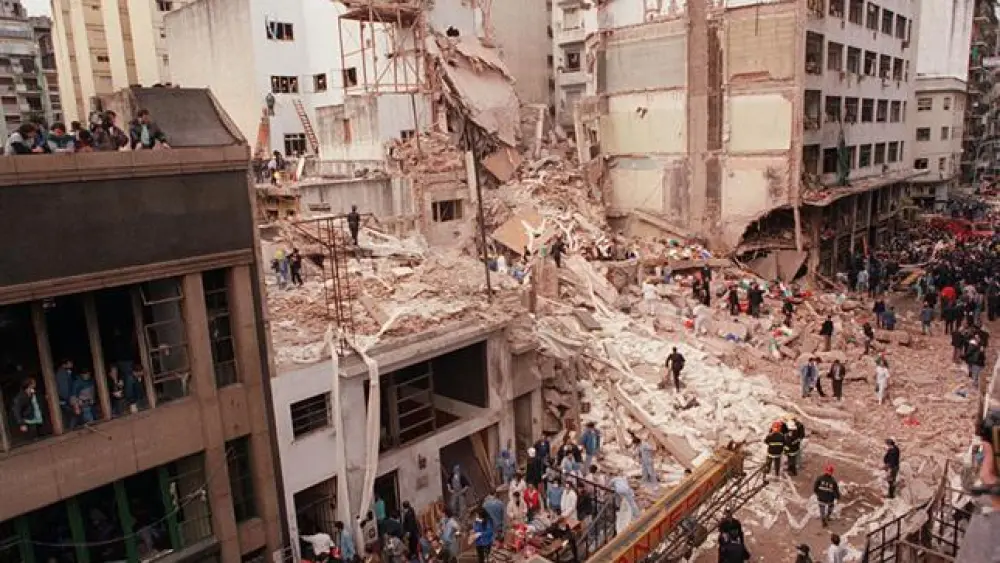
The ruins of the AMIA Jewish Community Center after the 1994 bombing in Buenos Aires. Credit: La Nación via Wikimedia Commons.

Argentina announced on Saturday that it is going to tighten security at its border with Paraguay after its embassy in Britain received an anonymous tip about a person possibly smuggling bomb-making materials into the country through that border.

The tip warned about the transfer of ammonium nitrate “for a bomb with a Jewish objective,” the Argentinean Security Ministry said in a statement reported by Reuters.

Security authorities are investigating the individual mentioned in the tip.

In 1992, the Israeli embassy in Buenos Aires was attacked with a car bomb, killing 29 people; in 1994, a truck bomb blew up the AMIA Jewish community center there, killing 85.

Iran and its proxy Hezbollah were implicated in these attacks, and Hezbollah has used Paraguay as a base for its illicit financial operations.

As NATO leaders meet in Ankara, JNS spoke with former U.S. envoy James Jeffrey and JINSA’s Blaise Misztal about why U.S. and Israeli officials disagree about Turkey.
“Iran’s demonstrated aggression was unwarranted, dangerous and a clear violation of the ceasefire,” CENTCOM said.
The organization asked the court to reconsider, arguing that it could be forced to suspend operations in the state and nationwide if the designation takes effect.
The 19-year-old waived trial after prosecutors said that he conspired to join ISIS and communicated about “violence against Jewish people,” per a federal filing.
Rabbi Aaron Starr, rabbi of Shaarey Zedek and president of the Michigan Board of Rabbis, declined to comment directly on Dr. Abdul El-Sayed but told JNS, “look at what he says about ‘genocide’ and who his funders are.”
“Contemporary Antisemitism 2026" explores ways that can influence how cultures identify, understand, and confront anti-Jewish and anti-Israel sentiment.