


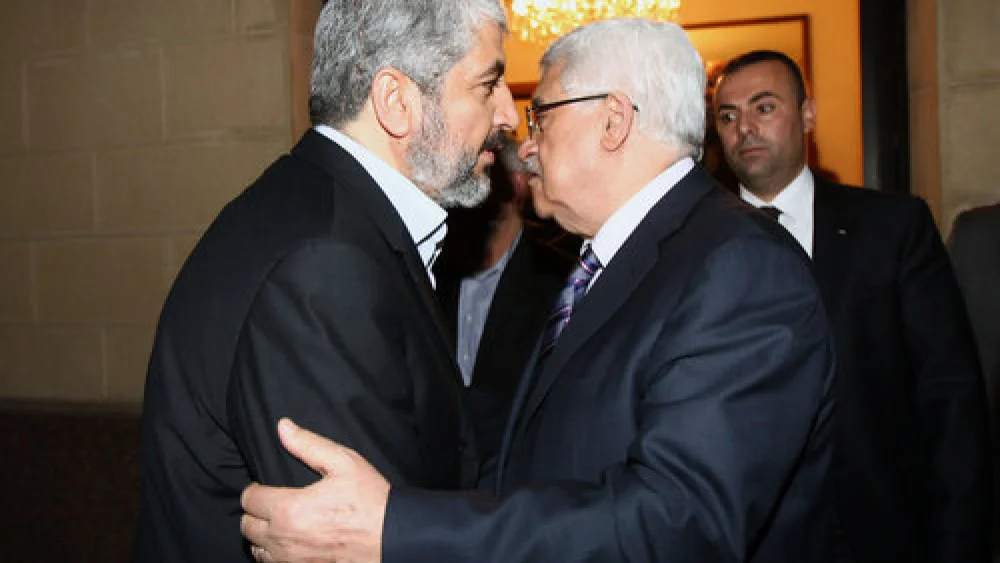
Palestinian Authority chief Mahmoud Abbas’s Fatah faction has reiterated its desire to reconcile with Hamas, China’s Foreign Ministry announced on Tuesday following talks in Beijing.
Representatives of Fatah and Hamas recently held negotiations in the Chinese capital with a view to forging a Palestinian unity government.
Fatah reportedly dispatched Azzam al-Ahmad, a member of the Executive Committee of the Palestine Liberation Organization, and Samir al-Rifai, a member of Fatah’s Central Committee.
The Hamas delegation was led by the deputy head of its political bureau, Moussa Abu Marzouk, and included senior officials such as Khalil al-Hayya and Hossam Badran.
In February, Fatah and Hamas officials converged on Moscow for a two-day “national dialogue” on forming a unity government under the auspices of the Russian Foreign Ministry.
Earlier that month, at the invitation of Qatari Emir Sheikh Tamim bin Hamad Al Thani, Abbas traveled to Doha to discuss ways to incorporate Hamas into a P.A.-led government for Judea, Samaria and Gaza.
Hamas is an “essential part of the Palestinian political mosaic,” then-P.A. Prime Minister Mohammad Shtayyeh told world leaders gathered in Qatar on Dec. 10.
“We want a situation in which Palestinians are united. … I think it is time that Hamas call the Palestinian president and tell him we’re all united behind you, and you are the legitimate authority of the Palestinian people and we are ready to engage,” Shtayyeh stated at the Doha Forum, an annual event sponsored by the state of Qatar.
Amid the unity talks, Shtayyeh submitted the collective resignation of his government last month. Abbas then appointed Fatah loyalist Mohammad Mustafa to fill the prime minster’s role.
The United States wants the P.A. to assume control of Gaza after Israel’s war against Hamas ends, a move that Jerusalem rejects because of Ramallah’s overt support for terrorism.
On Jan. 27, Abbas’s spokesman told Al Arabiya that the P.A. is prepared to hand over the reins to Hamas if it won a general election. Ramallah is “prepared to hold general elections, and if Hamas wins, the president will hand over the Authority,” Nabil Abu Rudeineh said.
The U.S. State Department has refused to rule out Hamas retaining power in Gaza or even joining a P.A.-led governing body that would also have jurisdiction in Judea and Samaria.
According to recent polls, 89% of Palestinians support establishing a government that includes or is led by Hamas. Only around 8.5% said they favor an Authority controlled exclusively by Fatah.
Israeli Prime Minister Benjamin Netanyahu has repeatedly emphasized his opposition to the P.A. taking over Gaza in a post-Hamas world.
“There will not be any element that educates for terrorism, finances terrorism and dispatches terrorism” in the Strip, Netanyahu said.
“I will not allow us to replace Hamastan with Fatahstan, that we replace Khan Yunis with Jenin,” he continued. “I will not allow the State of Israel to repeat the fateful mistake of Oslo, which brought to the heart of our country and to Gaza, the most extreme elements in the Arab world, which are committed to the destruction of the State of Israel and who educate their children to this end.”



