


Alice Miller was excited. Like hundreds of Israeli mothers that day, she was accompanying her daughter to a military appointment. Her daughter was there to take the Israeli Air Force’s pilot selection tests. As they got to the building, her daughter opened the gate and walked into the testing facilities. Miller had every reason to be proud.
More than three decades ago, she had gone all the way to Israel’s Supreme Court for the chance to challenge what had been, until then, an exclusively male military unit, to take those same tests herself.
“She opened the gate and walked in,” Miller told JNS. “That simple act, for me, was just so moving.”
On Nov. 8, 1995, the Supreme Court ruled 3–2 that the military could not categorically bar women from pilot selection. It ordered the Air Force to give Miller the chance to take the same aptitude tests as men. By then, she had been asking the military to test her for nearly two years.

Why the Air Force said no
Miller, who immigrated to Israel from South Africa as a child, was studying aeronautical engineering at the Israel Institute of Technology-Technion in Haifa through the military’s academic reserve program when she first applied in November 1993. In December, the commander of the academic reserves turned down her request.
Miller kept challenging the subsequent refusals, and in August 1994, at just 22 years of age, she petitioned the High Court. By the time the justices heard arguments the following June, she had finished an officers’ course and still wanted to fly.
“I was already a civil pilot myself and I’d studied aerospace engineering and I just knew that there was no reason on earth that a woman cannot be a pilot,” Miller told JNS. “That conviction helped me through the court case.”
She refused to accept the answer to her simple question, “Lama?” (“Why?”), which was, in all cases, “Kacha,” (“Just because”).
Asked why she kept pushing, Miller said, “The position of women in society in 1995 was not something I could live with. Women were being excluded for no reason.
“I walked through the main door,” she recalled. “I was told no, I turned left. I was told no again, so I turned right. And in the end, I understood that I needed to get to the High Court. Let me ask these guys ‘Why not?’ Their answer was: ‘There is no reason, Alice.’ I just walked through the front door.”
In court, the military made a case about how it staffed its squadrons. It invested heavily in training each pilot and counted on years of service afterward, including in the reserves. The law then generally required men to serve in the reserves until age 54 and women until 38. Pregnancy and childbirth could affect women’s availability or exempt them from service. Even if a woman volunteered to serve longer, the Air Force argued, it could not count on that commitment in the same way when planning for operational readiness.
Those concerns persuaded two of the five justices, Yaakov Kedmi and Tzvi Tal.
What the court decided
Justice Eliyahu Matza, writing the lead opinion, pointed out that the Air Force already had to plan around absences by male reserve pilots, including long stays abroad. It could make similar allowances in planning for women’s service. He also drew on Canada’s experience of bringing women into military aviation gradually. The Air Force could start with a small group, he reasoned, and see how the arrangements worked in Israeli squadrons.
Justice Dalia Dorner approached the case through Israel’s Basic Law: Human Dignity and Liberty. In her view, excluding someone because she was a woman could itself violate her dignity. The military had to show that its policy was justified. Dorner concluded that it had failed to justify turning Miller away before assessing her aptitude.
Miller took the tests and was rejected in preliminary screening. The following spring, seven women who had passed the qualifying exams were slated to enter the course. In 2000, the Knesset amended the Defense Service Law.
Women in the cockpit over Iran
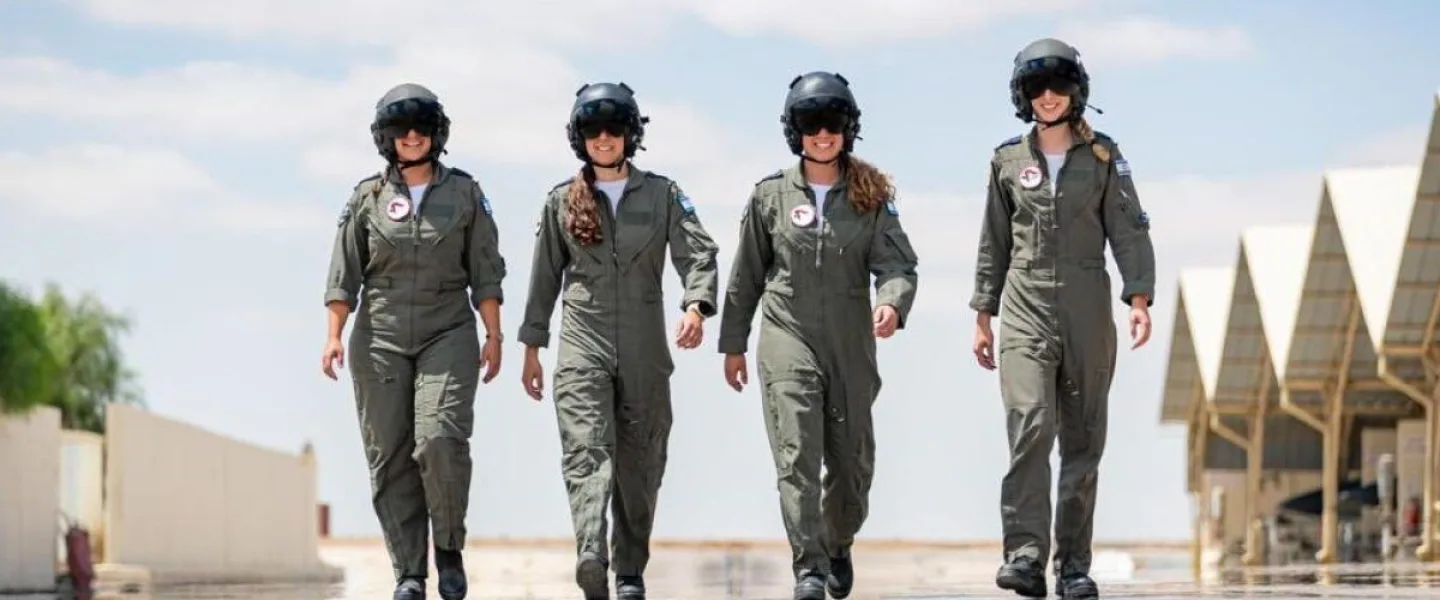
In June 2025, during “Operation Rising Lion,” a woman pilot and a woman navigator flew together in an Israeli fighter jet on a combat mission for the first time, the Air Force said. In March 2026, the IDF reported that about 30 women pilots and navigators had taken part in strikes on Iran.
Did Miller see the two women in the cockpit and think, even for a moment, that she had something to do with it?
“I feel like I had a role in it, yes,” she said, humbly. “I felt like I was in the right place at the right time with the right conviction.”
In figures provided to JNS, the IDF said 981 women were serving in combat roles in the Israeli Air Force in 2026, excluding flight cadets. Among the roles it listed were forward assault landing officers, cargo loading officers and members of an all-female unit of Arad, a rapid-response unit trained to defend air bases against ground attacks.
The Air Force began integrating women into combat roles in air defense in 1997, as airborne mechanics in 2000 and in electronic warfare in 2001, according to the IDF. Women entered its drone units in 2014 and have served as operators, mission commanders and squadron commanders.
“Today, women play a significant role at the heart of the Israeli Air Force’s operational activities, participating in complex missions and holding key operational and command positions,” a senior military official told JNS. The official said the Air Force was working to open more roles to women.

From aerospace to disaster relief
After a decade in the Air Force and two more in the private sector, Miller felt the need to change careers following the Oct. 7, 2023, Hamas massacres. She now leads NATAN Worldwide Disaster Relief, an Israeli nonprofit that sends volunteer teams to help people affected by disasters and humanitarian crises.
“I want to wake up and know that what I do today helped someone somewhere,” she said, almost ironically.
No regrets
Asked whether she had any regrets about the court case, Miller said emphatically: “No regrets. Not one.”
Did she think she’d been a little naïve to believe that, at 22, she could challenge the close-knit, male-dominated world of Israeli military aviation? “No, I went in with my eyes open wide. I felt it was simple,” she said. “I was just asking a simple question. I just wanted them to explain to me why not.”
Miller said the ruling was part of a broader shift in Israeli society toward improvement in women’s rights, but there is still much work to be done. She pointed to women’s representation in the Knesset as an area where she still wanted to see progress. She credited activists such as Yael Yechieli, the founder of Project 5050. The initiative campaigns for equal representation of women and men in decision-making roles across Israel, including in the Knesset, in local government and on the boards of publicly traded companies.
“Equality does not come on its own,” Miller said. “We have to work to make it happen. It won’t happen on its own. Men in power are not busy asking themselves how they can give 50% of their power away.”
On the day that her daughter came out of the building after trying out for the pilot course, her response to her mom’s inquiries on how it went was “Meh.” The young woman ultimately decided against becoming a pilot and now serves in another combat role.
“But who cares?” Miller said of her daughter’s choice. “As long as she had the opportunity. As long as she was able to open that gate and walk right in.”


